
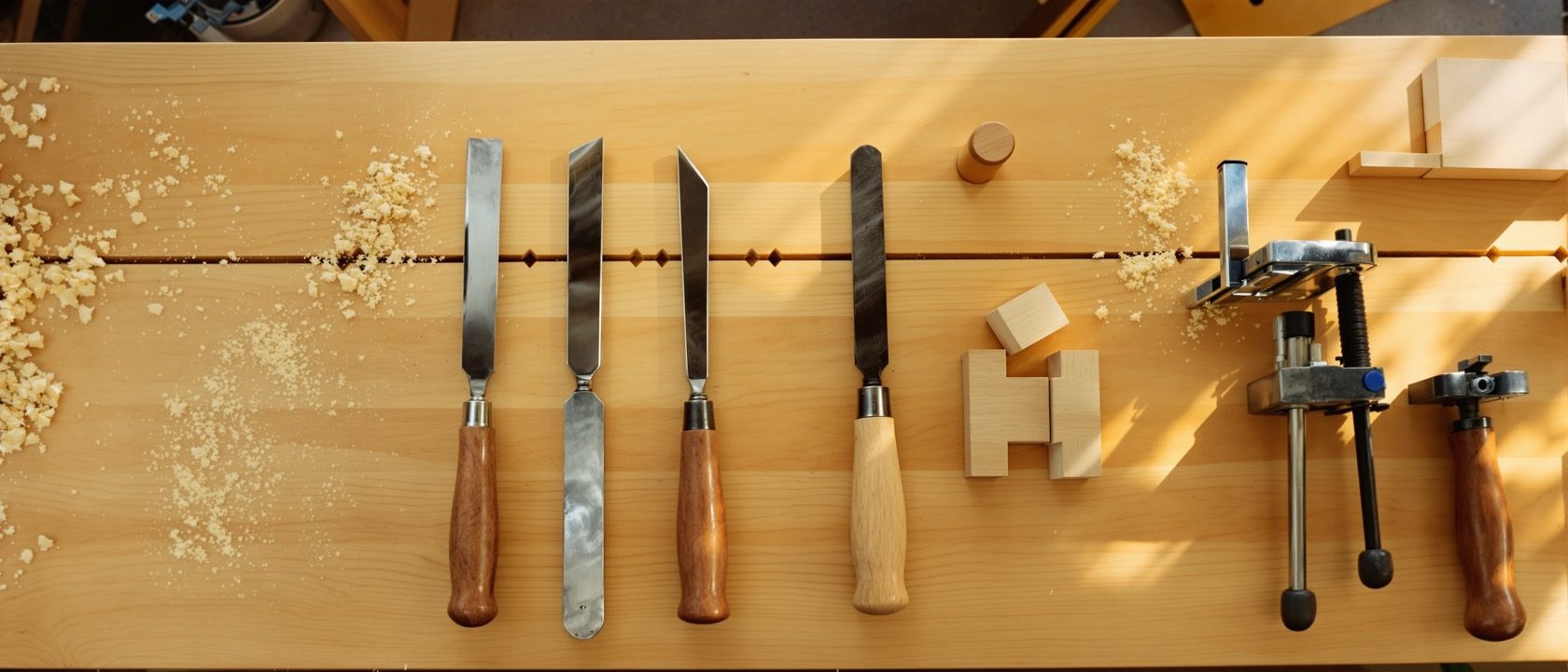
Live Exposure — the Workshop
Tool safety, the dust that matters, and why making makes a better designer
The workshop is where the drawing meets the machine. This short closing unit covers the two things a designer should carry from it for life: the safety habits that keep fingers attached, and the health hazards — wood dust and the formaldehyde released when cutting MDF — that follow the board grade you chose in Unit I right to the saw. And it makes the case for making itself: a designer who has cut a joint draws details that can be built.
Learning objectives
By the end of this lesson, you will be able to — mapped to the course outcomes for the Wood, Cane & Bamboo Workshop:
State the first laws of workshop tool safety and why they exist.
Explain the two health hazards of the workshop — wood dust and MDF-cutting formaldehyde — and their control.
Connect the board grade specified in Unit I to the dust and off-gassing it produces when cut.
Explain why hands-on making produces a designer who draws buildable details.
Safety and the dust that matters
Guards on, push-sticks, protection worn — and the two hazards worth a lifetime’s caution: wood dust is a carcinogen, and cutting UF-bonded board releases formaldehyde with the dust.[1, 2]
The first law of the workshop
Before any making, the safety habits that keep a workshop's fingers attached: guards left on the saw and planer, push-sticks to keep hands away from the blade, eye and ear protection worn as a matter of course, loose clothing and jewellery removed, and a working respect for what a spinning blade does to flesh. None of this is optional and none of it is negotiable — the machines do not forgive a lapse. A designer who spends time in the workshop learns to read a machine's danger, which is knowledge that carries into every site visit and every conversation with a fabricator.[1]
Why make at all
A designer who has cut a mortise, felt a board move and watched an untreated cane split draws details that can be built. The workshop closes the loop between the object drawn and the object made.[3]
Making makes a better designer
Here is the reason a design degree includes a workshop. A designer who has actually cut a mortise, felt a board move under a plane, and watched an untreated cane split is a designer who draws details that can be built. The knowledge is not transferable from a book — it lives in the hands. Every abstract fact in this course — that wood moves, that a grade matters, that a hollow culm cannot be mortised — becomes real and permanent the moment you make with the material. The workshop is where the drawing and the object finally meet.[3]
At a glance
| Aspect | The fact | The other side |
|---|---|---|
| Machine guards | Left ON, always — the first law | MYTH: a guard slows you down enough to remove. It saves fingers |
| Wood dust | A recognised carcinogen (hardwood dust → nasal cancer) | Control with extraction + respirator — not optional |
| Cutting MDF | Releases fine dust AND formaldehyde from the UF resin | The Unit I grade follows you to the saw — extraction matters |
| The value of making | A designer who has cut a joint draws buildable details | Book knowledge alone leaves details that only look resolved |
Key terms
A shaped stick that feeds stock past a saw blade so hands stay clear. Basic, non-negotiable table-saw safety.
The cover over a blade or cutter. Left on, always — it is the difference between a near miss and an injury.
A recognised carcinogen (hardwood dust is linked to nasal cancer). Controlled by extraction and respiratory protection.
Capturing dust at the machine before it fills the air. The primary control for both wood dust and MDF-cutting exposure.
Cutting UF-bonded MDF/particleboard releases formaldehyde as well as dust — the Unit I board grade made physical at the saw.
The understanding of a material that lives in the hands, not a book — the reason a workshop sits inside a design degree.
Study task
Make one small thing — even a single joint, a jointed corner, a little box — by hand, and keep notes as you go. Record two things: what you learned about the material that no drawing had told you (how the board moved under the plane, how much a joint really needs to be clamped, how the grain tore), and what you would now change in a drawing because of it. Then write one paragraph on the safety and dust reality of the making: what protection you used, and how the board grade you were cutting changed the hazard. That short record — the drawing corrected by the making — is the whole reason a workshop sits inside a design degree.
Self-assessment
1. Beyond flying debris, what are the two health hazards of the furniture workshop?
2. Why does a design degree include a hands-on workshop?
Recap
References & further reading
- [1]Workshop machine safety — guarding, push-sticks, PPE — standard woodworking-workshop practice (HSE woodworking guidance; Taunton woodworking safety references).
- [2]Wood dust is IARC Group 1 (carcinogenic to humans; nasopharyngeal/sinonasal cancer). Cutting UF-bonded MDF/particleboard also releases formaldehyde (IARC Group 1). Control by extraction and respiratory protection. IARC Monographs; see Unit I ref 9. https://monographs.iarc.who.int/list-of-classifications
- [3]Korn, Peter — Woodworking Basics: Mastering the Essentials of Craftsmanship. Taunton Press, 2003. On the formative value of hands-on making for a designer.
Further reading
- Korn, Peter — Woodworking Basics: Mastering the Essentials of Craftsmanship. Taunton Press, 2003.
- Bird, L., Jewitt, J., Lie-Nielsen, T. et al. — Taunton's Complete Illustrated Guide to Woodworking. Taunton Press, 2005.
- IARC Monographs — Wood Dust and Formaldehyde (Group 1 carcinogens). International Agency for Research on Cancer.
Sources gathered and fact-checked June 2026. Published values vary by source, sample and method — treat as indicative and confirm against the cited standard before structural use.
The author
Amogh N P
Architect, interior designer, and creative polymath. Studio Matrx began in his notebooks — his vision of design made honest, useful, and open to everyone. Its Academy is written and taught in his memory, and free, forever.
More about Amogh →