
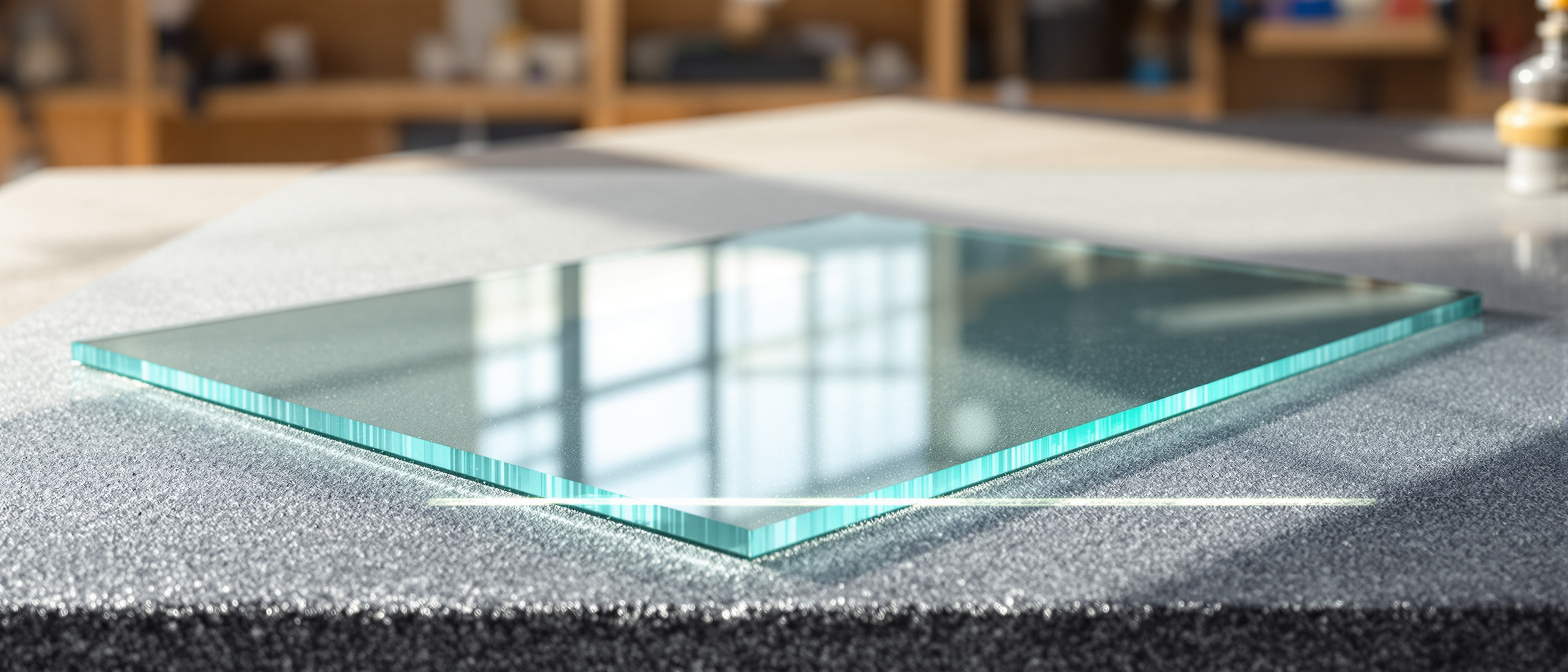
Glass
Float, not blown — and 'toughened' is not 'unbreakable'
Glass is the material we trust most and understand least. Before you cut, frost or fix a single sheet, it is worth knowing how it is really made — not blown, but floated on a bath of molten tin — and that the two ‘safety glasses’ are two different ideas: toughened glass that shatters into blunt granules, and laminated glass that holds together like a windscreen. This unit sets that foundation and then meets the material by feel: scoring and snapping, edging, sand-blasting and etching, and the golden rule that you never clamp glass rigidly.
Learning objectives
By the end of this lesson, you will be able to — mapped to the course outcomes for the Glass, Stone & Metal workshop:
Explain the float process and why almost all architectural flat glass is float glass, not blown glass.
Distinguish annealed, toughened (tempered) and laminated glass by how they are made and how they break.
Judge which safety glass a situation needs, and bust the 'toughened is unbreakable' myth.
Describe how glass is worked by feel — cutting, edging, polishing, sand-blasting and etching.
How glass is really made
Almost all architectural flat glass is float glass — molten glass floated on molten tin until it spreads dead flat, the method Pilkington announced in 1959. Glassblowing is a craft for vessels and art, and has never made sheet glass at scale.[1]
Glass floated on molten tin
Almost all architectural flat glass is FLOAT glass. Molten glass at around 1000°C is poured continuously onto a bath of molten tin, on which it floats and spreads dead flat, then cools into a ribbon with two fire-finished faces needing no grinding or polishing. The method was developed by Sir Alastair Pilkington and announced in 1959, and it so dominates that 'flat glass' and 'float glass' are almost synonyms today.[1]
Try it — the material decoder
The whole hard-materials palette of this workshop in one place — glass, natural stone, engineered stone and metal — each with what it really is and the folklore it is confused with, graded VERIFIED, NUANCED or MYTH. Filter by family and read the pairs.
Material decoder · what it really is vs the folklore
Each material shows the verified fact and the showroom folklore it is confused with — graded VERIFIED, NUANCED or MYTH.
Float glass
Annealed clear sheet
Really: The ordinary clear flat glass of windows and tables, made by the FLOAT process — molten glass floated on molten tin (Pilkington, 1959). Almost all architectural flat glass is float glass.
The folklore · Sheet glass is NOT blown. Glassblowing makes vessels and art; it has never made architectural flat glass at scale.
Toughened (tempered) glass
Heat-treated safety glass
Really: Float glass reheated and quenched so its surface is in compression — roughly 4-5x stronger than annealed, and it shatters into small blunt granules. A recognised SAFETY glass.
The folklore · 'Toughened glass is unbreakable' is a MYTH — it still breaks (edge damage, impact, rare nickel-sulphide inclusions cause spontaneous breakage) and cannot be cut or drilled after tempering.
Laminated glass
Interlayer safety glass
Really: Two or more glass sheets bonded to a tough plastic interlayer (usually PVB). When it breaks it HOLDS TOGETHER on the interlayer — the windscreen principle — so it also cuts sound and UV.
The folklore · Laminated and toughened are NOT the same. Toughened breaks safe into pebbles; laminated stays in one sticky sheet. Overhead and some barrier glazing wants laminated, not just toughened.
Frosted / etched glass
Surface-worked glass
Really: The translucent 'frost' is a WORKED SURFACE — either sand-blasted (abraded) or acid-etched — scattering light for privacy. It is a finish on ordinary glass, not a different glass.
The folklore · It is not a special opaque material; it is float glass with a roughened face, which is why a greasy fingerprint darkens sandblasted glass until it is sealed.
Granite
Igneous natural stone
Really: A hard IGNEOUS rock of interlocked quartz and feldspar. Very hard, heat- and scratch-resistant, and largely acid-resistant — the durable workhorse for counters and flooring.
The folklore · Commonly confused with marble as 'the same premium stone'. It is not: granite is far harder and shrugs off the lemon juice that etches marble.
Marble
Metamorphic natural stone
Really: METAMORPHOSED limestone — mostly calcium carbonate. Prized for veining and translucency (Makrana marble built the Taj Mahal), but softer than granite and ACID-SENSITIVE.
The folklore · 'Marble is bullet-proof luxury' is a MYTH — citrus, vinegar and many cleaners ETCH it (a dull mark), and it scratches and stains more readily than granite. It rewards care, not neglect.
Kota / limestone & sandstone
Sedimentary Indian stone
Really: Sedimentary Indian stones: Kota (a hard blue-grey limestone), and sandstones from Rajasthan (Jodhpur red, Dholpur, Jaisalmer yellow). Honest, affordable, characterful flooring and cladding.
The folklore · Not a 'cheap substitute for granite' — they are their own materials with their own strengths (Kota's grip underfoot, sandstone's warmth); many are calcareous and, like marble, acid-sensitive.
Stone sealing
Penetrating sealer
Really: A penetrating sealer slows liquids soaking into a porous stone, buying you time to wipe a spill. Useful, and worth re-applying periodically.
The folklore · 'Sealing makes stone stain-proof' is a MYTH. A sealer only slows absorption; it is not a force-field. Marble left under a wine glass will still stain and etch — the sealer bought minutes, not immunity.
Engineered 'quartz' stone
Resin-bound quartz
Really: An artificial slab of ~90% crushed quartz bound in ~7-10% POLYMER RESIN with pigment. Non-porous, consistent in colour, needs no sealing — genuinely useful.
The folklore · 'Quartz counters are natural stone' is a MYTH — they are a manufactured resin-and-mineral composite, not a slab quarried whole. The resin is why they behave unlike granite.
Engineered stone & heat
The resin's limit
Really: Because the binder is polymer resin, engineered stone is LESS heat-tolerant than granite — a hot pan can scorch, discolour or crack it, and strong UV can yellow the resin outdoors.
The folklore · 'Engineered stone is indestructible and heat-proof' is a MYTH. Use a trivet; keep it out of full sun. The very resin that makes it non-porous is its heat and UV weakness.
Sintered stone / porcelain
Fired, resin-free slab
Really: A large slab of mineral particles FIRED (sintered) under heat and pressure with NO resin binder — so it is highly heat- and UV-resistant, unlike resin quartz. A distinct category.
The folklore · Often lumped in with 'quartz', but it is chemically different — no resin — which is exactly why it tolerates a hot pan that would mark engineered quartz. Brittle at edges, though.
Silica dust (the hazard)
Why Australia banned it
Really: Cutting or grinding high-silica engineered stone DRY releases respirable crystalline silica, which causes accelerated silicosis in fabricators. AUSTRALIA banned engineered stone from 1 July 2024 — the first country to do so.
The folklore · This is not scare-talk: it is a documented occupational-disease crisis. The workshop rule is wet-cutting, extraction and respiratory protection — never dry-cut engineered stone.
Mild / carbon steel
Ferrous workhorse
Really: Iron with a little carbon — strong, cheap, easily welded and worked. The structural and fabrication workhorse for frames, railings, gates and furniture. It rusts, so it needs a coating.
The folklore · Most decorative 'wrought iron' gates and grilles are actually MILD STEEL, fabricated or cast — true wrought iron has not been mass-produced since the early 20th century.
Stainless steel
Passive-film alloy
Really: Steel with at least ~10.5% chromium, which forms a thin, SELF-HEALING chromium-oxide passive film. 304 is the general grade; marine 316 adds ~2% molybdenum for chloride resistance.
The folklore · 'Stainless steel never rusts' is a MYTH. It resists corrosion, but chlorides (coastal air, pools, cleaners) cause pitting and 'tea-staining', and 304 near the sea should have been 316.
Aluminium
Light non-ferrous
Really: Light, corrosion-resistant (it grows its own oxide skin), non-magnetic. ANODISING thickens and colours that oxide for durable finishes — windows, framing, screens, trims.
The folklore · Anodising works ONLY on aluminium (and a few others) — you cannot anodise steel. And aluminium is anodic to steel, so the two corrode where they touch in the damp (see Unit V).
Brass vs bronze
Copper alloys
Really: Both are copper alloys, often confused. BRASS is copper + ZINC (bright, golden, machinable — fittings, hardware). BRONZE is copper + TIN (warmer, harder, corrosion-tough — hardware, art).
The folklore · 'Brass and bronze are the same' is a MYTH — different second metal, different colour and behaviour. Both develop a PATINA, which is a protective surface, not damage to be scrubbed off.
Galvanised steel
Sacrificial zinc coat
Really: Steel dipped in molten ZINC. The zinc corrodes preferentially to protect the steel even at a scratch — a SACRIFICIAL, electrochemical coating, not a decorative one.
The folklore · 'Galvanising is just grey paint' is a MYTH — it protects electrochemically, so a scratched galvanised rail still resists rust while scratched paint does not. Powder-coat over it for colour.
Meet the material by hand, and name the folklore as folklore — that is the whole workshop.
Annealed, toughened, laminated
Annealed float glass breaks into long sharp shards. Toughened glass is reheated and quenched so it is 4–5× stronger and breaks into blunt granules — a safety glass, but not unbreakable. Laminated glass holds together on a plastic interlayer when it breaks, like a windscreen — a different safety idea entirely.[2, 3]
Ordinary float glass
ANNEALED glass is ordinary float glass, cooled slowly so it is stress-free and can be cut and worked. It is the base material — but when it breaks it forms long, sharp SHARDS, so on its own it is not a safety glass and is limited in doors, low glazing and overhead use by glazing rules.[2]
Working glass by feel
Glass is a feel-led craft: score once and snap, grind and polish every edge, and frost by sand-blasting or acid etching. And because glass hates point loads, it is set on soft gaskets and setting blocks — never bolted hard against metal.[2]
The score-and-snap logic
A glazier's craft is in the edge. Score once, cleanly, and snap; a re-scored line chips. Every visible edge is ground and polished — a flat-ground arris, a pencil round, a bevel — both to remove the cutting hazard and because edges are where stress concentrates and breaks begin. Holes are drilled with diamond bits and water cooling. All of it happens BEFORE toughening, never after.[2]
At a glance
| Aspect | The fact | The folklore |
|---|---|---|
| Architectural flat glass | Made by the float process (molten glass on molten tin) | Blown on a blowpipe |
| Glassblowing | Makes vessels and art, never sheet | How window glass is made |
| Toughened glass | ~4-5x stronger; breaks into blunt granules; can still break | Unbreakable |
| Cutting toughened glass | Impossible after tempering — cut and drill first | Cut it to size like any glass |
| Laminated glass | Holds together on a plastic interlayer (windscreen) | The same thing as toughened |
| Wired glass | For fire integrity; weaker against impact than plain glass | A strong impact-safety glass |
Key terms
Flat glass made by floating molten glass on a bath of molten tin (Pilkington, 1959) — almost all architectural flat glass, in its stress-free 'annealed' state.
Ordinary, slowly-cooled float glass — stress-free and workable, but it breaks into long sharp shards, so it is not a safety glass on its own.
Glass reheated and quenched to put its surface in compression — ~4-5x stronger, breaks into blunt granules, cannot be cut after toughening. Strong, not unbreakable.
Sheets bonded to a plastic (PVB) interlayer so the glass holds together when broken — the windscreen principle; also cuts sound and UV.
A rare tiny impurity that can expand over time and cause a toughened pane to shatter spontaneously — the reason 'toughened is unbreakable' is false.
Grinding and polishing a glass edge (flat, pencil-round, bevel) to remove the cutting hazard and the stress-raiser where breakage begins.
Study task
Collect three glass offcuts — ideally an annealed piece, a toughened piece and a laminated piece — and get to know them by hand. Feel the polished edge against a raw one, and note which pieces are labelled with a safety mark. Then write a short spec for two real situations: a full-height glass partition beside a stair, and an overhead skylight. For each, state which glass you would specify and why, in terms of how it breaks — blunt granules or held-together sheet — not just ‘toughened’ as a magic word. Finish with the one operational fact a fabricator must never forget: that every hole, notch and edge is finished before the glass is toughened, because it can never be cut afterward.
Self-assessment
1. How is architectural flat glass actually made?
2. Which statement about toughened (tempered) glass is TRUE?
3. What is the safety idea behind laminated glass?
4. Why must all cutting and drilling of toughened glass be done first?
5. What is wired glass actually for?
Recap
References & further reading
- [1]Britannica, 'Float-glass method'; Pilkington/NSG, 'The Float Process' — molten glass on molten tin, Sir Alastair Pilkington, announced 1959. https://www.britannica.com/technology/float-glass-method
- [2]Glass processing references — cutting, edgework, drilling, sand-blasting and acid etching; annealed vs processed glass (glass fabrication guides). https://www.pilkington.com/en/gbl/knowledge-hub-selection/architectural-and-technical-glass-knowledge-hub/learn-about-glass-technology/the-float-process
- [3]Safety and processed glass — toughened (tempered), laminated (PVB), wired and nickel-sulphide inclusions; safety-glazing principles. https://www.pilkington.com/en-gb/uk/architects/glass-information/how-glass-is-made
Further reading
- John F. Pile, Interior Design (Harry N. Abrams) — materials, including glass.
- Pilkington / NSG technical literature — the float process and glass processing.
- Stanford Hohauser, Architectural and Interior Models (Van Nostrand Reinhold) — modelling with materials.
Sources gathered and fact-checked June 2026. Published values vary by source, sample and method — treat as indicative and confirm against the cited standard before structural use.
The author
Amogh N P
Architect, interior designer, and creative polymath. Studio Matrx began in his notebooks — his vision of design made honest, useful, and open to everyone. Its Academy is written and taught in his memory, and free, forever.
More about Amogh →