
Engineered Stone
'Quartz' is mostly resin — and the silica dust is a real hazard
No surface is more over-sold than engineered ‘quartz’ stone. It is a genuinely useful, non-porous, consistent material — but it is not natural stone: it is about ninety per cent crushed quartz bound in seven to ten per cent polymer resin. That resin explains everything — why it never needs sealing, why a hot pan can scorch it, and, most seriously, why cutting it dry releases the silica dust that has caused accelerated silicosis in fabricators and led Australia to ban it outright. This unit tells engineered stone straight, and treats the safety as the verified fact it is.
Learning objectives
By the end of this lesson, you will be able to — mapped to the course outcomes for the Glass, Stone & Metal workshop:
State what engineered 'quartz' stone actually is — crushed quartz bound in polymer resin — and why it is not natural stone.
Explain the resin-driven limits (heat, UV) and distinguish engineered quartz from resin-free sintered stone and porcelain.
Describe the crystalline-silica hazard, accelerated silicosis and Australia's 2024 ban, and the safe-working response.
What engineered stone really is
Engineered ‘quartz’ stone is an artificial slab of ~90% crushed quartz in ~7–10% polymer resin with pigment — not a quarried slab. Terrazzo, marble chips in a cement or resin matrix, is its century-old ancestor.[1]
Crushed quartz in resin
Engineered 'quartz' stone is an ARTIFICIAL product: roughly 90% crushed quartz (and other minerals) bound in about 7-10% POLYMER RESIN, with pigments, cast and cured into slabs. It is genuinely useful — non-porous, so it never needs sealing, consistent in colour and pattern, and hard-wearing. But it is a manufactured composite, engineered for uniformity, not a slice of a mountain.[1]
The resin's limits
The resin that makes it non-porous is also its weakness: it is less heat-tolerant than granite (a hot pan scorches it) and can yellow in UV. Sintered stone and porcelain are a separate, fired, resin-free category that tolerates the heat quartz cannot.[1, 2]
Non-porous and consistent
The resin binder gives real advantages: engineered quartz is NON-POROUS, so it resists stains and bacteria and needs no sealing (unlike marble or Kota); it is hard and consistent, with none of the surprises of a natural slab; and colours and patterns are repeatable batch to batch. For a busy kitchen that wants a maintenance-light, uniform surface, it is a sound, honest choice.[1]
The silica hazard & the ban
This is the serious, verified fact of the unit. Cutting high-silica engineered stone dry releases respirable crystalline silica, which causes irreversible silicosis — seen as accelerated disease in fabricators. Australia became the first country to ban engineered stone, from 1 July 2024. Always wet-cut, extract the dust and wear a fitted respirator.[3, 4]
Respirable crystalline silica
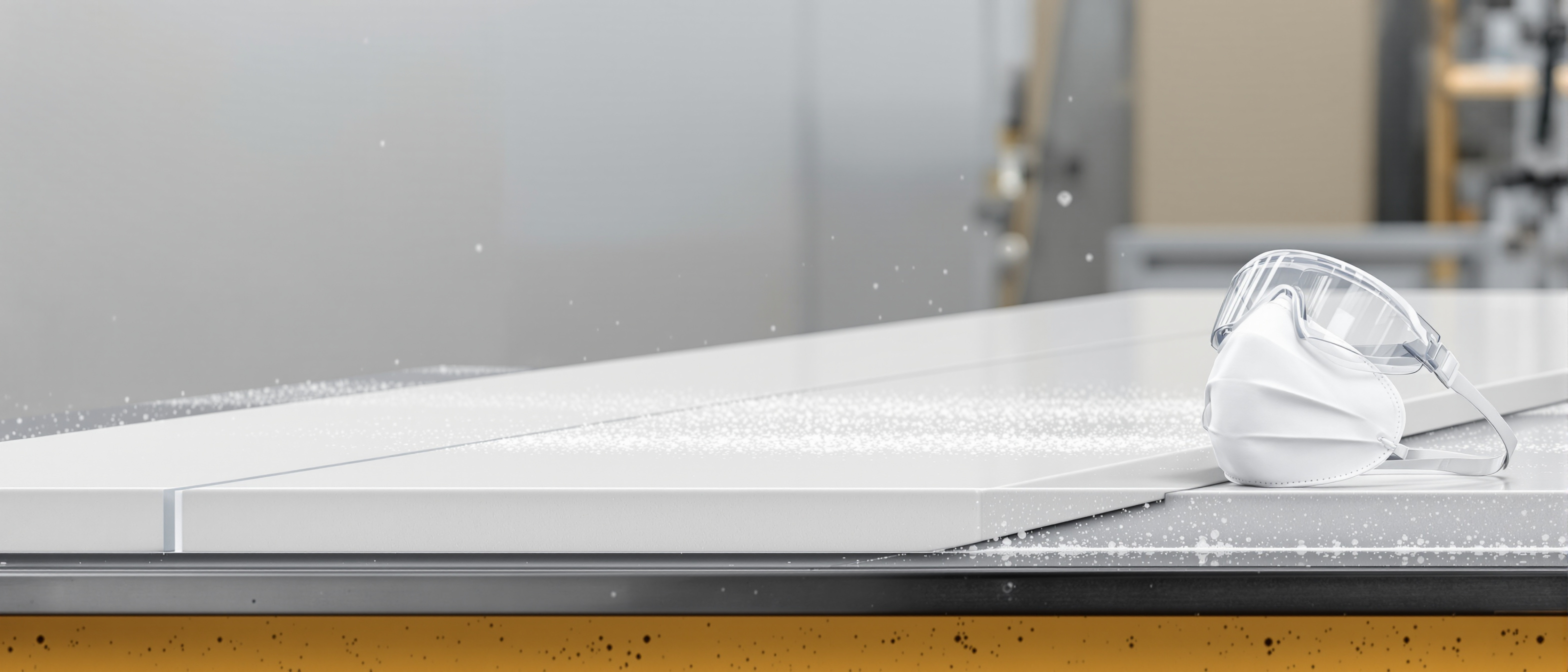
This is the serious, VERIFIED fact of the unit, stated plainly. Engineered stone is very high in crystalline silica, and cutting, grinding or polishing it DRY throws fine respirable silica dust into the air. Breathed in, it causes SILICOSIS — irreversible, scarring lung disease — and in engineered-stone fabricators it has appeared as ACCELERATED silicosis, striking young workers within a few years. This is documented occupational medicine, not caution-culture.[3]
At a glance
| Aspect | The fact | The folklore |
|---|---|---|
| Engineered 'quartz' stone | ~90% crushed quartz bound in ~7-10% polymer resin | A natural quarried slab |
| Heat resistance | Less than granite — resin scorches; use a trivet | Heat-proof and indestructible |
| Outdoors / strong sun | Resin can yellow — usually not recommended | Fine anywhere |
| Sintered stone / porcelain | Fired, resin-free — heat- and UV-tough | The same as engineered quartz |
| Cutting engineered stone | Wet-cut, extract dust, respiratory protection — never dry | Dry-cut like any stone |
| The silica risk | Verified: accelerated silicosis; Australia banned it in 2024 | Overblown health scare |
Key terms
An artificial slab of ~90% crushed quartz bound in ~7-10% polymer resin with pigment — non-porous and consistent, but not natural stone and less heat-tolerant than granite.
The plastic that holds crushed quartz together — the source of engineered stone's non-porosity, and of its heat and UV weakness (it scorches and can yellow).
A slab made by firing mineral particles under heat and pressure with NO resin — highly heat- and UV-resistant, unlike engineered quartz; brittle at edges.
A century-old engineered stone: marble/stone chips in a cement or resin matrix, ground and polished — the ancestor of the modern quartz surface.
Fine silica dust released by dry-cutting high-silica stone; breathed in, it causes silicosis — irreversible lung scarring, seen as accelerated disease in engineered-stone workers.
From 1 July 2024 Australia became the first country to ban manufacture, supply, processing and installation of engineered stone, over the silicosis risk (imports banned 1 Jan 2025).
Study task
Write an honest client-facing comparison of three counter surfaces for an Indian kitchen: a natural granite, an engineered quartz, and a sintered/porcelain slab. For each, state plainly what it is made of, whether it needs sealing, how it behaves with a hot pan and in sunlight, and its real maintenance. Do not let the word ‘quartz’ imply ‘natural stone’. Then write the fabrication-safety note that must accompany any engineered-stone job: why it is never dry-cut, what wet-cutting, extraction and respiratory protection actually mean on site, and the fact that Australia has banned the material over silicosis. The goal is a recommendation a client can trust and a fabricator can work safely.
Self-assessment
1. What is engineered 'quartz' stone actually made of?
2. Which is TRUE about engineered stone and heat?
3. How does sintered stone / porcelain differ from engineered quartz?
4. Why did Australia ban engineered stone in 2024?
5. What is the safe way to cut engineered stone?
Recap
References & further reading
- [1]Engineered stone composition and performance — ~90% crushed quartz in ~7-10% polymer resin; non-porosity vs heat/UV limits; terrazzo as engineered stone. https://www.caesarstone.com/
- [2]Sintered stone and porcelain slabs — fired, resin-free surfaces with high heat and UV resistance (technical/trade references). https://www.neolith.com/en/
- [3]Crystalline silica and silicosis in engineered-stone fabrication — respirable dust, accelerated silicosis, wet-cutting and respiratory protection. https://www.safeworkaustralia.gov.au/safety-topic/hazards/crystalline-silica-and-silicosis
- [4]Safe Work Australia, 'Engineered stone ban' — prohibition from 1 July 2024 (first country); imports prohibited from 1 January 2025; definition by silica content and resin. https://www.safeworkaustralia.gov.au/safety-topic/hazards/silica/engineered-stone-ban
Further reading
- Safe Work Australia — engineered stone prohibition and crystalline-silica guidance.
- John F. Pile, Interior Design (Harry N. Abrams) — surfacing materials.
- Trade technical literature on engineered quartz and sintered stone (composition and care).
Sources gathered and fact-checked June 2026. Published values vary by source, sample and method — treat as indicative and confirm against the cited standard before structural use.
The author
Amogh N P
Architect, interior designer, and creative polymath. Studio Matrx began in his notebooks — his vision of design made honest, useful, and open to everyone. Its Academy is written and taught in his memory, and free, forever.
More about Amogh →