
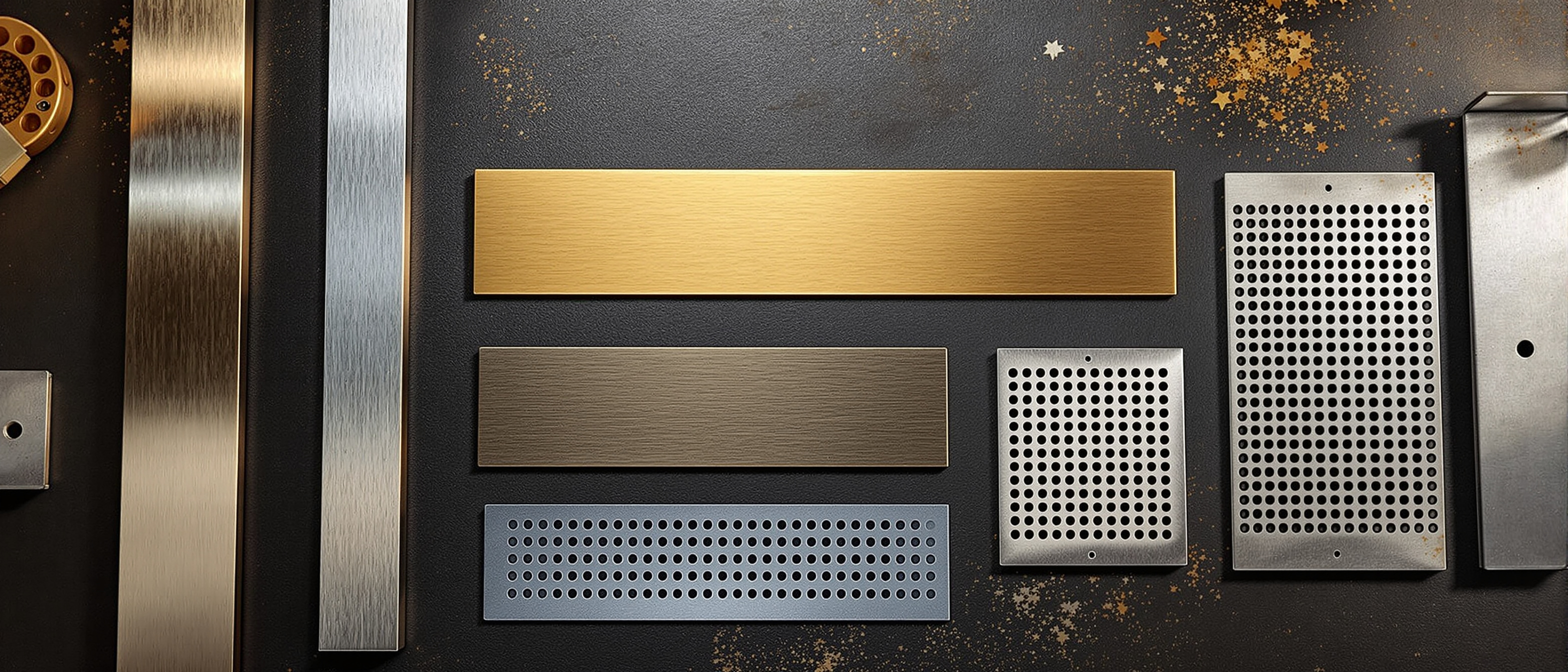
Metal & Steel
Stainless can rust — and 'wrought iron' gates aren't wrought iron
Metal in interiors comes wrapped in confident half-truths: that stainless steel never rusts, that the pretty gate is wrought iron, that galvanising is just grey paint. None is quite true. Stainless resists corrosion only through a self-healing chromium-oxide skin that chlorides can still defeat; true wrought iron has not been mass-produced in a century, so that gate is mild steel; and galvanising is a sacrificial zinc coat that protects even at a scratch. This unit sorts the metals, their finishes and their joinery — and builds toward metal in real elements: jali, railing and stair.
Learning objectives
By the end of this lesson, you will be able to — mapped to the course outcomes for the Glass, Stone & Metal workshop:
Distinguish ferrous and non-ferrous metals and name the common interior metals and their properties.
Explain the stainless passive film, why 304 differs from 316, and bust the 'stainless never rusts' and 'wrought iron' myths.
Describe metal joinery (welding, brazing, riveting, bolting) and finishes (galvanising, powder-coat, anodising, PVD, patina).
Specify metal in built form — jali, railing, stair and furniture — matching metal, grade and finish to the setting.
The metal families
Metals split into ferrous (iron-based: mild steel, cast iron, stainless) and non-ferrous (aluminium, copper, brass, bronze). Stainless resists corrosion via a self-healing chromium-oxide film — 304 for general use, marine 316 with molybdenum; brass is copper+zinc, bronze is copper+tin.[1, 2]
The first split
Metals split into FERROUS (iron-based: mild/carbon steel, cast iron, stainless steel — mostly magnetic, and the plain ones rust) and NON-FERROUS (no iron: aluminium, copper, brass, bronze, zinc, titanium — lighter or more corrosion-resistant, non-magnetic). Mild steel is the cheap, strong, weldable workhorse of frames and fabrication; cast iron is hard and brittle, good in compression. The split predicts weight, corrosion and joining.[1]
Three metal myths
The folklore, named: stainless can rust (chlorides pit and tea-stain it); most ‘wrought iron’ is really mild steel; and galvanising is not paint but a sacrificial zinc coat that protects steel even at a cut or scratch.[1, 2, 3]
Resistant, not immune
'Stainless steel never rusts' is a MYTH. Its passive film resists corrosion, but CHLORIDES defeat it: coastal salt air, swimming pools and harsh cleaners cause PITTING and rusty-brown 'TEA-STAINING', especially on 304 near the sea where 316 should have been used. Iron contamination (grinding dust, steel wool) also rusts on the surface. Stainless is corrosion-RESISTANT, not corrosion-proof, and the right grade and cleaning matter.[2]
Joinery, finishes & built form
Metal is joined by welding (MIG/TIG/arc), brazing, riveting and bolting, and finished by galvanising, powder-coat, anodising (aluminium only), PVD and patina. In built form it becomes jali, railing and stair — where safety rules on guard height and infill gaps apply.[1, 4]
Weld, braze, rivet, bolt
Metal is joined by WELDING (melting the parent metals together — MIG/MAG for speed, TIG for fine clean work on stainless and aluminium, stick/arc on site), by BRAZING and soldering (joining with a lower-melting filler without melting the parts — good for copper and brass), and mechanically by RIVETING and BOLTING (demountable, and useful for joining dissimilar metals with an isolator). Match the method to the metal, the thickness and whether the joint must come apart.[4]
At a glance
| Aspect | The fact | The folklore |
|---|---|---|
| Stainless steel | Resists corrosion via a self-healing chromium film; can still pit in chlorides | Never rusts, ever |
| 304 vs 316 stainless | 316 adds molybdenum for the sea; 304 is for general use | All stainless is the same |
| 'Wrought iron' gates | Almost always mild steel — true wrought iron isn't mass-produced | Genuine wrought iron |
| Brass vs bronze | Brass = copper + zinc; bronze = copper + tin | Two names for one metal |
| Galvanising | A sacrificial zinc coat — protects even at a scratch | Just grey paint |
| Anodising | Works on aluminium, not steel | A finish for any metal |
Key terms
Ferrous = iron-based (mild steel, cast iron, stainless — mostly magnetic, plain ones rust); non-ferrous = no iron (aluminium, copper, brass, bronze — lighter/more corrosion-resistant).
The thin, self-healing chromium-oxide layer (from ~10.5% chromium) that gives stainless its corrosion resistance and re-forms when scratched — but is defeated by chlorides.
304 is the general grade; 316 ('marine') adds ~2% molybdenum for much better resistance to chlorides and pitting near the sea or pools.
True wrought iron is fibrous, slag-streaked smith's iron not mass-produced since the early 20th century; today's 'wrought iron' gates are mild steel.
A sacrificial zinc coating on steel that corrodes preferentially to protect it even at a scratch — electrochemical protection, not paint.
Anodising = thickened coloured oxide on aluminium; PVD = a thin hard coloured coating (rose-gold/black hardware); patina = a controlled surface on brass, bronze, weathering steel.
Study task
Design a metal railing for a real setting — say a first-floor balcony in a coastal city like Chennai or Mumbai. Specify the metal and, crucially, the grade and finish: justify 316 over 304 stainless, or a galvanised-and-powder-coated mild steel, in terms of the salt air that pits the wrong choice. State how the pieces are joined (welded, bolted) and how the joints are protected. Then check the two safety numbers that a railing lives or dies by — the guard height and the maximum gap a child could pass through — and note them. The exercise is to move from ‘metal railing’ to a specification that will still look good, and be safe, in ten years by the sea.
Self-assessment
1. Why does stainless steel resist corrosion — and can it still rust?
2. What is most modern 'wrought iron' actually made of?
3. What is the difference between brass and bronze?
4. Why is galvanising not 'just grey paint'?
5. Which finish works only on aluminium (and a few others), not steel?
Recap
References & further reading
- [1]Metals for interiors — ferrous/non-ferrous families, aluminium and anodising, brass vs bronze, galvanising as sacrificial zinc; finishes (Ron Fournier, 'Metal Fabricator's Handbook'). https://galvanizeit.org/hot-dip-galvanizing/what-is-zinc/zinc-coatings
- [2]Stainless steel 304 vs 316, the chromium-oxide passive film, molybdenum and chloride/pitting corrosion ('tea-staining') — thyssenkrupp / Reliance Foundry references. https://www.reliance-foundry.com/blog/304-vs-316-stainless-steel
- [3]Wrought iron vs mild steel — genuine wrought iron and its decline; modern 'wrought iron' as fabricated mild steel. https://en.wikipedia.org/wiki/Wrought_iron
- [4]Metal joinery and built form — welding (MIG/TIG/arc), brazing, riveting and bolting; jali, railing (guard heights/gaps) and stair fabrication. https://www.aws.org/
Further reading
- Ron Fournier, Metal Fabricator's Handbook (HP Books).
- John F. Pile, Interior Design (Harry N. Abrams) — metals as interior materials.
- Trade references on stainless grades and finishes (thyssenkrupp / stainless-steel associations).
Sources gathered and fact-checked June 2026. Published values vary by source, sample and method — treat as indicative and confirm against the cited standard before structural use.
The author
Amogh N P
Architect, interior designer, and creative polymath. Studio Matrx began in his notebooks — his vision of design made honest, useful, and open to everyone. Its Academy is written and taught in his memory, and free, forever.
More about Amogh →