
 Lesson 9.3
Lesson 9.3 · Digital & the Future
Integrating Physical & Digital
A visitor does not see your sign system, your screen system and your app as three projects - they experience one journey, and the moment those channels disagree about a name or a direction, the whole thing breaks
The visitor never sees your three systems. They see one journey - and it breaks the instant the sign, the screen and the app disagree about what a place is called.
Picture a visitor arriving at a large new hospital. On the way in, their phone app guides them to the heart unit. At the entrance, a big illuminated screen welcomes them and lists departments, but it calls the same place Cardiology. Inside, the overhead signs point the way to Block C. At a junction, a printed directory labels it C2 - Heart and Vascular. Four channels, four names for one destination. Each was probably designed well in isolation - a competent app, a slick screen, clear signs, a tidy directory - and together they have produced exactly the disorientation the whole building was meant to prevent. The visitor, already anxious, now has to do the detective work of realising these are all the same place, and their trust in every channel drops.
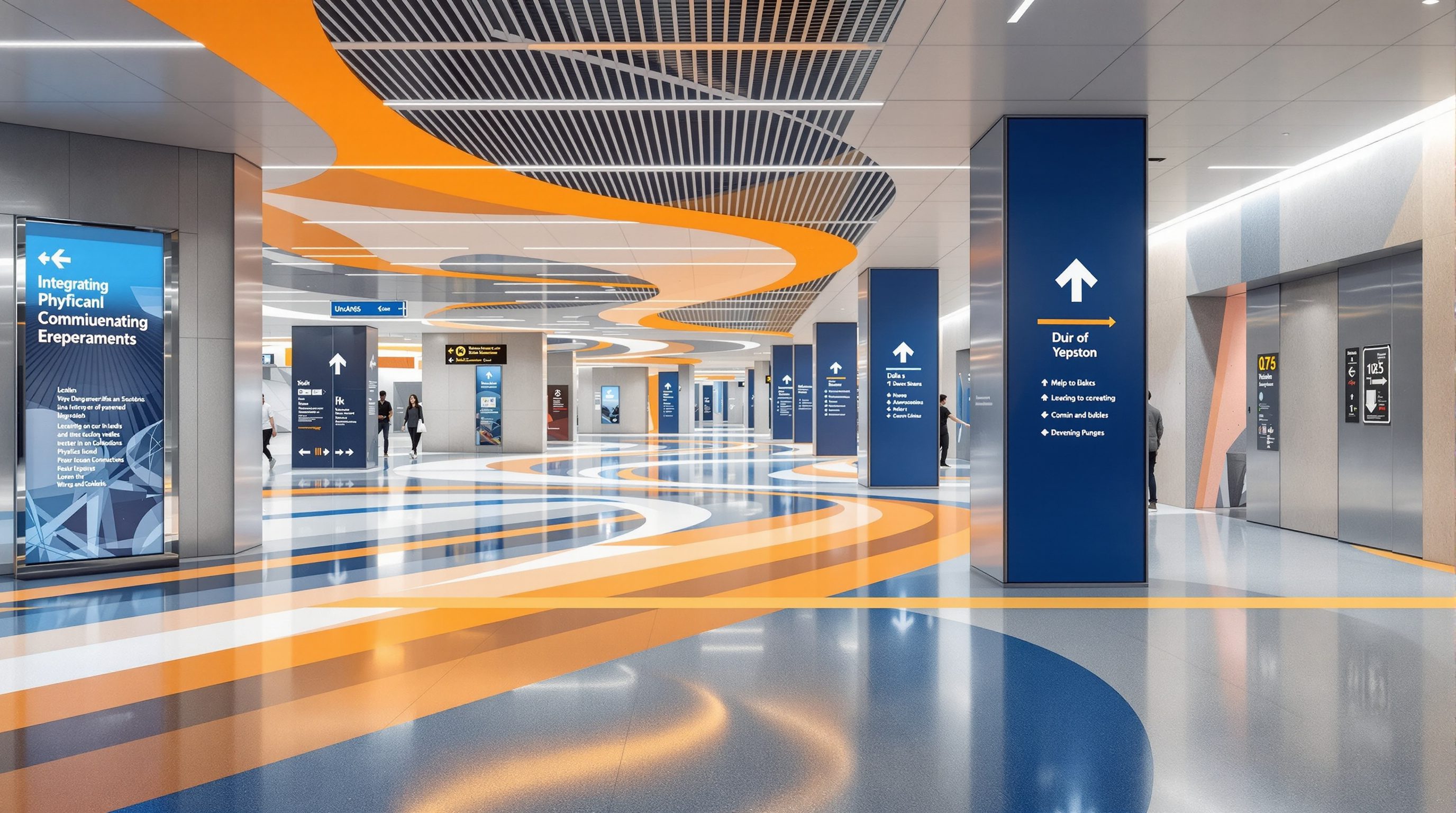
This is the central truth of wayfinding in the digital age: a person does not experience your physical signage, your digital displays and your phone app as separate systems - they experience one continuous journey, and they expect every channel to tell the same story. The moment the channels disagree - a different name, a different colour, a different map orientation, a contradictory direction - the system fractures, because wayfinding runs on trust and consistency, and a contradiction destroys both. Integration is therefore not a nice-to-have polish at the end; it is the core discipline of multi-channel wayfinding. This lesson is about designing the physical and the digital as one coherent system from a single source of truth - shared names, shared colours, shared maps - so that the sign, the screen and the phone confirm one another at every step, and the journey flows as one.
One source of truth -> same name, same colour, same map -> every channel confirms. Contradiction = the cardinal sin.
The visitor experiences one journey, not three systems
The foundational shift in mindset is to stop thinking in channels and start thinking in journeys. Inside an organisation, physical signage, digital displays and the app are often three different projects, with different budgets, different vendors, different teams and different timelines - the signage firm, the AV integrator, the software company. That is an organisational reality, but it is invisible and irrelevant to the person trying to find the toilet or the departure gate. They move through a single continuous experience, picking up information from whatever channel is in front of them at each moment - the app in the car park, the screen at the entrance, the overhead sign in the corridor, the door plate at the end - and they stitch it into one mental route. If those fragments are consistent, the stitching is effortless and invisible. If they conflict, the person bears the cost of reconciling them, exactly when they are least able to.
This is what the retail and service world calls omnichannel: designing so that the experience is seamless across every channel a person touches, rather than a set of disconnected silos. In wayfinding it means the channels must be planned together, around the journey, not designed separately and merely installed in the same building. The designer's unit of thought becomes the user's path from origin to destination - for the hospital visitor, from the app at home, to the car park screen, to the entrance directory, to the corridor signs, to the department door - and the question is whether every channel along that path reinforces the same, single, clear route.
The consequence is that consistency across channels is not a cosmetic preference; it is the whole point of integration. A place can have beautifully designed signs and a clever app and still fail utterly at wayfinding if the two do not agree, because the contradiction itself is the failure - it freezes the person and poisons their trust in every channel, so that afterwards they believe none of them. Conversely, a modest physical system and a simple app that agree perfectly will serve people far better than two brilliant systems that quarrel. The designer's job in a multi-channel world is therefore, above all, to make the channels speak with one voice.
The user sees a JOURNEY, not your sign / screen / app silos. One path, every channel must agree.
The single source of truth: one name, one colour, one map
Coherence across channels does not happen by goodwill; it happens by a single source of truth - one authoritative set of wayfinding data that every channel draws from, so the sign, the screen and the app cannot drift apart because they are all expressions of the same underlying information. Three things above all must be shared.
First, nomenclature - the names. Every destination must have exactly one name, used identically everywhere: not Cardiology on the screen, Heart Unit on the sign, and C2 in the app. This sounds trivial and is the single most common integration failure, because names are set by different people at different times - the clinical team names the department, the signage firm abbreviates it to fit the panel, the app developer uses the database code. A shared, governed naming list - a wayfinding dictionary for the project - is the humble backbone of integration, and agreeing it early is one of the highest-value things a designer can do. Second, colour and coding. If Block C is cyan on the signs, it must be cyan on the screens and cyan in the app; a zone colour is only powerful as an orientation aid if it is the same across every channel, so that a person who has learned follow the cyan can follow it on glass and on their phone too. Third, the map. There should be one base map of the place, from which the printed you-are-here, the kiosk map and the app map are all generated - same geometry, same landmarks, same labels - rather than three different cartographers drawing three different maps that subtly disagree.
Beyond these, iconography and typography should be shared too - the same pictograms and, where technically possible, the same or a compatible typeface - so the channels feel like one family, not strangers. The deeper principle is governance: someone must own the wayfinding data and its consistency, and changes must flow to every channel at once. When a department is renamed or moves, the sign, the screen and the app must all update together; if the screen and app update but the physical sign lags, you have manufactured a contradiction. Designing the single source of truth, and the process that keeps every channel faithful to it, is the real engineering of integrated wayfinding - unglamorous, and the difference between a system that coheres and one that quietly tears itself apart.
Channels that confirm, never contradict
With a single source of truth in place, the channels can play their complementary roles along the journey - but the governing rule at every handoff is that each channel must confirm the others, and must never contradict them. Contradiction is the cardinal sin of integrated wayfinding, because a person who is told left by the app and right by the sign does not calmly pick one - they freeze, lose confidence, and no longer trust either channel for the rest of the journey. Reassurance, by contrast, is the great gift of a well-integrated system: when the overhead sign says exactly what the app just said - Block C, this way - the person feels confirmed, relaxes, and moves with confidence. The phrase to hold is yes, still this way, said in two voices that agree.
This means designing the handoffs between channels with care, because the journey passes from one to another repeatedly. The app guides you to the building and hands off to the entrance screen; the screen orients you and hands off to the overhead signs; the signs carry you to the door plate. At each handoff the new channel should pick up exactly where the last left off - same name, same direction, same map - so the transition is seamless rather than a jolt. A good physical-digital integration often uses the physical sign as the anchor and the digital as the extension: a QR code on the you-are-here sign opens the app already centred on that spot, so the two are literally the same point of truth.
It also means being deliberate about which channel owns which job, to avoid both gaps and contradictions. The permanent, glanceable, universal information - names, primary directions, exits - is owned by physical signage and echoed faithfully by the others. The live, changeable information - status, queues, delays - is owned by digital and must not be contradicted by a stale physical sign (which is why temporary changes are handled by digital or by well-managed temporary physical signs, not by leaving a wrong permanent sign up). The personal, searched, routed information is owned by the phone. When each channel has a clear role and all draw from one source, they form a layered, reinforcing system: the person is told the same true thing by whatever channel they happen to look at, and the overall effect is not three systems competing for attention but one calm, coherent voice guiding them home.
Every handoff: the new channel picks up where the last left off. Confirm, never contradict. 'Yes, still this way' in two voices that agree.
Designing and governing the integrated system
Turning these principles into a real project takes deliberate process, because integration fails by default - the silos are the natural state and coherence has to be actively engineered and maintained. A few moves make the difference.
Plan the channels together, around the journey, from the start. Map the key user journeys through the place and, for each, decide which channel carries which moment and how they hand off - before any single channel is designed in detail. This is a wayfinding strategy decision (Module 2), now extended across physical and digital, and it prevents the classic failure of three teams optimising three systems that never meet. Agree the single source of truth early: the naming list, the zone colours, the base map, the icon set - documented, owned and shared with every vendor as the non-negotiable common reference. Write integration into the briefs and contracts of the signage firm, the AV integrator and the app developer, so consistency is a contractual deliverable, not a hope - each must draw from the shared data and match the shared system.
Test across channels, not within them. It is not enough that the signs are good and the app is good; you must walk the real journeys and check that the channels agree at every handoff - the kind of testing lesson 9.4 and Module 10 develop. A cross-channel audit catches the renamed department that updated on the screen but not the sign, the zone that is teal in the app and cyan on the wall, the map that is north-up in the kiosk and forward-up on paper. Govern change over the building's life: appoint an owner of the wayfinding data, and establish that any change - a new department, a moved entrance, a renamed block - propagates to every channel together, so the system does not drift into contradiction as the years pass, which is how most integrated systems actually fail.
Through all of it, remember the hierarchy the course has built. The architecture speaks first and must be legible; physical signage completes it and reaches everyone; digital and the phone are further layers that add change, search and personalisation for those they serve. Integration is the discipline that makes all of these speak as one - so that whether a person reads the space, a sign, a screen or their phone, they hear a single, consistent, trustworthy voice telling them where they are and where to go. That single voice, sustained across every channel and over time, is what integrated wayfinding is for, and it is felt by the visitor not as cleverness but as the quiet, reassuring sense of a place that has its act together and is looking after them.
Wayfinding data & nomenclature governance
Single source of truth, naming list, base map
An owned, shared naming and data set is a project decision, not a code requirement - but it is the backbone of integration; agree it early and write it into every vendor brief.
Accessibility (NBC / Harmonised Guidelines)
Consistency of accessible routes across channels
Accessible routes and information must be consistent and complete across physical and digital channels; verify the accessible experience end to end with an accessibility consultant. Module 7.
Cross-channel coordination & contracts
Signage firm, AV integrator, app developer alignment
Consistency across vendors is a contractual and coordination matter - defer integration delivery, data feeds and change governance to the project manager and the respective specialists.
Workshop — audit a place for cross-channel coherence
Integration is invisible when it works and glaring when it fails. In this workshop you will follow one real journey through a multi-channel place and audit whether the physical signs, the digital screens, the directory and (if present) the app tell a single consistent story.
A multi-channel place, a phone, and a notebook. You are auditing consistency across channels, not the quality of any one channel alone.
Goal: a cross-channel coherence audit of one real journey
Inputs: a multi-channel place (large hospital, airport, mall, campus) + this lesson + a notebook + a phone
Time: ~50 minutes
- 1Choose one destination and define the journey to it. List every channel you pass through in order - app, car park screen, entrance directory, overhead signs, door plate - and note which channel carries each moment.
- 2Check the NAME: write down exactly what each channel calls your destination. Are they identical, or does the sign, screen, directory and app each use a different name or abbreviation? Flag every mismatch.
- 3Check the COLOUR and MAP: is the zone's colour the same across every channel? Are the maps (paper, kiosk, app) the same base map, same orientation, same landmarks - or do they disagree?
- 4Check the HANDOFFS and for CONTRADICTIONS: at each point where one channel hands off to the next, does the new one pick up where the last left off? Find any place two channels give contradicting directions or information, and note how it felt.
- 5Write a one-paragraph verdict: does this place speak with one voice across its channels, where is the worst contradiction or inconsistency, what single shared element (a name, a colour, a map) would most improve coherence, and who owns fixing it.
You’ll walk away with
A one-page cross-channel audit: a table of what each channel calls the destination, the colour/map consistency, the contradictions found at handoffs, and a one-line verdict naming the single highest-impact consistency fix.
Three altitudes on the same idea
Read the band that fits you — or all three.
Integration is a coordination role that belongs at the level where the whole project is shaped - and legible architecture makes it far easier. A building organised into clear, consistently named zones gives every channel the same simple structure to express, so the app, the screen and the sign naturally agree; a confusing plan forces each channel into different work-arounds that then conflict. Push for one naming system and one zoning logic across the project, bring signage, AV and app scopes under a shared wayfinding strategy early, and make the single source of truth - names, zones, base map - a project-wide reference that every consultant and contractor must use. Guard against the silos by owning the journey, not just the building.
You are often the one who makes the channels visually and verbally one family. Carry the sign system's typefaces, pictograms, colour coding and naming into the screen templates and the app styling so they read as one system, and design the physical-digital links - the QR on the you-are-here sign, the kiosk that matches the wall - as deliberate handoffs. Agree the naming list and zone palette with the client and clinical or operational teams early, and insist the AV and app vendors draw from them. Test by walking the journeys yourself, watching for any place the screen, the sign or the app contradicts another, because that contradiction undoes all the craft.
Start seeing multi-channel places as one journey and hunt for the contradictions. In a hospital, airport or mall, follow a route and check whether the app, the screens, the signs and the directory use the same name, the same zone colour and the same map for each destination - you will find disagreements everywhere, and each one is a wayfinding failure. Notice how reassuring it feels when a sign confirms what your phone just said, and how disorienting when they disagree. Learn the core idea now: integration means one source of truth spoken the same way in every channel, so the person hears one voice, not three arguing.
“If each part of the wayfinding is well designed on its own - good signs, a slick screen system, a clever app - the overall experience will be good. Integration is just a final styling step to make them look similar.”
Do it yourself
No tools needed - reason it through.
- 1Explain why a visitor experiences one journey rather than three systems, and why that makes cross-channel consistency the core of integration rather than a cosmetic finish.
- 2What is a single source of truth in wayfinding, and name the three things it must above all share across channels.
- 3Why is inconsistent nomenclature - different names for the same place - the most common integration failure, and how does a project prevent it?
- 4Explain the rule that channels must confirm and never contradict, and what happens to a person's trust when two channels disagree.
- 5Describe two process moves that keep an integrated system coherent over the building's whole life, not just at opening day.
The one line to carry out
Peer-reviewed journals & authoritative standards
- 01Sign system — Wikipedia — Sign system, 2026.
- 02Wayfinding — Wikipedia — Wayfinding, 2026.
- 03Information design — Wikipedia — Information design, 2026.
- 04Digital signage — Wikipedia — Digital signage, 2026.
Once the physical and digital channels work as one, that connected system can start to listen as well as speak - gathering data on how people actually move. Next we look at data, smart wayfinding and an honest view of the future.
The author
Amogh N P
Architect, interior designer, and creative polymath. Studio Matrx began in his notebooks — his vision of design made honest, useful, and open to everyone. Its Academy is written and taught in his memory, and free, forever.
More about Amogh →