
Product, Display & Fixtures
The right display for the right product
A display unit exists to hold, protect and present product so it sells — and different products need different displays. This unit teaches choosing the right display for the right product within cost; the methods and composition of arranging product (with the honest reminder that clutter sells less); the design and types of fixtures — the furniture of retail; and the specialists: POP displays, modular systems and special fixtures, plus the virtual merchandising tool kit.
Learning objectives
By the end of this lesson, you will be able to — mapped to the course outcomes for Visual Merchandising:
Choose the right display and fixture for a given product, within cost.
Use display methods, techniques and composition to build a display.
Design and specify fixtures — including POP, modular and special fixtures.
Right display, right product
Choosing the right display for the right product matches the fixture to how the product is best shown and handled, balanced against cost. And arranging product is composition — pyramid, repetition, balance — where the honest rule is that more is not more: a crammed display sells less.[1, 2]
Purpose, type and cost
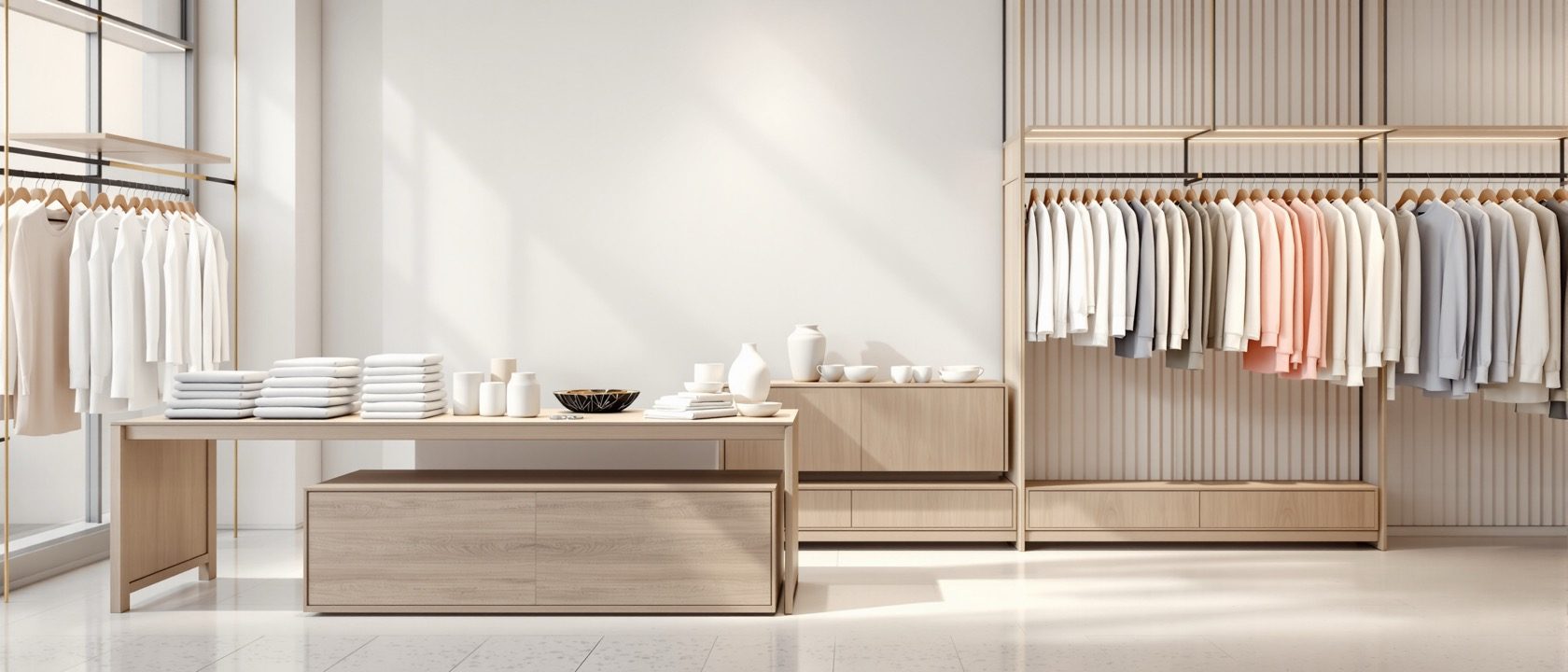
The PURPOSE of a display unit is to hold, protect and PRESENT a product so it sells — and different products need different displays. Folded knitwear wants a TABLE or shelf; hanging garments want a RAIL; jewellery wants a lit CASE; shoes want a stepped stand; heavy goods want sturdy GONDOLAS. Choosing the RIGHT display for the RIGHT product means matching the fixture to how the product is best SHOWN, HANDLED and kept — and balancing that against COST, because fixtures are a real budget line. The wrong fixture hides or cheapens good product; the right one flatters and sells it. This is a practical craft decision every retail project turns on: not the prettiest fixture, but the one that shows THIS product best, to THIS shopper, at a sensible price.[1, 2]
Fixtures — the furniture of retail
Fixtures — gondolas, rails, tables, plinths, cases, mannequins — are the furniture of retail, designed and detailed like joinery. And special fixtures do special jobs: POP displays (the last-moment prompt), modular systems (flexible and economical), and special fixtures for particular goods, plus the virtual merchandising tool kit.[1, 2]
The furniture of retail
FIXTURES are the furniture of retail — the gondolas, wall systems, rails, tables, plinths, cases and mannequins that hold and show product — and their DESIGN matters as much as any furniture. Good fixture design suits the product, fits the brand and the store's look, is flexible and durable, and comes at a workable cost. The main TYPES: wall fixtures (shelves, rails, slat-wall), floor fixtures (gondolas, tables, four-ways, round racks), feature fixtures (plinths, cases, mannequins) and the checkout. A visual merchandiser must know the fixture vocabulary, choose and often DESIGN fixtures, and detail them like any joinery. The fixtures are the stage on which the product performs — get them right, and the product looks its best; get them wrong, and no display can save it.[1, 2]
At a glance
| Aspect | The fact | The folklore |
|---|---|---|
| A display unit's purpose is | To hold, protect and PRESENT product so it sells | To fill space |
| The right display is | The one that shows THIS product best, at a sensible COST | The prettiest or priciest one |
| 'More is more' | A myth — a crammed display has no focal point and sells LESS | True — cram in product |
| Display technique is | Composition — pyramid, repetition, balance, and EDITING | Piling product up |
| Fixtures are | The furniture of retail — designed and detailed like joinery | Just shelves that come with the shop |
| POP / modular / special fixtures | Specialists — impulse, flexible systems, and bespoke for particular goods | All the same as any shelf |
Key terms
A fixture that holds, protects and presents product so it sells — chosen to suit how the product is best shown and handled, and balanced against cost.
The craft of matching the fixture type to the product — folded knits on a table, hanging garments on a rail, jewellery in a case — for the best presentation within budget.
Arranging product using design principles — the pyramid/triangle, repetition, balance, rhythm and editing — so a display reads as ordered, attractive and easy to shop.
The furniture of retail — gondolas, rails, tables, plinths, cases and mannequins — designed and detailed like joinery to suit the product, brand, flexibility and cost.
A Point-Of-Purchase display — a small feature at the till or decision point that prompts a last-moment, add-on or impulse pick-up; useful when it offers something genuinely relevant.
Modular = reconfigurable standard systems, flexible and economical; special = bespoke fixtures for particular goods like jewellery, eyewear or cosmetics.
Study task
Pick one product category — say knitwear, shoes, jewellery or ceramics — and design a display for it. First, choose the right fixture for how it is best shown, handled and kept, and note a rough cost level. Second, arrange the product using a clear composition — a pyramid or repetition, a focal point, balance — and deliberately practise editing: show fewer pieces, with breathing room, and note why that sells better than cramming. Third, add one special fixture where it helps (a POP unit at the till, a modular wall system, or a bespoke accessory stand) and justify it. Sketch the display in plan and elevation. Finally, write one line on how the wrong fixture would have hidden or cheapened the same product. The goal is to match display to product, and to feel why less, well-shown, sells more.
Self-assessment
1. How do you choose a display for a product?
2. Does cramming in more product sell more?
3. What are fixtures?
4. What is a POP display?
Recap
References & further reading
- [1]Swati Bhalla & Anurag Swati, Visual Merchandising, McGraw Hill, New Delhi, 2010 — product display, fixture design and types. https://www.mheducation.co.in/
- [2]Reji Mathew, Apparel Merchandising, Book Enclave, New Delhi, 2008; and display methods, fixture types and POP display (visual-merchandising references). https://www.wgsn.com/
Further reading
- Swati Bhalla & Anurag Swati, Visual Merchandising, McGraw Hill, New Delhi, 2010.
- Reji Mathew, Apparel Merchandising, Book Enclave, New Delhi, 2008.
- Visual-merchandising and fixture-design references (display methods, POP and modular fixtures).
Sources gathered and fact-checked June 2026. Published values vary by source, sample and method — treat as indicative and confirm against the cited standard before structural use.
The author
Amogh N P
Architect, interior designer, and creative polymath. Studio Matrx began in his notebooks — his vision of design made honest, useful, and open to everyone. Its Academy is written and taught in his memory, and free, forever.
More about Amogh →