
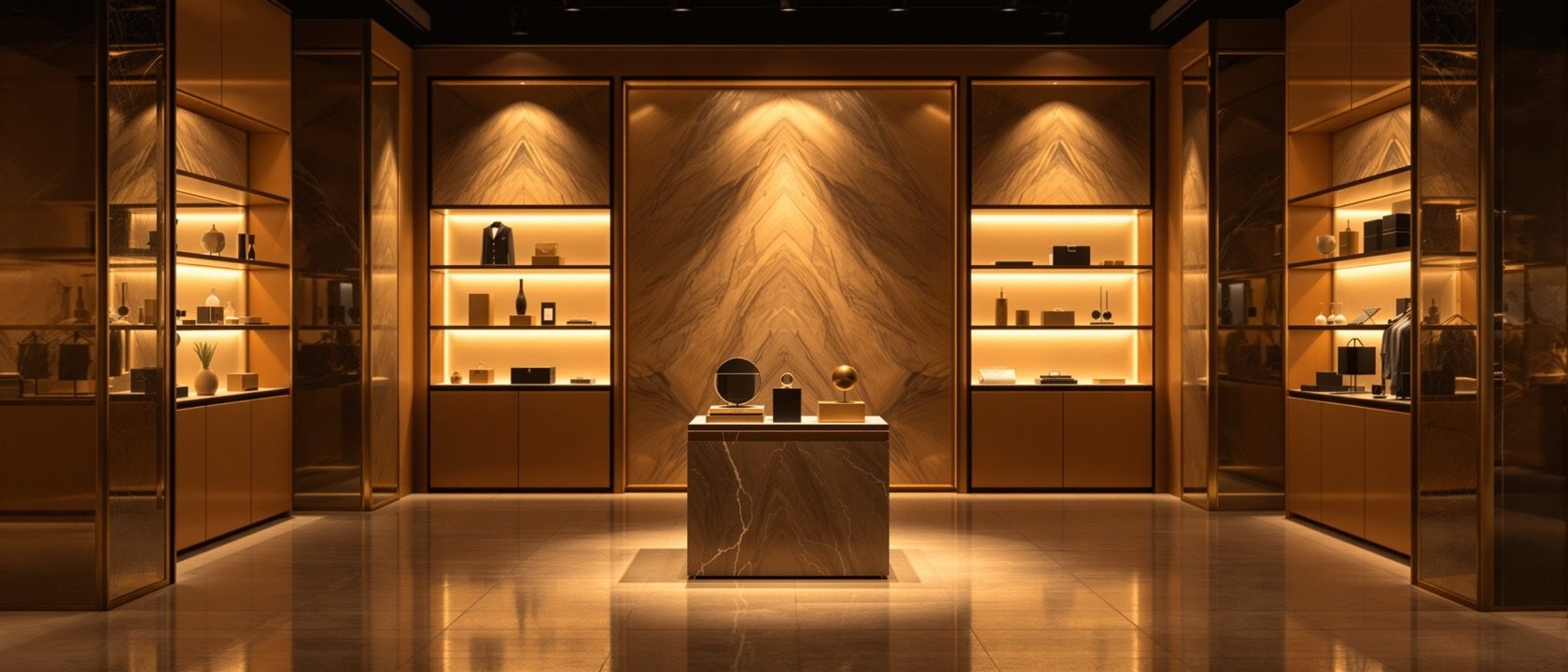
Components of Visual Merchandising
The store interior, the exterior — and the atmospherics
Visual merchandising applies the same design elements and principles the degree teaches — but to the arrangement of product. Its components are the store interior and its atmospherics (aroma, music, lighting, fixtures — a term Kotler coined in 1973), and the store exterior (marquee, facade, signage, window display). And four tools make any display work: the focal point, the theme, colour and lighting. Told honestly: atmospherics are real and powerful, but they set a mood — they are not magic.
Learning objectives
By the end of this lesson, you will be able to — mapped to the course outcomes for Visual Merchandising:
Apply the elements and principles of design to a display.
Design the store interior and its atmospherics — aroma, music, fixtures, light.
Design the store exterior — marquee, facade, window display and focal point.
Elements, principles & the interior
VM applies the same elements and principles — balance, focal point, rhythm, colour, proportion — to product. And the store interior is a total sensory environment: its atmospherics of aroma, music, lighting, fixtures and materials set how it feels — real and powerful, but a mood-setter, not magic.[1, 2, 3]
Design, applied to product
Visual merchandising applies the same design ELEMENTS and PRINCIPLES the whole degree teaches — line, shape, colour, texture, space; balance, rhythm, proportion, emphasis, harmony — but to the arrangement of PRODUCT. A good display has a FOCAL POINT (emphasis), a stable composition (balance, a pyramid), rhythm (repetition), a colour story (harmony or contrast), and the right proportion and space. This is why an interior-design training is such good preparation for VM: the discipline of composing elements into an ordered, attractive, expressive whole is exactly the same — only the 'material' is merchandise, and the goal includes selling. Learn to see a display as a COMPOSITION, and the principles you already know do most of the work.[1, 2]
The exterior, focal point, theme & light
The store exterior — marquee, facade, signage, and above all the window display — is the store’s face and decides who walks in. And four tools make any display work: a focal point (with breathing room), a unifying theme, a colour story, and lighting that does an outsized share of the work.[1, 2]
The face to the street
The store EXTERIOR is the store's FACE — its pitch to everyone who passes. Its components are the MARQUEE and FACADE (the storefront's overall look and identity), the SIGN BOARDS (name and brand — kept clear and legible), and above all the WINDOW DISPLAYS. The shop window is the single most public, highest-stakes piece of VM: it has SECONDS to stop a passer-by and give them a reason to come in. A strong exterior has a clear brand identity, an inviting entrance, and windows with a theme, a focal point, good lighting and a story. The exterior decides who walks in at all — and so, in a sense, it is where selling begins, out on the pavement, before a customer has even entered.[1, 2]
At a glance
| Aspect | The fact | The folklore |
|---|---|---|
| VM applies | The same design elements & principles — to PRODUCT | A separate set of rules |
| Store atmospherics are | Aroma, music, light, fixtures — real, mood-setting (Kotler, 1973) | Magic that makes people buy anything |
| The store exterior is | The FACE — marquee, facade, signage, WINDOW — where selling begins | Just a wall with a door |
| Every display needs | A FOCAL POINT — with breathing room around it | As much product as fits |
| Colour in retail is | Powerful for mood/theme/brand — but 'colour psychology' is overstated | A proven trigger that makes people buy |
| Lighting does | An OUTSIZED share — ambient + accent on focal points | Little that matters |
Key terms
The deliberate design of a store's sensory environment — aroma, music, lighting, materials — to shape mood and behaviour; a term coined by Philip Kotler in 1973. Real, but a mood-setter, not magic.
The interior tools of VM — fixtures and display units, lighting, aroma, music, colour, props and materials — composed into a total atmosphere that fits the brand.
The store's face to the street — the marquee and facade, the sign boards, and the window displays — which decide who walks in at all.
The single dominant element in a display or store that catches the eye first and leads it onward; the anchor of a good composition, needing breathing room around it.
A single unifying idea — a season, colour, story or lifestyle — that ties a display's elements together so it reads as intentional rather than random.
Layered ambient light (overall mood) plus accent spotlights (on focal points and hero product); it does an outsized share of VM's work, setting mood and directing the eye.
Study task
Choose one shop with a strong window display and analyse its components. First, the exterior: how do the facade, signage and window work together to stop a passer-by and invite them in? Identify the window’s focal point, its theme, its colour story and its lighting. Then step inside and read the atmospherics: the light, any music or scent, the materials and fixtures — and describe the mood they create and whether it fits the brand. Now redesign one weak element (say a cluttered focal point or flat lighting) and explain your fix using the elements and principles. Finally, write one honest line on the difference between atmospherics that set a mood for an honest offer and atmospherics used as a trick — and why the first works better in the long run. The goal is to read and compose the components of a display.
Self-assessment
1. What are store 'atmospherics'?
2. Why is the store exterior so important?
3. What does every good display need?
4. How should colour be treated in retail display?
Recap
References & further reading
- [1]Swati Bhalla & Anurag Swati, Visual Merchandising, McGraw Hill, New Delhi, 2010 — components of VM, store interior and exterior. https://www.mheducation.co.in/
- [2]The elements and principles of visual merchandising; the focal point, display theme, colour and lighting (visual-merchandising references). https://www.wgsn.com/
- [3]Philip Kotler, 'Atmospherics as a Marketing Tool', Journal of Retailing, 1973 — the sensory environment of the store. https://www.kellogg.northwestern.edu/academics-research/research/detail/1973/atmospherics-as-a-marketing-tool/
Further reading
- Swati Bhalla & Anurag Swati, Visual Merchandising, McGraw Hill, New Delhi, 2010.
- Philip Kotler, 'Atmospherics as a Marketing Tool', Journal of Retailing, 1973.
- Reji Mathew, Apparel Merchandising, Book Enclave, New Delhi, 2008.
Sources gathered and fact-checked June 2026. Published values vary by source, sample and method — treat as indicative and confirm against the cited standard before structural use.
The author
Amogh N P
Architect, interior designer, and creative polymath. Studio Matrx began in his notebooks — his vision of design made honest, useful, and open to everyone. Its Academy is written and taught in his memory, and free, forever.
More about Amogh →