
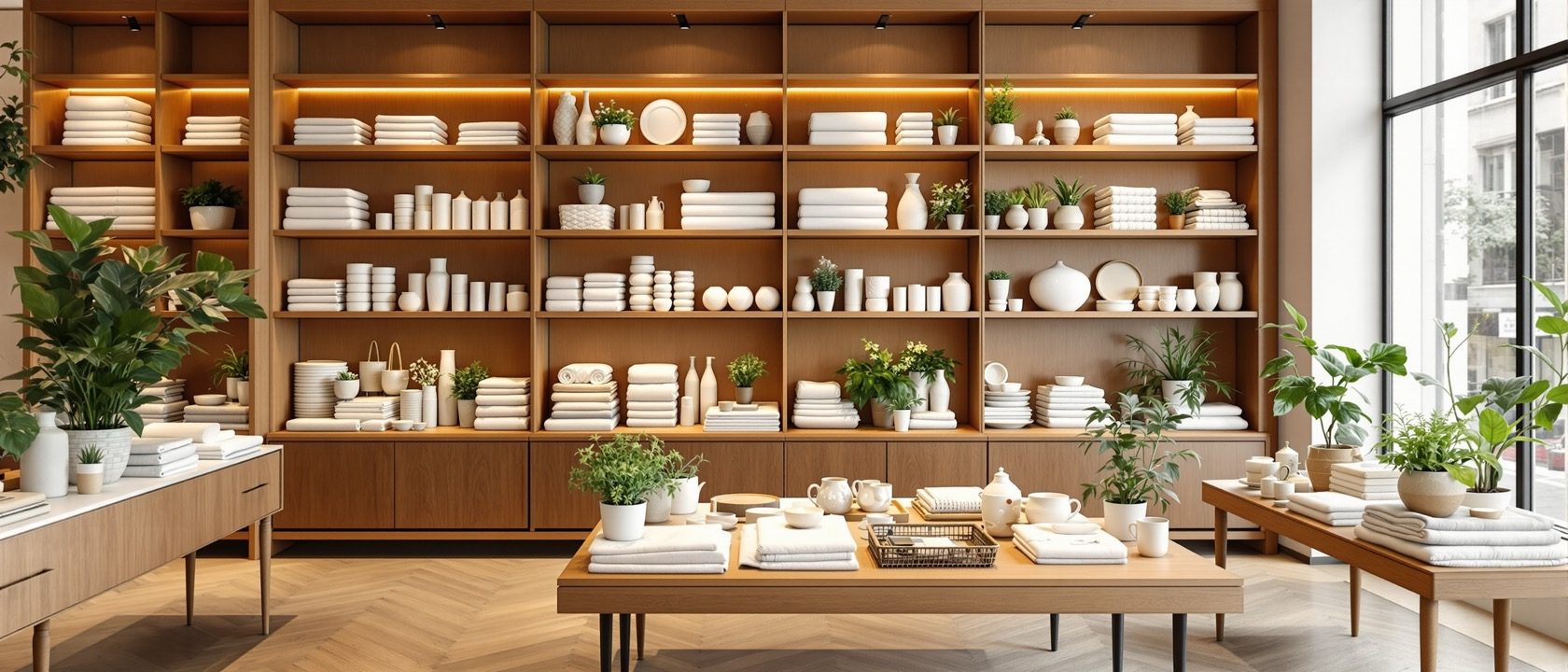
Retailing & Visual Merchandising
The strategic silent salesperson — not just decoration
Retailing is the business of selling directly to the end customer — from the kirana corner shop to the mall to the online store — and it is one of India’s largest, fastest-changing sectors. Visual merchandising is the strategic presentation of a store and its products to attract, sell and communicate the brand — a store’s ‘silent salesperson’. This unit introduces both, and clears the field’s first myth: VM is not decoration, it is a strategic, psychological craft grounded in how people actually shop.
Learning objectives
By the end of this lesson, you will be able to — mapped to the course outcomes for Visual Merchandising:
Explain retailing, its evolution and its role in the economy.
Define visual merchandising and its functions.
Recognise VM as a strategic, psychological craft, not decoration.
What is retailing?
Retailing is the last step from maker to user, run on a marketing mix (product, price, place, promotion, people, presentation). It has evolved from the bazaar and general store to the department store, the mall and e-commerce — and in India it is huge, mostly unorganised (kirana), and changing fast.[1, 4]
Selling to the end customer
RETAILING is the business of selling goods and services directly to the END customer, for their own use — the last step of the chain that brings a product from maker to user. It ranges from the corner kirana shop to the department store, the branded boutique, the mall and the online store. Retail runs on a MARKETING MIX — the right PRODUCT, at the right PRICE, in the right PLACE, with the right PROMOTION, plus the PEOPLE and the PRESENTATION that a store adds. And it has evolved dramatically: from the ancient BAZAAR and the general store, through the department store and the supermarket, to the shopping mall, the branded chain and now e-commerce and the phone. Understanding retailing — how it works, how it makes money, how it has changed — is the ground a visual merchandiser stands on, because VM exists to make a RETAIL space and its product sell.[1, 4]
What is visual merchandising?
Visual merchandising is the strategic presentation of a store and its products — window, display, fixture, layout, light, atmosphere — to attract, show, sell and communicate the brand. It is the ‘silent salesperson’, working every open hour on every shopper — and it is not just decoration.[1, 4]
The silent salesperson
VISUAL MERCHANDISING is the strategic PRESENTATION of a store and its products — the window, the displays, the fixtures, the layout, the lighting and the whole sensory atmosphere — to ATTRACT shoppers, SHOW and SELL the merchandise, and COMMUNICATE the brand. It is often called a store's 'SILENT SALESPERSON', because it works every hour the shop is open, on every shopper, without a word: catching the eye, telling the story, guiding the walk, making product desirable and easy to buy. And here is the first myth to clear: VM is NOT just decoration or 'making the shop pretty'. It is a STRATEGIC, psychological craft — grounded in how people actually move, look and decide — whose job is to SELL and to serve the shopper. Beauty is a means; findability, flow, desire, conversion and brand are the ends. Explore the vocabulary in the VM decoder below.[1, 4]
Decode the vocabulary
Retail and visual merchandising carry real terms and comfortable myths. Filter the VM decoder by theme and see each idea graded VERIFIED, NUANCED or MYTH.
VM decoder · the vocabulary of retail & display
Retailing & VM, atmospherics, display and store planning — graded VERIFIED, NUANCED or MYTH.
Visual merchandising
The silent salesperson
Means: The strategic PRESENTATION of a store and its products — window, display, fixture, layout, light and atmosphere — to attract shoppers, show and sell the merchandise, and communicate the brand.
Honestly · The heart of the course: VM is a strategic, psychological craft, not a garnish. Done well it is a store's 'silent salesperson', working every hour the shop is open to help people find, understand, want and buy — and to tell them who the brand is.
'VM is just decoration'
It's strategic
Means: The belief that visual merchandising just means making a shop look pretty.
Honestly · A MYTH. VM is STRATEGIC — it drives findability, customer flow, conversion and brand communication, and it is grounded in consumer psychology (how people move, look and decide). 'Pretty' is a by-product; SELLING and serving the shopper are the point.
Retail in India
A huge, changing sector
Means: Retail's role in the nation's economy — among its largest employers and contributors — spanning ORGANISED retail (malls, branded stores) and the vast UNORGANISED sector (the kirana corner shop), and changing fast.
Honestly · Context every retail designer needs. Indian retail is enormous and still mostly unorganised; it is being reshaped by malls, brands, e-commerce and rising incomes — 'the changing face of retail' — and VM is central to how physical stores stay relevant.
'Online killed retail & VM'
It expanded VM
Means: The belief that e-commerce has killed physical retail and made visual merchandising obsolete.
Honestly · A MYTH. Physical retail persists (people still want to touch, try and experience), and VM has EXPANDED to span the physical store AND the digital storefront — product photography, site layout, online display. Experience-led physical retail is a response to online, not a victim of it.
Atmospherics
Kotler, 1973
Means: The deliberate design of a store's sensory ENVIRONMENT — sight, sound, scent, touch — to shape mood and behaviour; a term coined by Philip Kotler in 1973.
Honestly · The evidence base for the 'atmosphere' half of VM. Light, colour, music, scent and materials genuinely affect how long people stay, how they feel and what they notice. Real and powerful — but a tool to set the RIGHT mood for a brand, not a magic wand.
'Sensory tricks sell anything'
Mood, not magic
Means: The belief that the right music, scent and lighting can make people buy anything.
Honestly · A MYTH. Atmospherics SET A MOOD and fit a brand; they nudge, they don't compel. They cannot override a bad product, a wrong price or an absent need — and shoppers resent obvious manipulation. Use them to make an honest offer feel right, not to trick.
Retail lighting
Most of the impact
Means: The layered lighting of a store — AMBIENT (overall level and mood) plus ACCENT (spotlights that pick out the focal points and hero products) — and the warmth or coolness of the light.
Honestly · Lighting does an outsized share of VM's work: it sets mood, models product, and directs the eye. Accent light on a focal display is one of the most powerful moves in the whole craft — and poor lighting can kill even a beautiful display.
Colour vitals
Powerful, often overstated
Means: The use of colour in displays and interiors to set mood, signal a brand, coordinate a theme and draw the eye.
Honestly · Colour genuinely draws attention, coordinates a display and carries brand — but retail 'colour psychology' (this colour makes people buy) is often OVERSTATED and culture-bound. Use colour for contrast, harmony, theme and brand fit; be sceptical of universal 'colour makes you buy' claims.
The focal point
Catch the eye, lead it in
Means: The single dominant point in a display or store that CATCHES the eye first and LEADS it onward — a hero product, a styled group, a lit feature — the anchor of a good composition.
Honestly · Every strong display has one. Without a focal point the eye has nowhere to land and wanders off; with one, it is caught and then led through the merchandise. And crucially, the focal point needs BREATHING ROOM — which is why clutter kills it.
'More is more'
Clutter sells less
Means: The belief that cramming in more product means more sales.
Honestly · A MYTH. A cluttered, over-full store sells LESS: the eye can't find a focal point, nothing stands out, and the space feels cheap and stressful. EDITING — fewer pieces, clear focal points, negative space around them — makes product look desirable and easy to choose. Less, well-shown, sells more.
Composition in display
Pyramid, repetition, balance
Means: Arranging a display using the principles of composition — the pyramid/triangle grouping, repetition, symmetry and asymmetry, balance and rhythm — so it reads as ordered and attractive.
Honestly · The same design principles the whole degree teaches, applied to product. A pyramid gives a stable focal shape; repetition gives rhythm; balance gives calm. Composition is what separates a considered display from a random pile.
Right display, right product
Match fixture to goods
Means: Choosing the RIGHT display type and fixture for the RIGHT product — folded knits on a table, hanging garments on a rail, jewellery in a case — balancing presentation against cost.
Honestly · A practical craft skill: the fixture must suit how the product is best shown, handled and protected, and it must fit the budget. The wrong fixture hides or cheapens good product; the right one sells it. Display type and cost are real design decisions.
The window display
The store's face
Means: The store's shop-window — its FACE to the street, the first and often only pitch to a passer-by, a staged scene that stops them and invites them in.
Honestly · The most public, highest-stakes piece of VM: a window has seconds to stop a passer-by. A strong window has a clear theme, a focal point, good lighting and a reason to come in — it is a silent, standing advertisement working on everyone who walks past.
POP display
The last-moment prompt
Means: A Point-Of-Purchase display — a small feature near the till or decision point that prompts a last-moment, add-on or impulse pick-up.
Honestly · A legitimate and effective tool when it offers something genuinely useful or tempting at the right moment (the batteries by the torch, the socks by the shoes). It tips into manipulation only when it preys on people; used honestly, it helps shoppers and sellers both.
The decompression zone
Underhill's landing strip
Means: The TRANSITION ZONE just inside the entrance (Paco Underhill's 'landing strip') where shoppers adjust from the street and take little in — so key product placed here is systematically MISSED.
Honestly · A hard-won insight from watching real shoppers: for the first few steps people are orienting, not shopping. Keep the decompression zone open and welcoming, and don't waste your best product or signage there — they won't be seen.
The power wall
Prime by convention, not by law
Means: The right-hand wall just past the entrance, treated by long-standing retail convention as prime, high-impact space for feature merchandise.
Honestly · Widely taught — but handle the usual rationale with care. The claim that shoppers reliably turn RIGHT on entering (Underhill's 'invariant right') is NOT supported by peer-reviewed evidence: controlled studies find entry turning closer to a coin-flip, shaped by the entrance, the layout and the local walking/driving side rather than an innate bias (Kim et al., 2022). Use the right-hand wall as a feature zone WHERE your own entrance and sightlines make it the first thing seen — and verify it against your store's real traffic, not folklore.
The arena principle
See it all
Means: Arranging merchandise in TIERS or steps, like an amphitheatre, so that ALL of it is visible from the front rather than the back rows being hidden.
Honestly · A simple, powerful display-and-layout rule: stepped or tiered presentation (and rising heights toward the back) means nothing is lost from view. It maximises how much product a shopper can see and take in at a glance.
The Gruen effect
Its own inventor disowned it
Means: The disorienting effect of a deliberately confusing store or mall layout that makes shoppers lose track of their intent and buy on impulse — named after architect Victor Gruen.
Honestly · Real — but a cautionary tale, not a goal. Victor Gruen DISOWNED the cynical, manipulative use of his ideas (1978), calling the developments that abused them 'bastard'. It marks the ETHICAL line: design to help shoppers navigate and choose, not to disorient and exploit them.
The best visual merchandising serves the shopper as much as the seller — compelling, profitable and honest at once.
At a glance
| Aspect | The fact | The folklore |
|---|---|---|
| Retailing is | Selling goods & services directly to the end customer | Only big shops and malls |
| Indian retail is | Huge, mostly UNORGANISED (kirana), and changing fast | Small and static |
| Visual merchandising is | The strategic SILENT SALESPERSON — present product to sell & brand | Making the shop look pretty |
| 'VM is just decoration' | A myth — it's strategic, psychological, drives flow & conversion | True |
| VM's functions are | Attract, inform, engage, SELL, build brand | Only to look nice |
| VM grew because | Bigger stores, fewer clerks — the SPACE had to do the selling | Shops wanted decoration |
Key terms
The business of selling goods and services directly to the end customer for their own use — the last step from maker to user, from the kirana shop to the mall to the online store.
The levers a retailer pulls — product, price, place, promotion, plus the people and presentation a store adds — to bring the right offer to the right customer.
Organised = malls, branded chains, supermarkets; unorganised = the vast web of kirana corner shops, vendors and family stores that still dominates Indian retail.
The strategic presentation of a store and its products — window, display, fixture, layout, light and atmosphere — to attract, show, sell and communicate the brand; the 'silent salesperson'.
The idea that good visual merchandising sells on its own, every open hour and to every shopper, without a word — catching the eye, telling the story and guiding the buy.
To attract, inform, engage, sell and build the brand — the strategic jobs visual merchandising does, far beyond simply looking attractive.
Study task
Visit (or recall) two very different shops — say a small kirana or local store and a branded boutique or a mall store. For each, note how it does its visual merchandising: the window and facade, the way product is displayed, the fixtures, the lighting and atmosphere, and the overall layout. Which one uses VM as a deliberate, strategic silent salesperson, and which leaves it to chance? Identify three specific moves in the better one that attract, inform or sell — and one thing even the weaker shop does well. Then write two lines arguing why visual merchandising is not just ‘making the shop pretty’ but a strategic craft grounded in how people shop. The goal is to start seeing every shop as a designed (or undesigned) selling machine.
Self-assessment
1. What is visual merchandising?
2. Is visual merchandising just decoration?
3. What is distinctive about retail in India?
4. Why did visual merchandising grow as a craft?
Recap
References & further reading
- [1]Swati Bhalla & Anurag Swati, Visual Merchandising, McGraw Hill, New Delhi, 2010 — retailing, visual merchandising and its functions. https://www.mheducation.co.in/
- [4]Retailing, the retail marketing mix and retail in India (retail-management references); the definition and history of visual merchandising. https://nrf.com/
Further reading
- Swati Bhalla & Anurag Swati, Visual Merchandising, McGraw Hill, New Delhi, 2010.
- Reji Mathew, Apparel Merchandising, Book Enclave, New Delhi, 2008.
- Retail management and visual merchandising references.
Sources gathered and fact-checked June 2026. Published values vary by source, sample and method — treat as indicative and confirm against the cited standard before structural use.
The author
Amogh N P
Architect, interior designer, and creative polymath. Studio Matrx began in his notebooks — his vision of design made honest, useful, and open to everyone. Its Academy is written and taught in his memory, and free, forever.
More about Amogh →