
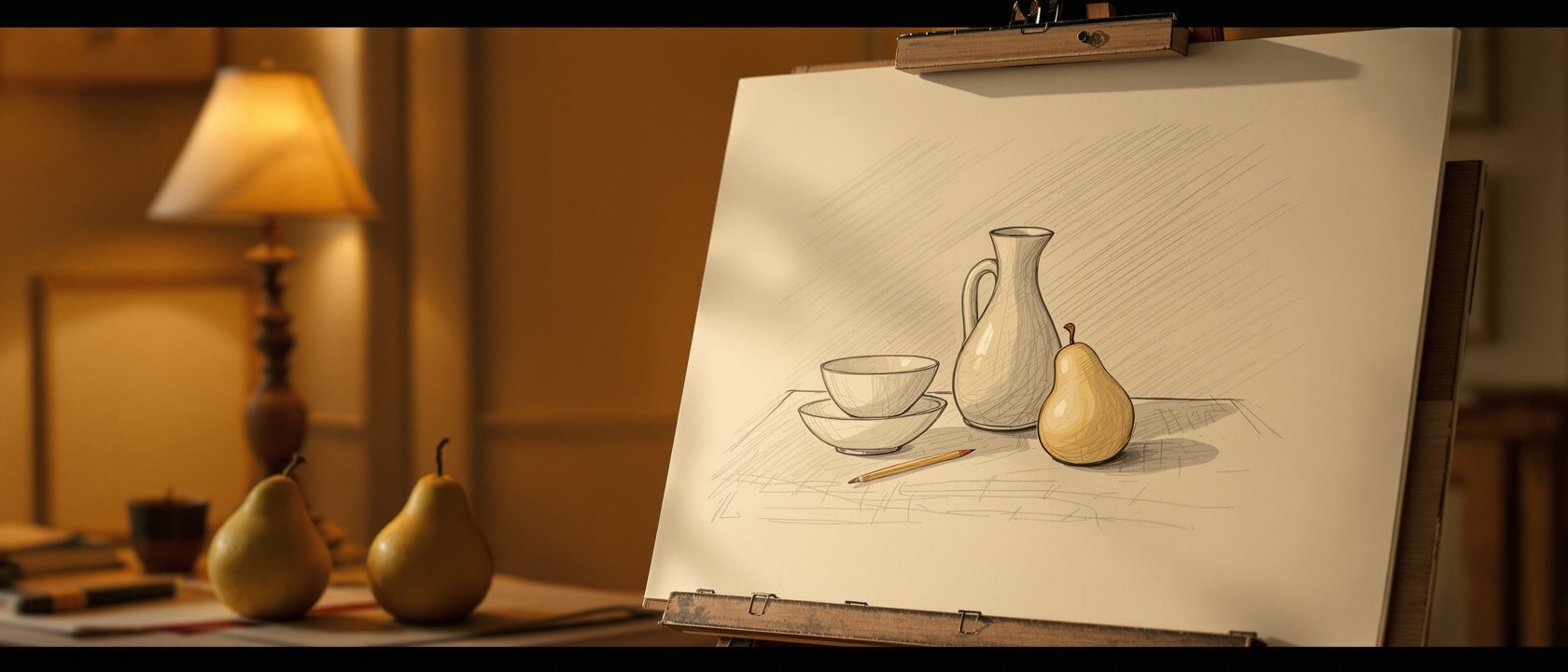
Still Life & Self-Portrait
The full light logic — and structure before likeness.
Two capstone subjects bring the course together. The still life — arrange objects with overlap and one dominant light, then render the full light logic (highlight to cast shadow). The self-portrait — build the head on structure and proportion (the eyes sit roughly halfway down) before chasing likeness. And study a master’s technique.
Learning objectives
By the end of this lesson, you will be able to — mapped to the course outcomes for Visual Arts:
Arrange and render a still life with the full light logic and cast shadow.
Use overlap, size, detail and softening to create depth, and match texture.
Build a self-portrait on head structure and proportion before likeness.
Study a famous artist's drawing technique — line and tonal approaches.
The still life
Arrange, then render the five values every form makes in light, ground it with a cast shadow, and build depth by overlap.[1, 4]
The composition is a decision
Before drawing, ARRANGE: vary heights and sizes, create OVERLAP (the single strongest depth cue), an odd number of objects often reads better, set a clear focal point, and fix ONE dominant light source. A still life is composed, not just copied — the arrangement is half the drawing.[1, 4]
The self-portrait & the masters
Build the head on the Loomis construction and correct proportion, then study how a line artist and a tonal one make their marks.[2, 5]
The eyes sit halfway down
The most useful correction: the EYES fall at roughly the vertical HALFWAY point of the whole head — beginners place them too high because they forget how big the cranium is. Rough averages: the head is about five eye-widths wide, one eye-width between the eyes, the nose-base about halfway from brow to chin, the mouth about a third from nose to chin. Loose GUIDES — your own face deviates.[2]
At a glance
| Aspect | One side | The other |
|---|---|---|
| Still life | Myth: just copy what's there | Reality: arrange it — overlap, focal point, one light |
| Cast shadow | Myth: a flat grey blob | Reality: direction, soft edge, colour — it anchors |
| Self-portrait | Myth: must be photo-realistic | Reality: structure first, likeness follows |
| Eye placement | Myth: near the top of the head | Reality: ~halfway down the whole head |
| Proportion rules | Guides/averages | Sighting the real face overrides them |
Key terms
The dark band where a form turns away from the light.
Light bounced back into the shadow side, keeping it from going dead black.
The shadow an object throws onto the surface — with direction, soft edge and colour.
One object in front of another — the strongest depth cue in a still life.
Building the head as a sliced sphere plus jaw, divided by curved guidelines.
Getting head proportion and tilt right first; likeness follows.
Studio exercise
Arrange three to five overlapping objects under a single lamp and render the full light logic in coloured pencil — highlight, mid-tone, core shadow, reflected light, and a cast shadow with a colour. Then draw a mirror self-portrait: build the Loomis head, place the eyes at the mid-line, and draw the observed features — structure first, likeness last.
Self-assessment
1. On a lit sphere, the order of values from the light is —
2. In a head, the eyes sit at roughly —
3. A self-portrait should begin with —
Recap
References & further reading
- [1]Bert Dodson, Keys to Drawing, 1985 (still-life composition, light logic, restatement).
- [2]Andrew Loomis, Drawing the Head and Hands, Viking, 1956 (head construction and proportions).
- [3]Art Fundamentals, 3dtotal Publishing, 2013 (light, form, cast shadow, colour).
- [4]Rudy de Reyna, How to Draw What You See, 1970 (rendering objects and depth).
- [5]Betty Edwards, Drawing on the Right Side of the Brain, 1979 (its self-portrait capstone project).
Further reading
- Andrew Loomis — Drawing the Head and Hands.
- Bert Dodson — Keys to Drawing.
- Art Fundamentals — 3dtotal Publishing.
Sources gathered and fact-checked June 2026. Published values vary by source, sample and method — treat as indicative and confirm against the cited standard before structural use.
The author
Amogh N P
Architect, interior designer, and creative polymath. Studio Matrx began in his notebooks — his vision of design made honest, useful, and open to everyone. Its Academy is written and taught in his memory, and free, forever.
More about Amogh →