
Perspective Sketching
Depth by eye — one-, two- and three-point perspective, freehand.
This is perspective as an observed sketching skill, estimated by eye — not the ruled construction of the technical drawing course. Find the horizon (always your eye level), the vanishing points, and the cone of vision; then learn one-, two- and three-point perspective and when each applies, and sketch a room by eye.
Learning objectives
By the end of this lesson, you will be able to — mapped to the course outcomes for Visual Arts:
Locate the horizon (eye level), vanishing points, picture plane and cone of vision.
Sketch in one-, two- and three-point perspective and know when each applies.
Draw foreshortened forms as they appear, checked by sighting.
Spot and avoid the common perspective errors.
The concepts
The horizon is your eye level and moves with you; parallels converge to vanishing points; the cone of vision keeps a sketch from distorting.[1]
It moves with you
The HORIZON LINE is your EYE LEVEL, and it moves with where you are: sitting gives a low horizon, standing a higher one, looking down a stairwell a very high one. Everything in the sketch is judged relative to it — objects above your eye level are seen from below, objects below it from above. Establish the horizon first, always.[1]
One-, two- and three-point
A wall square-on (one-point), a corner at an angle (two-point), or verticals converging too (three-point) — plus the common errors.[1, 2, 3]
Straight down a room
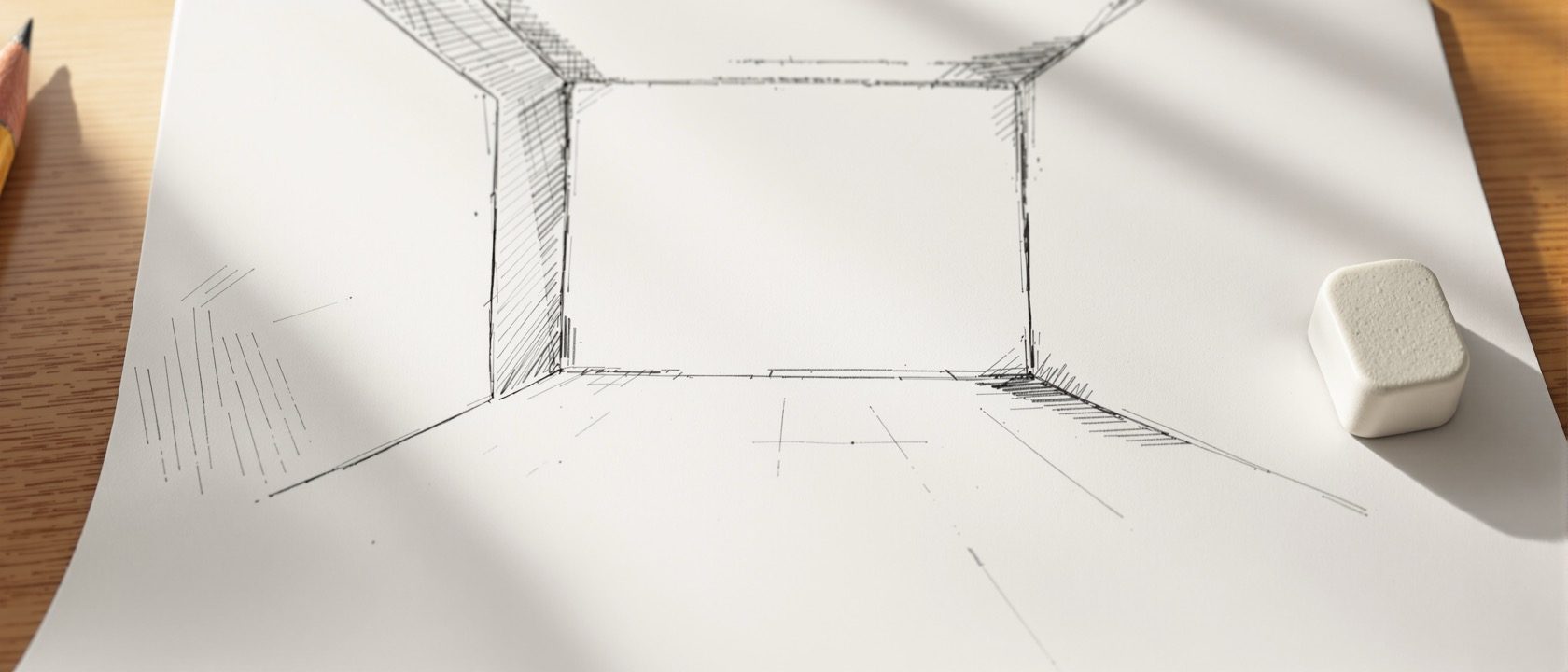
ONE-POINT perspective is used when one set of planes faces you square-on — looking straight down a corridor, a room or a street. All the depth edges converge to a SINGLE vanishing point on your eye level; the face-on planes stay true and the verticals stay vertical. The classic interior sketch.[1]
Explore the three systems
Toggle between one-, two- and three-point and see the vanishing points on the horizon.
Perspective explorer · one, two, three-point
One-point
1 vanishing point
One set of planes faces you square-on — looking straight down a room or corridor. All depth edges converge to a single vanishing point on your eye level; verticals stay vertical.
Observed by eye — the number of vanishing points depends on your viewpoint, not the object.
At a glance
| Aspect | One side | The other |
|---|---|---|
| Nature | Here: observed, by eye (sketching) | Ruled construction: the technical course |
| Horizon | It is: your eye level | It moves with where you stand/sit |
| One vs two-point | One: a wall faces you square-on | Two: you view a corner at an angle |
| Three-point | Adds: a third VP up or down | For looking sharply up or down |
| VP count | Myth: one correct number | Reality: depends on your viewpoint |
Key terms
Your eye level — the reference for the whole sketch; it moves with you.
Where a set of parallel edges appears to converge (on the horizon, for horizontals).
The ~60° cone within which a view looks natural; wider distorts.
The apparent compression of a form pointing toward the viewer.
The number of vanishing points, set by your viewpoint to the subject.
The imaginary glass surface you draw the scene onto.
Studio exercise
Freehand-sketch the room you are in, looking down its length: establish your eye-level horizon, find the single vanishing point by eye, box the room, then furnish it — no rulers. Then sketch a box on a table at an angle in two-point, keeping the verticals vertical and checking the convergence by sighting.
Self-assessment
1. The horizon line in a perspective sketch is always —
2. Looking straight down a corridor, you would sketch in —
3. A third vanishing point is added when —
Recap
References & further reading
- [1]Ernest R. Norling, Perspective Made Easy, 1939 (horizon, vanishing points, cone of vision, plainly).
- [2]Paul Laseau, Freehand Sketching: An Introduction, W. W. Norton (perspective as sketching).
- [3]Rudy de Reyna, How to Draw What You See, 1970 (foreshortening, observed depth); Ching, Drawing: A Creative Process.
- [4]Linear perspective — reinvented by Brunelleschi c.1415; first codified by L. B. Alberti, Della Pittura (On Painting), 1435.
Further reading
- Ernest R. Norling — Perspective Made Easy.
- Paul Laseau — Freehand Sketching: An Introduction.
- Francis D.K. Ching — Drawing: A Creative Process.
Sources gathered and fact-checked June 2026. Published values vary by source, sample and method — treat as indicative and confirm against the cited standard before structural use.
The author
Amogh N P
Architect, interior designer, and creative polymath. Studio Matrx began in his notebooks — his vision of design made honest, useful, and open to everyone. Its Academy is written and taught in his memory, and free, forever.
More about Amogh →