
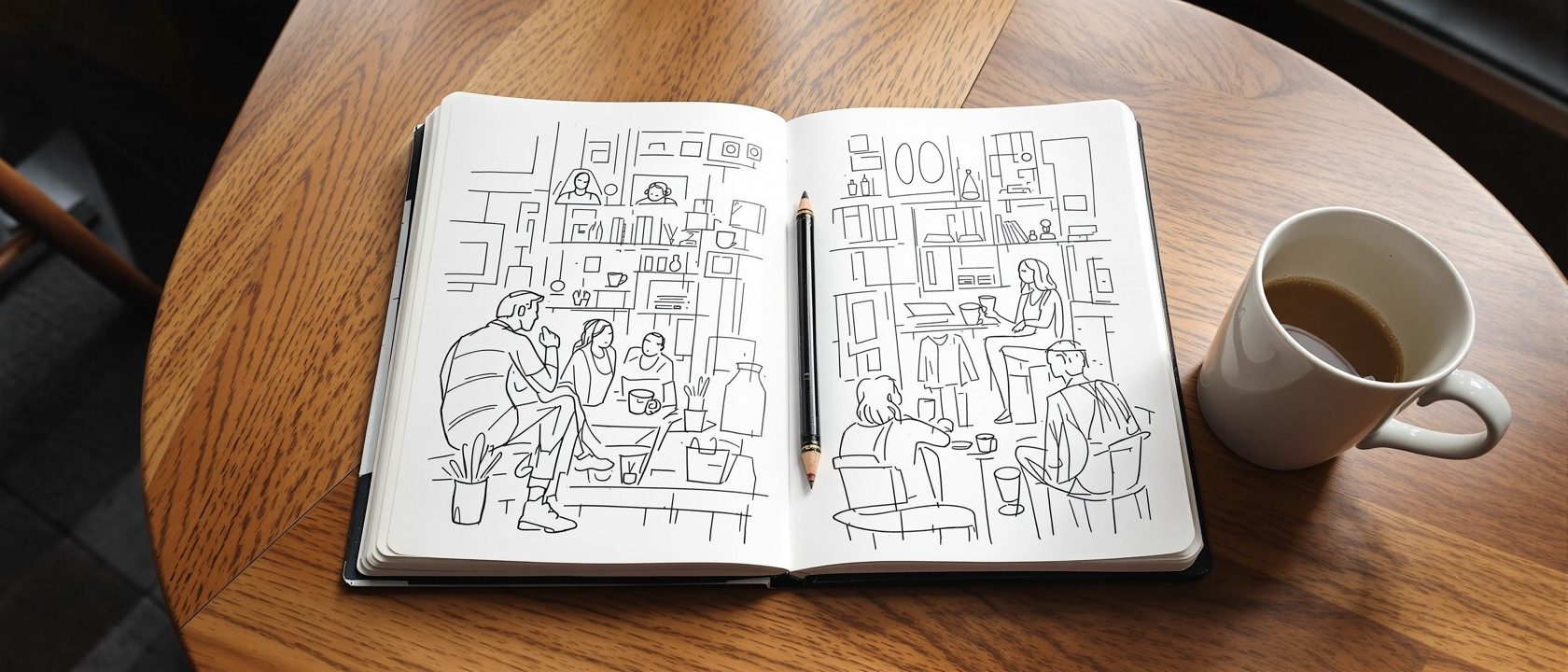
Drawing from Life
The live demo, the moving subject, and the daily sketchbook.
The last unit takes drawing off the desk. A live demonstration transmits what no book can — the sequence a drawing is built in, the pace and pressure of the hand. Sketching from life, where subjects move, forces gesture and editing. And the through-line of the whole course: a daily, low-stakes sketchbook — a gym, not a gallery.
Learning objectives
By the end of this lesson, you will be able to — mapped to the course outcomes for Visual Arts:
Explain what a live demonstration transmits that a book cannot.
Sketch a moving subject from life — gesture and editing over detail.
Keep a daily, low-stakes observational sketchbook.
See like a designer — edges, spaces, values — as a sustained habit.
Live exposure
What a live demo gives you that a book cannot, and why sketching moving subjects from life makes the skill instinctive.[1, 2]
Watch the process
Invite a working artist to DRAW LIVE and narrate their decisions. What a book cannot give you: the real-time SEQUENCE (where they start, how they block in), the PACE and PRESSURE of the hand, how a mistake is absorbed and corrected rather than erased, and how tools are actually held and switched. Structure it: watch → question → immediately attempt the same subject.[1]
Building a practice
The daily, low-stakes sketchbook — a gym not a gallery — and why short, regular practice builds the designer’s real skill: seeing.[1, 2]
A gym, not a gallery
Keep a private sketchbook that is NEVER graded on finish. Its value is mileage and honest observation, not finished pieces — treat it as a gym, not a gallery. Date the pages, mix quick gestures with one longer study, and draw from direct observation. The freedom to make bad drawings is what lets you make better ones.[2]
At a glance
| Aspect | One side | The other |
|---|---|---|
| Live demo | Myth: watching won't teach me | Reality: it transmits tacit process |
| Sketchbook | Myth: it must look finished | Reality: a gym not a gallery — mileage counts |
| Practice | Myth: wait for inspiration / time | Reality: short, regular, daily sessions |
| Source | From a photo: seeing already done | From life: you do the seeing |
| Talent | Myth: inborn gift | Reality: a trainable habit of seeing |
Key terms
Watching an artist draw and narrate — transmits tacit process a book cannot.
A fast capture of a subject's overall movement and proportion in a few marks.
Unwritten, hard-to-verbalise skill best learned by watching and doing.
A daily, low-stakes, un-graded drawing practice — a gym, not a gallery.
Drawing a subject from memory to sharpen observation (Nicolaides).
Drawing directly from an observed subject rather than a photograph.
Studio exercise
Start a dated sketchbook and keep it for the rest of term: one page of 30-second gesture drawings plus one 15-minute observed study, every day, from life — never from photos, never graded on finish. In your first week, watch one artist (in person or a video) draw a subject, then immediately attempt the same subject yourself.
Self-assessment
1. A live drawing demonstration is valuable mainly because it transmits —
2. A practice sketchbook should be treated as —
3. Nicolaides's method is built on —
Recap
References & further reading
- [1]The atelier / master-demonstration tradition; and Bert Dodson, Keys to Drawing, 1985 (sustaining a drawing habit).
- [2]Kimon Nicolaides, The Natural Way to Draw, Houghton Mifflin, 1941 (the daily working plan; life and memory drawing).
- [3]Claire Watson Garcia, Drawing for the Absolute and Utter Beginner, 2003 (confidence, routine, beginner practice).
Further reading
- Kimon Nicolaides — The Natural Way to Draw.
- Bert Dodson — Keys to Drawing.
- Claire Watson Garcia — Drawing for the Absolute and Utter Beginner.
Sources gathered and fact-checked June 2026. Published values vary by source, sample and method — treat as indicative and confirm against the cited standard before structural use.
The author
Amogh N P
Architect, interior designer, and creative polymath. Studio Matrx began in his notebooks — his vision of design made honest, useful, and open to everyone. Its Academy is written and taught in his memory, and free, forever.
More about Amogh →