
Pencil & Ink Technique
Building value — the six shading techniques, pen and ink, and seeing.
Tone is not one thing you smudge on; it is built, and there are six ways to build it. Learn the six shading techniques and why over-blending flattens a drawing; pen and ink, where every value is made from line density; the logic of colour mediums; and Betty Edwards’s seeing method — draw edges, spaces and values, not the symbol in your head.
Learning objectives
By the end of this lesson, you will be able to — mapped to the course outcomes for Visual Arts:
Build controlled value with the six pencil shading techniques.
Render tone in pen and ink from line density, using line weight for depth.
Explain the logic of coloured pencil, watercolour and marker.
Use Edwards's seeing skills — edges, spaces, relationships, values.
The six shading techniques
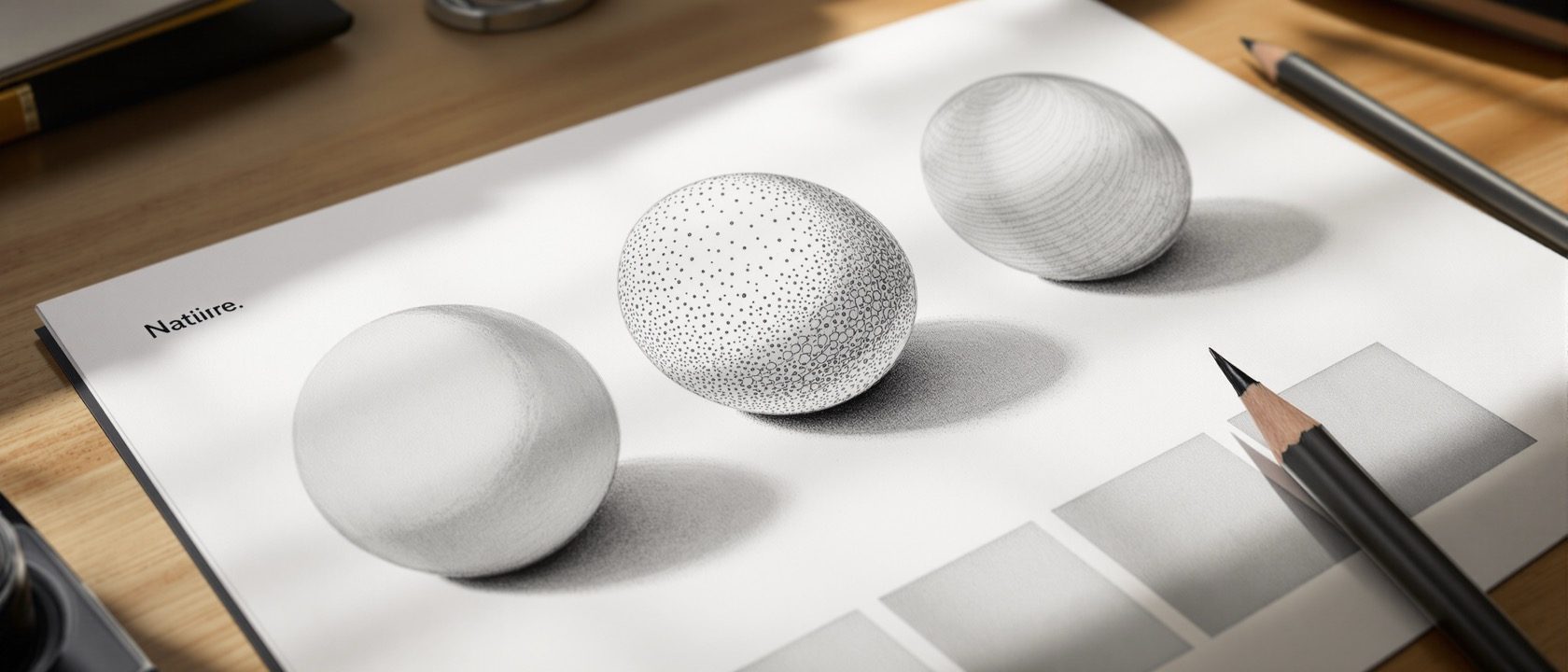
Hatching, cross-hatching, contour, stippling, scribble and smudging — each a distinct, controllable tool.[1, 2]
Lines make tone
HATCHING is parallel lines — value set by their spacing and pressure, the simplest controllable tone. CROSS-HATCHING layers sets of hatching at crossing angles; add a layer to step the value darker. Both give clean, rich darks that keep their crispness — the opposite of a smudge.[2]
Try the six techniques
Tap a technique to see its mark and how it builds value.
Shading explorer · six ways to build value
Hatching
Parallel lines. Value is set by how close together and how heavy the lines are — the simplest controllable tone.
Value is built by density and layering — smudging is one of the six and the most over-used.
Ink, colour and seeing
Build tone from line in pen and ink, learn each colour medium’s logic, and draw what you actually see.[3, 4, 5]
All value from line
Ink has no grey, so ALL tone is built from the density and spacing of lines and dots — closer marks read darker. LINE WEIGHT carries depth: thick lines advance and read as shadow-side and near edges; thin lines recede and read as light edges and detail. Ink also forces you to decide what stays white — the positive/negative space of the page.[3]
At a glance
| Aspect | One side | The other |
|---|---|---|
| Shading | Myth: shading = smudge everything | Reality: six tools; smudge is one, over-used |
| Ink tone | Built from: line & dot density | Line weight carries depth |
| Watercolour | Goes: light to dark | The paper is your white — reserve it |
| Coloured pencil | Build by: layering & burnishing | You build up, can't easily lighten |
| Edwards | Draw: the symbol in your head? | No — draw edges, spaces, values you see |
Key terms
Parallel / crossed line sets that build value in controllable steps.
Hatch lines following a surface's curve, describing 3D form.
Value built from the density of dots.
Thick lines advance / read as shadow; thin lines recede / read as light.
In watercolour, leaving the paper unpainted for the lightest areas.
The shape of the gaps around and between objects — drawn directly (Edwards).
Studio exercise
Render a single sphere six times, each with only one technique — hatching, cross-hatching, contour, stippling, scribble, smudging — to feel each tool’s character. Then draw a chair by rendering only the shapes of the gaps between its parts (negative space), and notice how the chair comes out right.
Self-assessment
1. Which shading technique makes hatch lines follow the curve of a form?
2. In pen and ink, darker value is made by —
3. In watercolour, your lightest areas are —
Recap
References & further reading
- [1]Bert Dodson, Keys to Drawing, 1985 (value, restatement, shading).
- [2]The six shading techniques — standard studio nomenclature (hatching, cross-hatching, contour, stippling, scribble, smudging).
- [3]Alphonso Dunn, Pen & Ink Drawing: A Simple Guide, Three Minds Press, 2015 (line, strokes, tone from density).
- [4]Art Fundamentals, 3dtotal Publishing, 2013 (colour mediums, value, form).
- [5]Betty Edwards, Drawing on the Right Side of the Brain, 1979 (the five perceptual skills; teach the brain label as metaphor).
Further reading
- Alphonso Dunn — Pen & Ink Drawing: A Simple Guide.
- Betty Edwards — Drawing on the Right Side of the Brain.
- Bert Dodson — Keys to Drawing.
Sources gathered and fact-checked June 2026. Published values vary by source, sample and method — treat as indicative and confirm against the cited standard before structural use.
The author
Amogh N P
Architect, interior designer, and creative polymath. Studio Matrx began in his notebooks — his vision of design made honest, useful, and open to everyone. Its Academy is written and taught in his memory, and free, forever.
More about Amogh →