
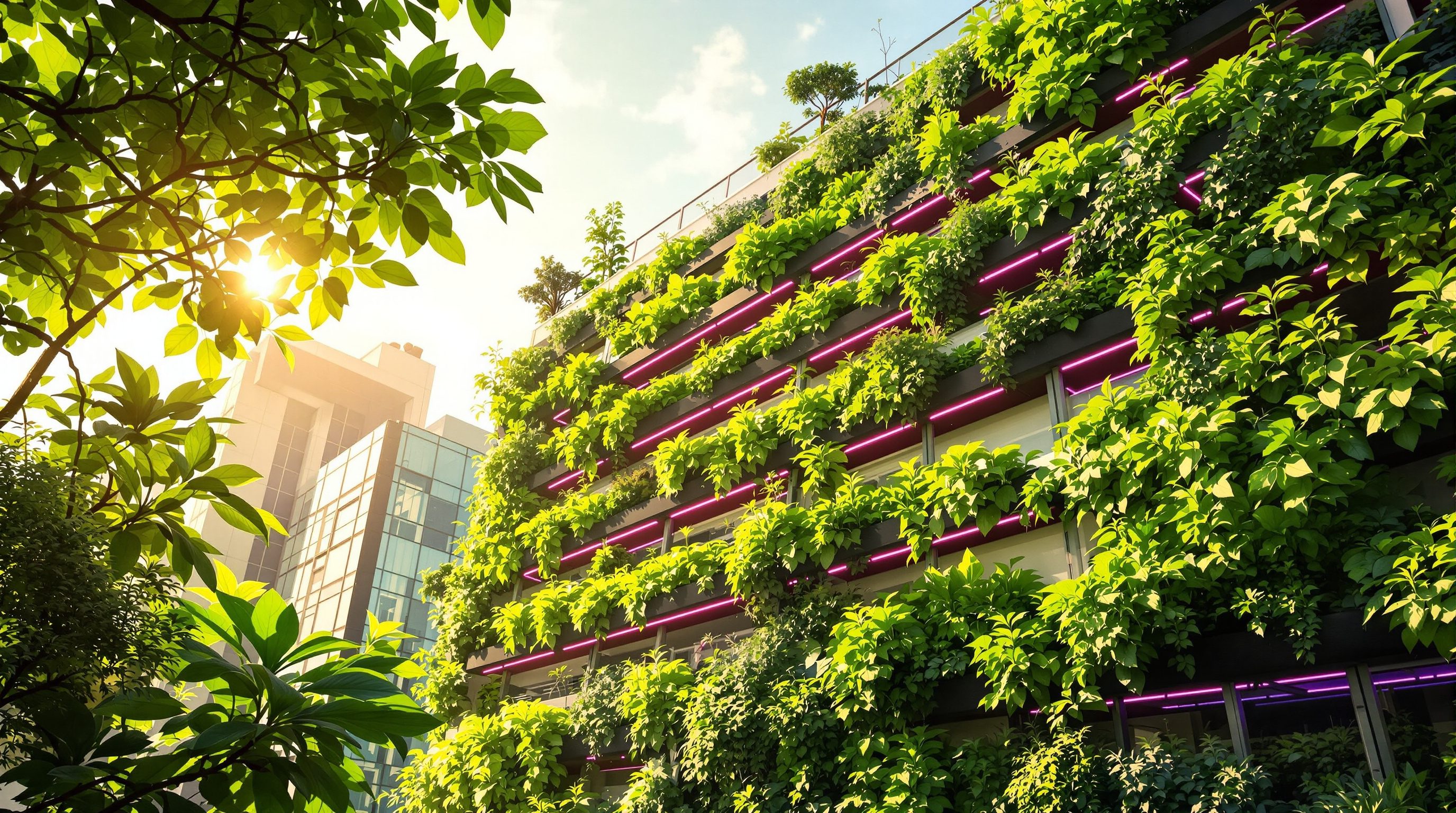
 Lesson 0.2
Lesson 0.2 · Bringing the Farm to the Building
What BIA & Vertical Farming Are
Three overlapping words - urban agriculture, building-integrated agriculture and vertical farming - name a family of ways to grow food in the city, and the single most useful way to read that family is by where the light comes from, from the free sun to the fully electric
Urban agriculture, building-integrated agriculture, vertical farming - the words get used loosely and interchangeably. They are not the same thing, and the difference matters.
The vocabulary of growing food in cities is a muddle. In casual talk - and a great deal of marketing - "urban agriculture", "building-integrated agriculture", "vertical farming", "indoor farming" and "controlled-environment agriculture" get thrown around as if they all mean the same shiny thing: crops glowing under pink LEDs in a stack of trays. They do not. They name a nested family of ideas at very different scales, with very different logic, cost and honesty attached - and a designer who cannot tell them apart cannot reason clearly about any of them. Getting the words right is not pedantry; it is the first act of thinking straight about the whole field.
This lesson defines the terms cleanly and then hands you the one idea that organises them all. Urban agriculture is the wide, old family: growing food in and around cities in any form. Building-integrated agriculture is the part of that family where food-growing is made part of the building itself - on the roof, up the facade, in an attached greenhouse, or in an enclosed indoor farm. Vertical farming is a technique within that - stacking crops in layers to multiply growing area - most associated with the high-tech, enclosed, electrically-lit indoor version. And cutting across all of them is the spectrum this course keeps returning to: from sun-powered growing, where the free sun does the light-work, to fully-lit growing, where electricity buys every photon. Learn the words and that spectrum, and the rest of the course has a frame to hang on.
Nesting: URBAN AG (wide) > BIA (built into building: roof/facade/greenhouse/indoor) > VERTICAL FARMING (stacked, usually indoor electric). Cross-cutting key: SUN-POWERED -> FULLY-LIT. Stacking needs you to supply the light.
Building-integrated agriculture: food-growing made part of the building
Start with the term at the centre of this course. Building-integrated agriculture (BIA) means growing food as an integral part of a building - not on a farm nearby, not in a pot on a windowsill as an afterthought, but designed into the architecture itself so the building hosts food production. The defining word is *integrated*: the growing is part of how the building is conceived, built and run, sharing its structure, its skin, its water, sometimes its warmth and its waste. BIA takes four main physical forms, and it is worth fixing them now because the rest of the course returns to each. On the roof, a rooftop farm or garden uses the large, usually empty flat roofs of city buildings to grow food in soil beds or hydroponic systems under the open sky. Up the facade, an edible wall or productive living wall grows food on the vertical skin of the building, greening it and yielding small harvests. As an integrated greenhouse, a glass or plastic enclosure sits on the roof or terrace or wraps part of the building, extending the season and sheltering crops while still using sunlight. And as an indoor farm, food is grown inside an enclosed, often windowless space within the building, under artificial light and full climate control.
Two things separate BIA from ordinary gardening or a nearby farm. The first is *scale and intent*: BIA aims at meaningful food production designed into the building, not a decorative planter. The second is *engineering entanglement*: because the growing shares the building's structure, waterproofing, drainage, water supply and sometimes its energy and climate systems, BIA is an architectural and engineering problem, not just a horticultural one. A wet, soil-laden or water-based growing system is heavy and must be carried by a roof or floor that was designed for it; water must be supplied, contained and drained without harming the building; and food grown for people to eat brings food-safety obligations. None of these are things a designer resolves alone - the structural loads, waterproofing, water and drainage, electrical and food-safety design belong with qualified engineers and specialists and the governing codes (the National Building Code of India, the relevant IS standards, food-safety regulation). What the designer owns is the vision and the judgement: whether growing food genuinely belongs in this building, in which form, and - the question the next sections sharpen - whether the sun or an electricity meter will be doing the work.
Vertical farming: stacking to multiply area - usually indoors
Vertical farming is the term everyone knows and almost everyone uses loosely, so define it precisely. At its literal root, vertical farming means *growing crops in vertically stacked layers* - trays or shelves or towers, one above another - so that a given floor area yields many times the growing surface it would as a single flat plane. That is the whole of the strict definition: it is a spatial technique for multiplying growing area by going upward, and in principle it could be applied to almost any growing method. In practice, though, the words "vertical farming" have come to mean something much more specific: the high-tech, enclosed, indoor version, in which crops are stacked in a windowless space, lit *entirely* by artificial grow-lights (usually LEDs), grown without soil by hydroponics, with temperature, humidity, carbon dioxide, water and nutrients all precisely managed - in other words, vertical stacking married to controlled-environment agriculture (CEA). That marriage is why the popular image of vertical farming is a clean, glowing cabinet of lettuce in purple light, and why "vertical farm", "indoor farm" and "plant factory" are often used as near-synonyms.
Keeping the strict meaning and the popular meaning apart matters, because the reason vertical stacking is so associated with indoor CEA is itself revealing. You stack crops to multiply area when floor area is scarce and precious - and floor area is scarce and precious precisely inside an expensive, enclosed, artificially-lit building, where every square metre carries a heavy share of rent, structure and, above all, the electricity bill for the lights. Outdoors, under free sunlight on a roof, there is far less pressure to stack, because the sun only reaches the top layer anyway: shade any lower tray from the sun and it will not grow, so real stacking outdoors is limited. Stacking many layers *only makes sense when you are supplying the light yourself*, because then you can put a light above every single layer. So the very feature that defines vertical farming - many productive layers - is bound up with the decision to replace the sun with electricity. This is the first hint of the spectrum that organises everything: vertical farming in its full, stacked, indoor sense lives at the fully-lit, energy-hungry end, and that is not a coincidence but a consequence of what stacking requires. Hold that thought; the fourth section makes it the master key.
Urban agriculture: the wide family it all belongs to
Widen the frame now to the oldest and largest of the three terms. Urban agriculture is simply the growing of food in and around cities, in any form - and unlike BIA and vertical farming it is neither new nor high-tech. It is the vast, ancient family within which the other terms are small, specialised branches. It includes the kitchen garden and the terrace vegetable plot; the community garden and the allotment where city-dwellers rent a patch to grow their own; the market garden and peri-urban farm on the city's edge that supplies its vegetables; the schoolyard plot, the balcony pots, the guerrilla garden on a vacant lot. Most urban agriculture, worldwide and throughout history, has nothing to do with buildings-as-farms or with technology: it is people growing food in the soil of the city, in the open air, under the sun. In India this family is especially alive - the terrace kitchen garden, the courtyard vegetable patch and the potted curry-leaf and chilli plant are a living tradition, not a novelty, and they represent urban agriculture in its most rooted and successful form.
Placing BIA and vertical farming *inside* urban agriculture, rather than treating them as replacements for it, corrects a common distortion. The technology-heavy versions attract the headlines, the investment and the hype, but they are the small, specialised tip of a much larger and more proven whole. A community rooftop garden feeding a neighbourhood, a terrace of vegetable beds, an allotment scheme greening a city - these are urban agriculture succeeding quietly at scale, mostly sun-powered, mostly low-tech, mostly affordable. Building-integrated agriculture is the subset where growing is designed into the building; vertical farming is the further, narrower subset that stacks crops, usually indoors under electric light. Seeing the nesting - urban agriculture containing BIA containing vertical farming - keeps a sense of proportion that the marketing tends to destroy. When someone says "urban farming is the future", the honest response is to ask *which* urban farming: the broad, sunlit, community-rooted family that already works, or the narrow, electric, capital-intensive tip that grabs attention. The rest of this course is largely about telling those apart, and the tool for doing so is the spectrum in the next section.
The organising spine: from sun-powered to fully-lit
Now the single idea that makes sense of the whole family - the organising spine of this entire course. The most useful way to read any way of growing food in buildings is not by its shape (roof, wall, greenhouse, box) or its method (soil, hydroponics) but by where the light energy comes from, arranged as a spectrum from sun-powered at one end to fully-lit at the other. This matters more than any other single distinction because light is the energy that grows a plant: photosynthesis turns light, water and carbon dioxide into food, and light is by far the largest energy input to growing. Whether that light is free sunlight or paid-for electricity therefore governs almost everything downstream - the energy use, the running cost, the sustainability, and which crops can possibly pay their way.
At the sun-powered end sit rooftop farms and gardens, edible facades and integrated greenhouses: the building hosts the growing, but the sun does the fundamental light-work exactly as it does on any farm, for free. These approaches are close in logic to ordinary agriculture and gardening; their energy demand is modest, their economics far gentler, and they can grow a wide range of crops. At the fully-lit end sits indoor vertical farming under controlled-environment agriculture: no sunlight at all, every photon supplied by electric grow-lights, plus electricity for cooling, dehumidification and pumping. In between lie hybrids - a greenhouse that tops up winter daylight with a few hours of supplementary light, a partly-daylit indoor room. A design's position on this line is the best single predictor of its character: the further toward fully-lit, the higher the energy, the higher the cost, the narrower the viable crops (high-value leafy greens and herbs, never staple grains), and the harder the sustainability case, especially on a carbon-heavy grid. This is why the spectrum, not the shape, is the master frame - and why the honest instinct throughout this course is to prefer approaches where the sun does the work, and to treat the fully-lit end with clear-eyed scepticism, reserving it for the narrow cases that genuinely justify replacing free sunlight with expensive electricity. India, rich in sun and terrace tradition, sits naturally at the left of this line; the reasons why fill the next module.
The nested definitions
Urban agriculture, BIA, vertical farming
Urban agriculture is the wide family; building-integrated agriculture is the subset built into the building; vertical farming is the stacking technique, usually fully-lit indoor. Do not use them interchangeably. Modules 0.3, 2, 3, 4.
The sun-to-lit spectrum
The master organiser
Read any approach by where the light comes from - free sun (rooftop, facade, greenhouse) to fully electric (indoor CEA). Position predicts energy, cost, sustainability and crops. Modules 1.3, 3.1, 9.2.
Integration is engineering
Why BIA is not just gardening
Because growing shares the building's structure, waterproofing, water, drainage and services, BIA is an architectural and engineering problem; a wet growing system is heavy. Loads, waterproofing, water, electrical and food-safety design belong to qualified specialists and the codes (NBC India, IS). Modules 5.1, 5.2, 6.4.
Workshop — sort the family and name the light
Precision with the vocabulary is a skill you can practise directly. In this short workshop you will take real examples, place each in the nested family, and - the decisive move - name where its light comes from.
Just this lesson and a notebook. No growing system and no site - this workshop is about clear definitions and the spectrum; the methods, systems, economics and any binding structural, water, electrical and food-safety design come later and stay with qualified engineers and specialists.
Goal: fluency with the terms and the sun-to-lit spectrum
Inputs: 6-8 real or imagined examples of growing food (from a balcony herb pot to a warehouse plant factory) + this lesson
Time: ~35 minutes
- 1List examples: write down 6-8 concrete cases - a terrace vegetable garden, a community allotment, a rooftop farm on an office block, an edible facade, a greenhouse on a school roof, a herb wall in a cafe, a warehouse vertical farm, a peri-urban market garden.
- 2Sort into the family: label each as urban agriculture only, or also building-integrated agriculture, or also vertical farming - and notice how few reach the innermost box.
- 3Name the light: mark each SUN-POWERED or FULLY-LIT (or hybrid), and write one line on why - this is the move that matters most.
- 4Spot the pattern: check whether the fully-lit examples are also the stacked, enclosed, indoor ones, and reason about why stacking and electric light go together.
- 5Write a three-sentence summary: define urban agriculture, BIA and vertical farming in your own words, and state how the sun-to-lit spectrum cuts across all three - flagged as your own reasoning to refine across the course.
You’ll walk away with
A one-page sorted list: each example placed in the nested family and marked on the sun-to-lit spectrum, plus a three-sentence definition of the three terms in your own words. Keep it as your working glossary.
Three altitudes on the same idea
Read the band that fits you — or all three.
For you the words map straight onto decisions: building-integrated agriculture is an architectural problem - food-growing designed into the structure, skin, water and services of the building - and vertical farming is a technique that, in its full stacked-indoor form, drags a huge electrical load in with it. Fix the family in your mind: urban agriculture is the wide field, BIA the subset built into the building (rooftop, facade, greenhouse, indoor), vertical farming the narrower, usually fully-lit, stacked subset. When a client asks for a "vertical farm", establish immediately which end of the sun-to-lit spectrum they mean, because a sunlit rooftop farm and an enclosed electric plant factory are utterly different briefs in load, energy, cost and risk. Own the vision and the judgement of where growing belongs and in which form; hand the binding structural (roof and facade loads for a heavy wet system), waterproofing, water, drainage, electrical and food-safety design to qualified engineers and specialists and the codes (NBC India, IS, food-safety regulation). Your value is refusing to blur the terms - naming exactly what is proposed and where it sits on the spectrum.
Most of what you will actually build lives at the gentle, human end of these terms - a herb wall in a kitchen, salad leaves in a cafe, a small growing unit in a workplace - and the vocabulary helps you be honest about the difference between that and an industrial vertical farm. A windowsill herb planter and a modest grow-light shelf are lovely, achievable interior growing; they are urban agriculture at its most intimate, mostly sun-powered or lightly lit, delightful for wellbeing, biophilia and a real connection to food. "Vertical farming" in its full sense - stacked trays, all-electric lighting, hydroponic CEA - is a different, energy-hungry, specialist world, and calling a herb wall a "vertical farm" oversells it. Learn what grows indoors and what it needs (light above all), and keep the honest distinction: a delightful edible interior is one thing, serious indoor food production quite another. Coordinate the binding water, drainage, electrical, weight and food-safety matters with specialists and the codes; your domain is the green, edible, healthy interior at human scale.
Getting these three words straight is the fastest way to sound like you understand the field rather than the marketing. Memorise the nesting: urban agriculture is the whole family of growing food in cities (mostly old, low-tech, sunlit - kitchen gardens, allotments, community plots); building-integrated agriculture is the subset where growing is designed into the building (rooftop, facade, greenhouse, indoor); vertical farming is the technique of stacking crops in layers, most associated with the enclosed, electrically-lit, hydroponic indoor version. Then learn the one idea that organises them all - the spectrum from sun-powered (the free sun does the light) to fully-lit (electricity buys every photon) - because a design's place on that line predicts its energy, cost, sustainability and crops better than anything else. Notice why stacking and indoor lighting go together: you can only put a light above every layer if you are supplying the light. You are not expected to run a farm; you are expected to use the words precisely and reason with the spectrum.
“Vertical farming, building-integrated agriculture and urban farming are basically the same thing - modern, high-tech ways of growing food in buildings, all meaning crops stacked indoors under LED lights.”
Do it yourself
No tools needed — reason it through.
- 1Define building-integrated agriculture and name its four physical forms.
- 2What is the strict definition of vertical farming, and why has the word come to mean the enclosed, electric-lit indoor version?
- 3Why does stacking crops in many layers only make sense when you supply the light yourself?
- 4How do urban agriculture, BIA and vertical farming nest inside one another?
- 5Why is "where the light comes from" a better organiser than the shape or the buzzword?
The one line to carry out
Peer-reviewed journals & authoritative standards
- 01Building-integrated agriculture — Wikipedia — Building-integrated agriculture, 2026.
- 02Vertical farming — Wikipedia — Vertical farming, 2026.
- 03Urban agriculture — Wikipedia — Urban agriculture, 2026.
- 04Controlled-environment agriculture — Wikipedia — Controlled-environment agriculture, 2026.
With the words defined and the spectrum in hand, we can survey the whole terrain - the approaches, the methods, the people chasing it, and a fast-moving, hype-scarred field. Next, the building-agriculture landscape.
The author
Amogh N P
Architect, interior designer, and creative polymath. Studio Matrx began in his notebooks — his vision of design made honest, useful, and open to everyone. Its Academy is written and taught in his memory, and free, forever.
More about Amogh →