
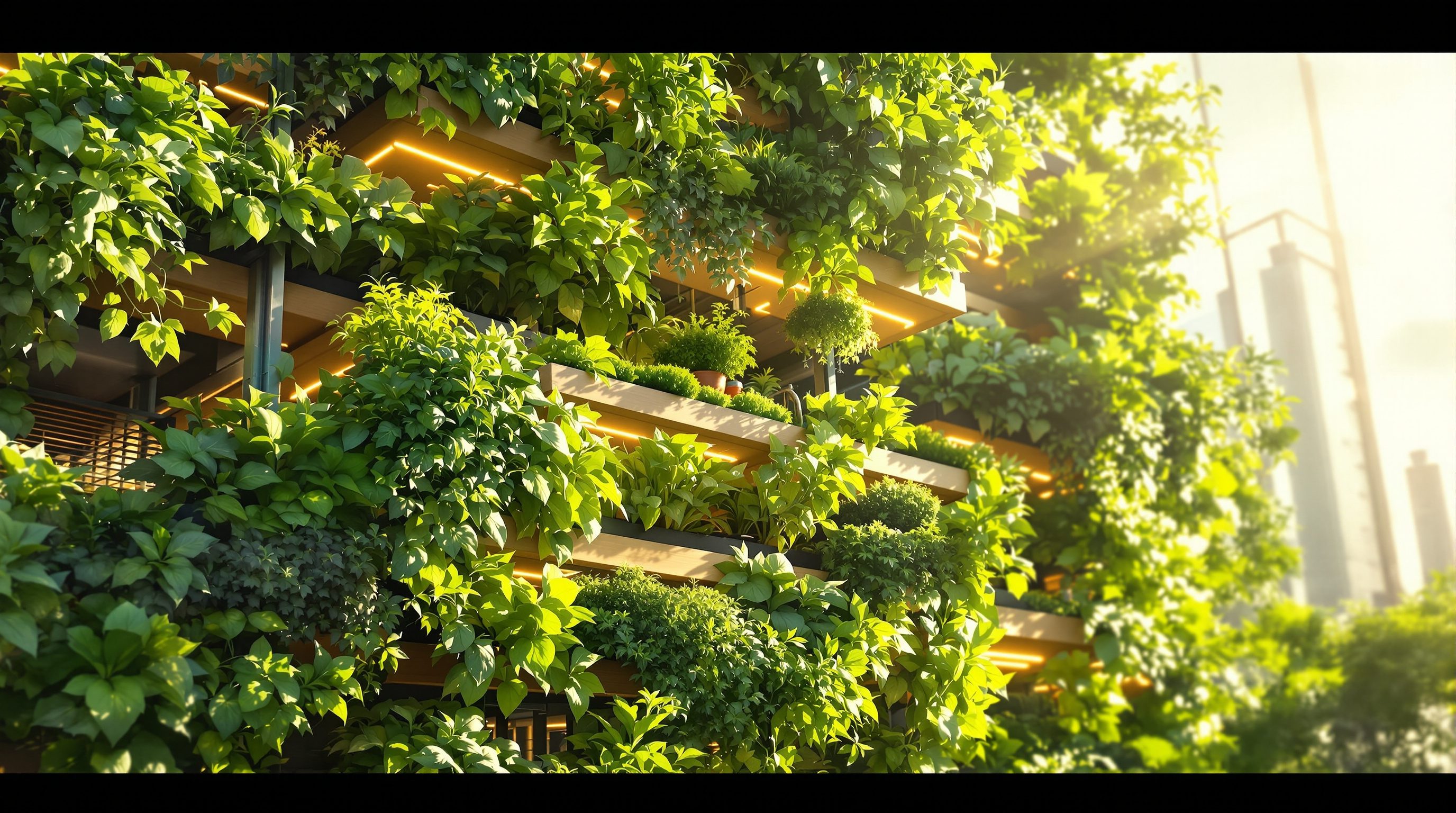
 Lesson 9.1
Lesson 9.1 · Reality, Limits & Honesty
Vertical-Farm-washing: Hype vs Reality
No corner of building agriculture is more oversold than indoor vertical farming, and the glossy promise to feed the world collides hard with a reality of energy bills and bankruptcies - so the first honest skill is learning to read a vertical-farming claim critically
The wall of glowing lettuce promised to feed the world. Then the electricity bill arrived.
Few images in modern architecture are as seductive as the high-tech vertical farm: clean white racks climbing a windowless hall, trays of impossibly green lettuce bathed in pink-purple LED light, a smiling technician with a tablet, and a caption promising to feed cities, end agriculture and save the planet - all from inside a building. It is beautiful, futuristic and hopeful, and for a decade it drew enormous investment, breathless media coverage and bold public claims. The promise was that stacking crops indoors under artificial light would let cities grow their own food locally, sustainably and at scale, making the distant field obsolete.
Then the reality arrived, and it was harsh. Across the world, some of the largest, best-funded, most-celebrated vertical farms went bankrupt or quietly shut down, undone not by bad luck but by an unforgiving number: the cost of the electricity needed to replace the free sun. This lesson is about that gap - between the glossy promise and the recorded reality - and it is not written to sneer. Growing food in buildings has genuine promise. But the specific, heavily-marketed claim that indoor vertical farming will feed the world is the biggest over-promise in the field, and learning to read such a claim critically, before you design around it or invest in it, is the first honest skill of Module 9.
Glossy promise (feed the world, glowing lettuce) vs record (bankruptcies, power bill). Hype engines: money, imagery, optimism, unfamiliarity. Read any claim with 6 Qs: light? crop? yield trick? carbon+grid? profit? could sun do it?
The glossy promise
The marketing of indoor vertical farming has been extraordinarily effective, and it rests on a small set of repeated claims worth naming plainly, because you will meet them in pitch decks, press releases, city plans and even architecture briefs. The headline promise is civilisational: vertical farms will 'feed the world', 'end agriculture', or 'make the farm obsolete' - the idea that stacking crops indoors can replace the distant field at the scale that feeds humanity. Beneath it sit supporting claims. There is the yield claim, usually a startling multiplier - a vertical farm produces '390 times' or 'hundreds of times' more per acre than a field - which sounds like abundance. There is the sustainability claim: because the food is grown locally, in the city, it must be greener, saving the emissions of long-distance transport and the water of irrigated agriculture. There is the resilience claim: food grown indoors is immune to weather, drought, pests and season, so it is the answer to climate change and food insecurity. And there is the technology claim: sensors, artificial intelligence, automation and ever-better LEDs are driving costs down so fast that profitability is always just around the corner.
Each of these claims contains a grain of truth, which is exactly what makes the package so persuasive. Indoor farms genuinely are weatherproof; they genuinely do use less water per kilogram than open-field irrigation; a stacked system genuinely does pack more growing area into a footprint; LEDs genuinely have improved. Wrapped in beautiful imagery - the clean room, the glowing racks, the green abundance - and amplified by investors who need the story to be big, the promise becomes a kind of visual shorthand for 'the future of food'. The imagery does heavy lifting: a photograph of a glowing wall of lettuce feels like proof, even though it shows only that lettuce grows under lights, not that the economics or the energy work. The honest reader's task is not to deny the grains of truth but to notice what the glossy promise consistently leaves out - the crop it can actually grow, the electricity it must actually buy, and whether any of it has ever actually made money without the next funding round.
The reality: closures and bankruptcies
The most powerful correction to the promise is not an argument but a record, and the record of large-scale indoor vertical farming is sobering. Through the late 2010s and early 2020s the sector attracted billions in investment and produced a string of high-profile, heavily-capitalised companies presented as the vanguard of a food revolution. A striking number of them have since gone bankrupt, closed flagship farms, laid off most of their staff, or pivoted away from the original vision. This is not a story of one or two unlucky firms; it is a pattern across the best-funded names in the industry, which is what makes it evidence rather than anecdote. When the leaders of a field, with the most capital and the best technology, cannot make the model work, the problem is structural, not managerial.
The cause of the failures is remarkably consistent, and it is the theme of this whole module: energy cost. An indoor farm must pay, in electricity, for all the light energy the sun gives a field for free, plus more electricity to remove the heat those lights create, to dehumidify the moist air the plants transpire, and to run the pumps and controls. That power bill is not a rounding error; it is frequently the single largest operating cost, and it does not fall much with scale, because more crops need proportionally more light. The result is food that is expensive to produce, competing against field-grown and greenhouse-grown produce that is far cheaper, in a low-margin business. Many farms stayed afloat only on continued investment, not on selling food at a profit, and when the cheap capital of the low-interest-rate era dried up, the underlying economics were exposed and the farms folded.
The honest reading of this record is careful, not gleeful. It does not prove that all indoor farming is worthless - some smaller, focused operations selling premium herbs or greens into the right markets do survive, and the technology continues to improve. But it decisively refutes the grand promise. A sector that repeatedly bankrupts its own champions has not found the way to feed the world; it has run, at enormous expense, a real-world experiment whose main finding is that replacing the sun with electricity is very hard to afford. Treat the bankruptcies as data, and let them calibrate every future claim.
Why the hype persists
If the record is so clear, why does the hype survive? Understanding this protects you from repeating it. Part of the answer is money: the sector was built on venture capital, which rewards a big, world-changing story over a modest, honest one. A pitch that says 'we will feed the world' raises more than one that says 'we can sell premium basil to nearby supermarkets at a small margin if power is cheap', so the incentive structure actively selects for over-promising. When investors, founders and their communications teams all need the story to be enormous, the story becomes enormous, and the caveats fall away.
Part is the imagery, which is genuinely powerful and genuinely misleading. A wall of glowing greens photographs beautifully and reads instantly as progress, abundance and cleanliness. It looks like the future, and looking like the future is not the same as being economically or thermodynamically sound - but the eye does not know that. Architecture is especially vulnerable here, because the productive, glowing, living building is such an attractive vision that it is tempting to design the picture and hope the numbers follow. Part is genuine, admirable techno-optimism: many people in the field sincerely want to fix a broken food system and reconnect cities to food, and that good motive can make uncomfortable numbers easy to wave away with 'the technology will improve'. And part is simple unfamiliarity - most people, including many decision-makers, have never been asked to think about how much energy sunlight actually delivers to a field for free, so the scale of what an indoor farm must replace is invisible to them.
The antidote is not cynicism, which is just a different way of being lazy. The cynic who says 'it is all a scam' is as wrong as the enthusiast who says 'it will feed the world', because both refuse to look at the specific case. The honest stance holds two things at once: growing food in buildings has real value, and the specific grand claim for indoor vertical farming is unsupported by its own record. Naming the four engines of hype - the money, the imagery, the optimism and the unfamiliarity - lets you feel their pull and still ask the plain questions the next section sets out. That is what separates a professional from a believer.
How to read a vertical-farming claim critically
The practical payoff of this lesson is a short set of questions you can put to any vertical-farming claim - a news story, a product pitch, a client's aspiration, a competition entry - that cuts through the imagery to what matters. Ask them in order, and most inflated claims deflate on the first two.
First: where does the light come from? This is the master question of the whole course. If the plants are lit by the free sun (rooftop, greenhouse, facade), the economics and sustainability are usually reasonable. If they are lit entirely by electricity, everything else is downstream of a very large energy bill, and the claim must justify that bill. Second: what crop is it, really? A claim about 'feeding the city' that quietly shows only lettuce, herbs and microgreens is describing garnish, not the grains, pulses, roots and oils that are actual calories - a point Lesson 9.3 makes decisive. Third: is the yield figure honest? A 'hundreds of times per acre' multiplier usually counts stacked layers and continuous cropping, not real output per unit of energy or money - it is a stacking trick, not abundance. Fourth: how is 'carbon' or 'sustainable' being counted? If the claim credits saved transport but omits the grid electricity burned to replace the sun, it is not a real life-cycle comparison, and 'local' does not mean 'low-carbon' when the grid is dirty. Fifth: does it make money selling food, or is it funded by the next investment round? Ask about profitability, not just revenue or growth. Sixth, and summarising: could a rooftop or a greenhouse do the same job with the free sun?
Applied together, these questions do not automatically condemn indoor farming - a claim that answers them well (a high-value crop, cheap clean power, a real market, honest accounting, an actual profit) may describe a genuinely sound niche operation. But they reliably expose the vertical-farm-washing: the glossy, well-funded promise that dodges energy, crop and profit while showing you a beautiful glowing wall. In India especially, where electricity is costlier and often more carbon-heavy and crop premiums lower, apply the questions harder still. Reading a claim this way is not scepticism for its own sake; it is the professional discipline that lets you back the growing-in-buildings ideas that genuinely work and decline the ones that only photograph well.
The six questions
Testing any vertical-farming claim
Light source? Real crop? Honest yield (not a stacking trick)? Carbon counted with the grid, not just transport? Profitable, or funded by the next round? Could the sun do it? Apply in order; most inflated claims deflate on the first two. Lessons 9.2, 9.3, 9.4.
Bankruptcies as data
Weighing the sector's record
A pattern of the best-funded, most-advanced indoor farms failing is structural evidence, not bad luck - it refutes the grand promise while leaving room for narrow, honest niche use. Treat the record as data, not as either proof of a scam or a temporary glitch.
Local is not low-carbon
Sustainability claims
A real comparison is life-cycle (Wikipedia: Life-cycle assessment), counting the grid electricity burned to replace the sun, not just the transport saved. On a dirty grid, indoor food can be far worse than a distant field. Lesson 9.2.
Binding results to specialists
Any real project
Even a claim that survives the questions still defers the structural (roof/facade loads), electrical, water, drainage, food-safety and horticultural design to qualified engineers and specialists, verified data and the governing codes (NBC India, IS, food-safety regulation). Figures here are illustrative.
Workshop - audit a real vertical-farming claim
The skill of this lesson is critical reading, so this workshop is a live audit: take a real claim from the world and put it through the six questions until its true shape appears.
Just a real claim and a notebook - the tool is critical reading, not a growing system. Any energy, yield or cost figure you note is illustrative; the binding structural, electrical, water and food-safety judgement always stays with qualified engineers and specialists.
Goal: turn a glossy claim into a testable one
Inputs: one real vertical-farming article, pitch, ad or city plan + this lesson + a notebook
Time: ~40 minutes
- 1Find a claim: pick a genuine vertical-farming story - a news article, a company's website, an advertisement, a competition entry or a city food plan - that makes a positive claim about growing food indoors.
- 2List its promises: write down exactly what it claims - feed the city, sustainable, high-yield, local, weatherproof, profitable - in the claim's own words, including the imagery it uses.
- 3Run the six questions: for each, answer honestly from the evidence given - where is the light from, what crop really, is the yield a stacking trick, is carbon counted with the grid, is it actually profitable, and could a rooftop or greenhouse do it with free sun?
- 4Mark the gaps: highlight every question the claim cannot answer from its own evidence - these silences (usually energy, crop and profit) are where the vertical-farm-washing lives.
- 5Write a verdict: in one honest paragraph, state what the claim genuinely supports (often: a high-value crop can be grown indoors) versus what it over-promises (often: feeding the city), and what a sun-powered alternative would offer - flagged as reasoning, with binding engineering left to specialists.
You’ll walk away with
A one-page claim audit: the promises, the six-question answers, the gaps, and an honest verdict separating what is supported from what is oversold. Keep it as a template for reading the next claim.
Three altitudes on the same idea
Read the band that fits you — or all three.
You will be handed the glowing-vertical-farm image as a brief - a client, a developer or a competition wanting the productive, futuristic building - and your value is to test it before you design it. Put the six questions to the proposal: where is the light coming from, what crop, is the yield claim a stacking trick, how is carbon counted, does it profit, and could a rooftop or greenhouse do it with free sun? Most 'feed the building' ambitions resolve, on honest questioning, into a sun-powered rooftop farm or integrated greenhouse that actually works, plus perhaps a small indoor unit for a high-value crop. Design the version that survives the questions, not the render that photographs best, and keep the binding structural, electrical, water and food-safety design with qualified engineers and specialists. Championing an over-promised indoor farm that later fails is a reputational risk; championing the honest, sun-powered version that quietly works is the professional win.
The hype reaches interiors as the glowing indoor herb wall or salad cabinet sold as a sustainability statement - and a small, honest version can be genuinely lovely, so your job is to keep it honest. A modest herb wall by a window, or a small grow-light unit for salad leaves and microgreens in a cafe or workplace, brings real delight, biophilia and connection to food, and its energy use is trivial. The problem is only the marketing leap from that to 'we grow our own food sustainably' at meaningful scale, which the numbers do not support. Specify the delightful, small, mostly-daylit version; be honest with clients that it is an ingredient and an experience, not a food supply; and coordinate water, drainage, electrical and food-safety details with specialists. The critical eye protects both the client and the genuine charm of small edible interiors from being oversold and then disappointing.
Learning to read a vertical-farming claim critically is one of the most transferable skills this course offers - it is critical thinking about technology, applied to a field drowning in hype. Hold the two truths together: growing food in buildings has real promise, and the grand claim that indoor vertical farming will feed the world is refuted by its own record of bankruptcies. Avoid both the believer ('it will change everything') and the cynic ('it is all a scam') - each refuses to look at the specific case. Instead memorise the six questions - light source, crop, yield trick, carbon accounting, profitability, and whether the sun could do the job - and practise applying them to real headlines. Understanding why the hype persists (money, imagery, optimism, unfamiliarity) makes you harder to fool. This clear-eyed, evidence-first habit will mark you out, in this field and any other full of shiny promises.
“Vertical farming is the future of food - the technology is advancing so fast, and the systems are so productive and sustainable, that stacking crops indoors under LEDs will soon feed cities locally and make traditional farming obsolete. The bankruptcies are just early growing pains that better technology will fix.”
Do it yourself
No tools needed - reason it through.
- 1Name three claims in the glossy vertical-farming promise, and the grain of truth each contains.
- 2Why are the sector's bankruptcies evidence of a structural problem rather than bad luck?
- 3List the four engines that keep the hype alive despite the record.
- 4Give the six questions for reading a vertical-farming claim critically, in order.
- 5Why is the cynic who says 'it is all a scam' as wrong as the enthusiast who says 'it will feed the world'?
The one line to carry out
Peer-reviewed journals & authoritative standards
- 01Vertical farming — Wikipedia - Vertical farming, 2026.
- 02Controlled-environment agriculture — Wikipedia - Controlled-environment agriculture, 2026.
- 03Plant factory — Wikipedia - Plant factory, 2026.
- 04Local food — Wikipedia - Local food, 2026.
- 05Life-cycle assessment — Wikipedia - Life-cycle assessment, 2026.
The six questions all circle one master issue that the next lesson meets head-on and in full: energy. Why does replacing free sunlight with electric grow-lights change everything - and what do the numbers actually say?
The author
Amogh N P
Architect, interior designer, and creative polymath. Studio Matrx began in his notebooks — his vision of design made honest, useful, and open to everyone. Its Academy is written and taught in his memory, and free, forever.
More about Amogh →