
 Lesson 5.3
Lesson 5.3 · The Building Systems
Energy & Lighting
The energy elephant returns as a building system - a sun-powered farm sips electricity for pumps and controls, while a fully-lit indoor farm must buy, as power, every bit of light the sun gives free, plus the cooling to remove the heat those lights make, which is the single fact that decides where indoor growing can ever pay
Sun-powered growing runs on a few pumps. A fully-lit indoor farm runs on a power station - that is the whole story.
By now the course's central truth is familiar: a plant grows on light energy, and where that light is the sun it is free, while where it must be electric it is expensive. This lesson is where that truth stops being an idea and becomes a building system - a set of cables, meters, transformers, lights, chillers and pumps that someone has to size, supply and pay for. And when you look at building agriculture through the electrical meter, the sun-to-lit spectrum splits into two utterly different worlds.
At one end, a sun-powered rooftop farm, edible facade or greenhouse needs only a modest trickle of electricity - enough to run some pumps, a few fans, and the controls. It is, in energy terms, a small building service, easily covered and, in sunny India, easily run from rooftop solar. At the other end, a fully-lit indoor vertical farm needs electricity for everything: it must replace the entire sun with grow-lights, then spend more electricity cooling the heat those lights make, more dehumidifying the moisture the plants release, and more running the pumps and controls. That is the energy elephant, standing in the plant room, and it is the single fact that decides whether an indoor farm can ever pay. This lesson looks the elephant in the eye as an engineering reality - and, as always, defers the binding electrical design to the qualified engineer.
Energy elephant as a building system. Sun-powered: free sun + tiny electricity (pumps/controls) -> rooftop solar covers it (great for India). Fully-lit indoor: ALL light as grow-lights (biggest) + cooling (lights = heat, pay twice) + dehumidify + pumps = torrent -> expensive, bankruptcies, only low-carbon if power is clean, dies on power cut. Prefer sun-powered + clean power. Engineer designs it.
The energy split: a trickle versus a torrent
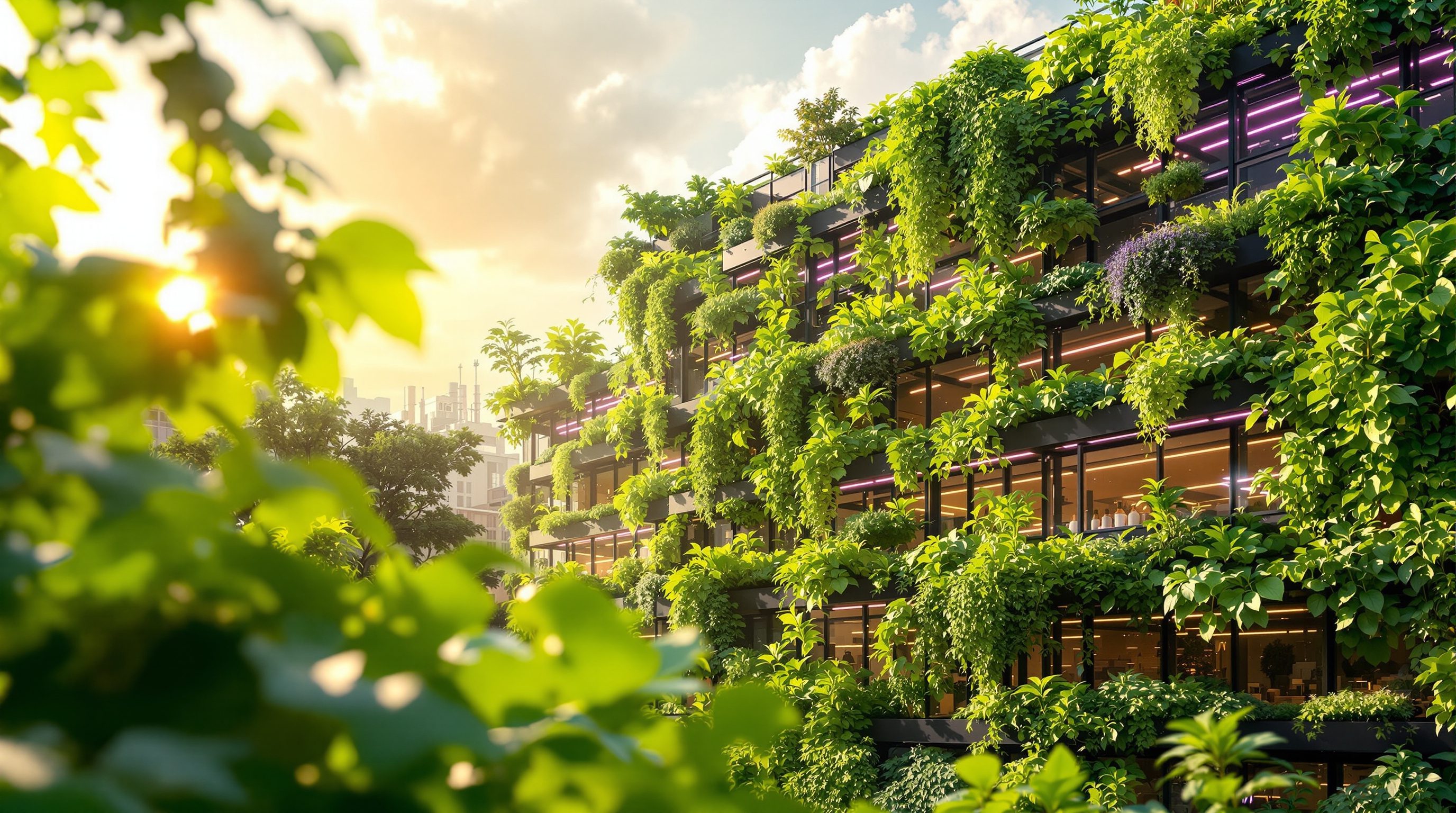
Everything about energy in building agriculture flows from one comparison, so start there. A sun-powered growing system - a rooftop farm, a terrace garden, an edible facade, a daylit greenhouse - gets the vast energy of light for free from the sun, exactly as plants have always done. What it needs electricity for is comparatively tiny: pumps to move irrigation water and, in hydroponic systems, to circulate nutrient solution; perhaps some fans for ventilation; sensors, timers and controls; a little lighting for people. In energy terms this is a minor building service, of the same modest order as running some pumps and controls anywhere in a building - and in a sunny country it can often be met from a small rooftop solar array, so that the sun both grows the plants and makes the little electricity the system needs.
A fully-lit indoor vertical farm is a completely different animal. It grows crops in an enclosed, often windowless space with no sunlight at all, which means it must supply, as electricity, *all* of the light energy the sun would otherwise give free - through banks of grow-lights running many hours a day. That alone is a large, continuous electrical load. But it does not stop there, and this is the part people miss: the lights convert almost all their electricity into heat, so the enclosed space heats up and must be actively cooled; the plants transpire water, so the humid air must be dehumidified; and the water and nutrients must be pumped and the whole environment controlled. Each of these is more electricity, and cooling in particular is large precisely because the lighting is large - you pay once to make the light, and again to remove the heat it becomes.
So the split is not a matter of degree but of kind. Sun-powered growing is a trickle of electricity; fully-lit indoor growing is a torrent. This is the energy elephant expressed as a building's electrical demand, and it is why, throughout this course, the honest counsel is to prefer sun-powered approaches wherever they work - because they let the sun, not the meter, do the expensive part. Where a design sits on the sun-to-lit spectrum decides its energy demand more than any other single choice, and energy demand, in turn, decides cost, sustainability and viability.
Sun-powered: free sunlight + tiny electricity (pumps, controls) = trickle. Fully-lit indoor: ALL light as electricity + cooling (lights = heat) + dehumidify + pumps = torrent. Not a difference of degree - a difference of kind. Prefer sun-powered.
Inside the indoor farm's electrical load
It is worth breaking the indoor farm's demand into its parts, because doing so shows why it is so stubbornly large and where the money goes. The dominant load is lighting. Photosynthesis needs a real intensity of light over many hours, and supplying that entirely from grow-lights - even efficient LEDs - is inherently energy-hungry, because you are recreating, artificially and continuously, the output of the sun across a whole growing area. LED efficiency has improved a great deal and continues to, which genuinely helps, but it cannot repeal the basic fact that replacing sunlight with electric light over a productive area takes a lot of electricity. Lighting is typically the single biggest slice of an indoor farm's energy bill.
The second big load is cooling, and it is large for a revealing reason: almost all the electrical energy that goes into the lights comes back out as heat. An enclosed room packed with grow-lights running for many hours becomes hot, and if crops are to stay in their comfortable range that heat must be removed by air conditioning or chillers - which run on yet more electricity. This is the cruel doubling at the heart of indoor farming: you pay to put light energy in, and you pay again to take the resulting heat energy out. The hotter the climate outside - much of India, for instance - the harder and costlier that cooling becomes.
Then there is dehumidification: plants transpire constantly, filling the sealed air with moisture that must be removed to prevent disease and keep conditions right, again using energy. And there are the pumps and controls - circulating nutrient solution, moving air, running sensors and automation - a smaller but constant draw. Add these together and you have a facility with a large, continuous electrical demand that needs a substantial electrical service: supply capacity, distribution, and often standby provision. The exact proportions vary by system and are engineering figures, not fixed numbers - but the shape is always the same: lighting dominant, cooling large and driven by the lighting, dehumidification and pumps behind. This load profile is precisely why indoor-farmed food is expensive, why the electricity bill can dwarf every other cost, and why the sector has seen so many well-funded businesses fail. The sizing and design of all of it is the electrical and services engineer's binding work.
Lighting = biggest load (recreating the sun over the whole area). Cooling = large because lights become heat (pay twice!). Dehumidify (plants transpire). Pumps + controls. Hotter climate = costlier cooling. = expensive food, many bankruptcies. Electrical engineer sizes it.
Sun-powered energy needs: modest, real, and often solar
Turn back to the sunny end of the spectrum, because the honest message is not just 'indoor is expensive' but 'sun-powered is genuinely cheap to run', and that positive point deserves its own attention. A rooftop farm or greenhouse still needs some electricity, and it should be designed properly - but the demand is modest and manageable. The main draw is pumps: moving irrigation water up to and around the growing area, and in hydroponic rooftop systems, circulating the nutrient solution. Beyond that there are controls and sensors, perhaps fans for greenhouse ventilation, and task lighting for people working early or late. None of this is trivial to design, but all of it is small in energy terms compared with the torrent an indoor farm demands - it is an ordinary, modest building service.
This modest demand opens a genuinely attractive possibility, especially in India: powering the growing system's electricity from rooftop solar. A building with a sunny roof suitable for growing is, by definition, a building with a sunny roof suitable for solar panels, and the amounts of electricity a sun-powered farm needs are well within what a modest array can supply. The result is a lovely closed logic: the sun grows the plants directly, and the sun also makes the small amount of electricity the pumps and controls require, so the whole productive system runs on daylight. In a country with abundant year-round sunshine, high solar potential, and a strong policy push on rooftop solar, this pairing of sun-powered growing with rooftop solar is close to ideal - low-carbon, low running cost, and resilient.
There is a resilience angle too. Because a sun-powered farm's electrical demand is small, keeping it running through a power cut is comparatively easy - a modest battery or the tolerance of plants to a short interruption in pumping - whereas an indoor farm loses its entire light and cooling supply the moment the power fails, with the crop at immediate risk. The contrast reinforces the theme: sun-powered growing is not only cheaper to run but simpler, more robust and more forgiving as a building system. Its electrical design is still real work for the services engineer - correct pump sizing, safe wiring, any solar integration - but it is modest, ordinary work, not the extraordinary demand of the fully-lit farm.
Sun-powered electricity = modest: mostly pumps + controls + some fans. Sunny roof for growing = sunny roof for SOLAR. Sun grows plants AND powers the pumps. India: abundant sun = near-ideal. Bonus: small load = easy to keep running in a cut (indoor farm dies instantly).
Clean power, resilience, and deferring the design
Two final points turn energy from a cost question into a design and ethics question. The first is where the electricity comes from, which decides whether indoor growing is even defensible on sustainability grounds. Because a fully-lit indoor farm consumes so much electricity, its carbon footprint is dominated by the carbon intensity of that power. Run on cheap, clean, renewable electricity, an indoor farm's enormous energy use is at least low-carbon; run on fossil-fuelled grid power, the same farm can be far worse for the climate than field or greenhouse growing, easily swamping the transport emissions it claims to save - 'local' does not mean 'low-carbon' when you are burning coal-heavy electricity to replace free sunlight. In India, where grid electricity is relatively expensive and often carbon-heavy, this makes energy-hungry indoor farming especially hard to justify for most crops, and makes the case for preferring sun-powered growing (and clean power) stronger still.
The second point is resilience. Growing is a living process that does not pause: an indoor farm whose power fails loses its light, cooling and dehumidification at once, and a crop can be damaged or lost quickly - so serious indoor farms need standby power and careful electrical reliability, which is more cost and complexity. Even sun-powered systems need their pumps to keep water moving, though they are far more forgiving. Reliability, backup and fail-safe behaviour are part of the electrical design, not extras.
All of which leads, as every lesson in this module does, to a firm deferral. The electrical and lighting design of a growing system - the load calculation and service sizing, the distribution and wiring, the grow-light selection and layout for an indoor farm, the cooling and dehumidification plant, any solar integration, the standby provision, and above all the electrical safety, made more critical by the constant presence of water - is a binding engineering result for a qualified electrical and services engineer, working to the wiring and electrical codes and the National Building Code of India. Nothing here is a specification; the figures are illustrative and the shape is the lesson. The competent stance is to face the energy question first (as the whole course insists), strongly prefer sun-powered growing and clean power, reserve fully-lit indoor farming for the narrow cases that genuinely justify its torrent of electricity, and hand the binding design to the engineer.
The energy split
Sun-powered vs fully-lit
Sun-powered growing needs only modest electricity (pumps, controls); a fully-lit indoor farm needs an enormous, continuous load (grow-lights, cooling, dehumidification, pumps). Position on the spectrum decides energy demand, cost and viability. The energy elephant, as a building system.
Lighting drives cooling
Why indoor load is so large
Grow-lights are the biggest load, and almost all their electricity becomes heat that must be actively cooled away - so lighting drives a large cooling load too. You pay to make the light and again to remove the heat. Hotter climates make cooling costlier.
Clean power and carbon
Whether indoor growing is defensible
An indoor farm's carbon is dominated by the electricity's carbon intensity. Clean power makes it at least low-carbon; fossil-heavy grid power can make it worse than field growing. In India's costly, carbon-heavy context, prefer sun-powered growing and clean power.
Electrical design and safety
Sizing, standby, safety near water
Load calculation, service sizing, grow-light and cooling plant, standby power and electrical safety (critical with water everywhere) are binding results for a qualified electrical and services engineer, to the wiring codes and NBC India. Figures here are illustrative.
Workshop - put a growing idea on the energy meter
Energy becomes real when you reason about what a growing idea would actually draw from the meter. In this workshop you will take two contrasting ideas and reason through their electrical demand - purely to feel the split, with the binding calculation reserved for the engineer.
Just a building you know and a notebook. This is a reasoning exercise about the energy split; the binding electrical, lighting, cooling and safety design - loads, sizing, wiring, standby, solar integration - always stays with a qualified electrical and services engineer working to the wiring codes and NBC India.
Goal: feel the gulf between sun-powered and fully-lit energy demand
Inputs: this lesson + a notebook + a building you know
Time: ~40 minutes
- 1Pick two ideas: choose a sun-powered idea (a rooftop or terrace farm) and a fully-lit idea (a small windowless indoor grow-room) for a building you know.
- 2List the loads: for each, write down every thing that would need electricity - and for the indoor one, be sure to include lights, cooling (because lights make heat), dehumidification, and pumps.
- 3Rank and compare: mark the biggest load in each case, and note how the sun-powered list is short and small while the indoor list is long and dominated by lighting-plus-cooling.
- 4Check the sun and the source: for the sun-powered idea, note whether the roof could carry solar panels to power its modest demand; for the indoor idea, note that its carbon depends entirely on how clean the electricity is.
- 5Write the honest verdict: in one paragraph, say which idea faces the energy elephant and why, whether the indoor idea could be justified (crop value, clean cheap power), and what an electrical engineer must design and confirm - framed as reasoning, never as a specification.
You’ll walk away with
A one-page energy comparison: the load lists for a sun-powered and a fully-lit idea, the biggest load in each, the solar and carbon notes, and an honest verdict on the energy elephant plus what the engineer must confirm. Keep it - it is the energy honesty at the heart of the course.
Three altitudes on the same idea
Read the band that fits you — or all three.
Read every food-growing idea through the electrical meter, because energy demand splits the sun-to-lit spectrum into two different buildings. A sun-powered rooftop farm or greenhouse is a modest building service - pumps, controls, a few fans - readily met, in sunny India, from rooftop solar, giving a low-carbon, low-cost, resilient system where the sun both grows the plants and powers the pumps. A fully-lit indoor farm is the energy elephant made physical: grow-lights recreating the whole sun over the growing area (the dominant load), plus large cooling because those lights become heat (you pay twice), plus dehumidification and pumps - an enormous, continuous demand that needs a substantial electrical service and standby power, that makes indoor food expensive, and whose carbon depends entirely on the grid's cleanliness. In India's costly, often carbon-heavy power context, that case is especially hard. Design to prefer sun-powered growing and clean power, reserve indoor farming for the narrow justified cases, integrate rooftop solar early, and defer the binding electrical, lighting, cooling and safety design (critical near water) to the electrical and services engineer and the codes (NBC India, wiring regulations).
Indoor growing means grow-lights, and grow-lights mean electricity and heat - so be honest about the scale of what you are specifying. A herb wall by a bright window or under a modest LED strip is a small, delightful electrical addition; growing serious quantities of food indoors under full artificial light is the energy-hungry, specialist territory the whole course is honest about, with real lighting, cooling and dehumidification loads that belong to engineers, not to a plug-in fixture. For the interior scale you will usually work at, favour daylight wherever it reaches, use efficient LED grow-lights only to supplement, keep the installation modest, and remember that lights make heat and sit near water - both electrical-safety matters. Choose good, efficient fixtures, put them on sensible controls, and coordinate any real electrical load, cooling implication and the ever-present water-and-electricity safety question with the services engineer. Your domain is the green, edible, human-scaled interior lit sensibly and safely; be candid with clients that a glowing wall of lettuce, at scale, carries an energy bill, and design accordingly.
Energy is the whole course's central truth turned into a building system, and this lesson is where you see it as cables, lights, chillers and pumps. Learn the split cold: a sun-powered farm (rooftop, greenhouse, facade) needs only a trickle of electricity - pumps, controls, some fans - often coverable by rooftop solar, so the sun grows the plants and powers the system; a fully-lit indoor farm needs a torrent, because it must supply all the light as grow-lights (the biggest load), then cool the heat those lights make (paying twice), then dehumidify what the plants transpire, then pump and control everything. That load profile is why indoor food is expensive and why so many indoor farms go bankrupt. Then learn the two twists: the carbon of an indoor farm depends entirely on how clean the electricity is (fossil power can make it worse than a field), and an indoor farm dies fast when the power fails, so it needs backup. In India's sunny, costly-power context, prefer sun-powered growing and clean power. You are not expected to size the electrics; you are expected to understand the energy split, respect the elephant, and know the binding design belongs to electrical and services engineers and the codes.
“LED grow-lights have become so efficient that the energy problem of indoor vertical farming is basically solved - cheap, efficient LEDs plus some solar panels mean you can now grow food indoors, anywhere, at low energy cost. The old worries about power are out of date.”
Do it yourself
No tools needed - reason it through.
- 1Contrast the electrical demand of a sun-powered farm with that of a fully-lit indoor farm, and say why it is a difference of kind, not degree.
- 2Explain why cooling is a large load in an indoor farm, and what is meant by 'paying twice' for the light.
- 3Why is pairing sun-powered growing with rooftop solar an especially good fit for India?
- 4Why does the carbon footprint of indoor farming depend so heavily on where the electricity comes from?
- 5What makes an indoor farm fragile when the power fails, and why is a sun-powered farm more forgiving?
The one line to carry out
Peer-reviewed journals & authoritative standards
- 01Grow light — Wikipedia - Grow light, 2026.
- 02Energy intensity — Wikipedia - Energy intensity, 2026.
- 03Solar energy — Wikipedia - Solar energy, 2026.
- 04Light-emitting diode — Wikipedia - Light-emitting diode, 2026.
- 05Electricity pricing — Wikipedia - Electricity pricing, 2026.
Weight, water and energy are the three great physical demands a growing system makes on a building. The last piece is how the growing system and the building's environment interact - heat, humidity, air, and the genuine cooling and greening a rooftop farm can give back. Next: environmental integration.
The author
Amogh N P
Architect, interior designer, and creative polymath. Studio Matrx began in his notebooks — his vision of design made honest, useful, and open to everyone. Its Academy is written and taught in his memory, and free, forever.
More about Amogh →