
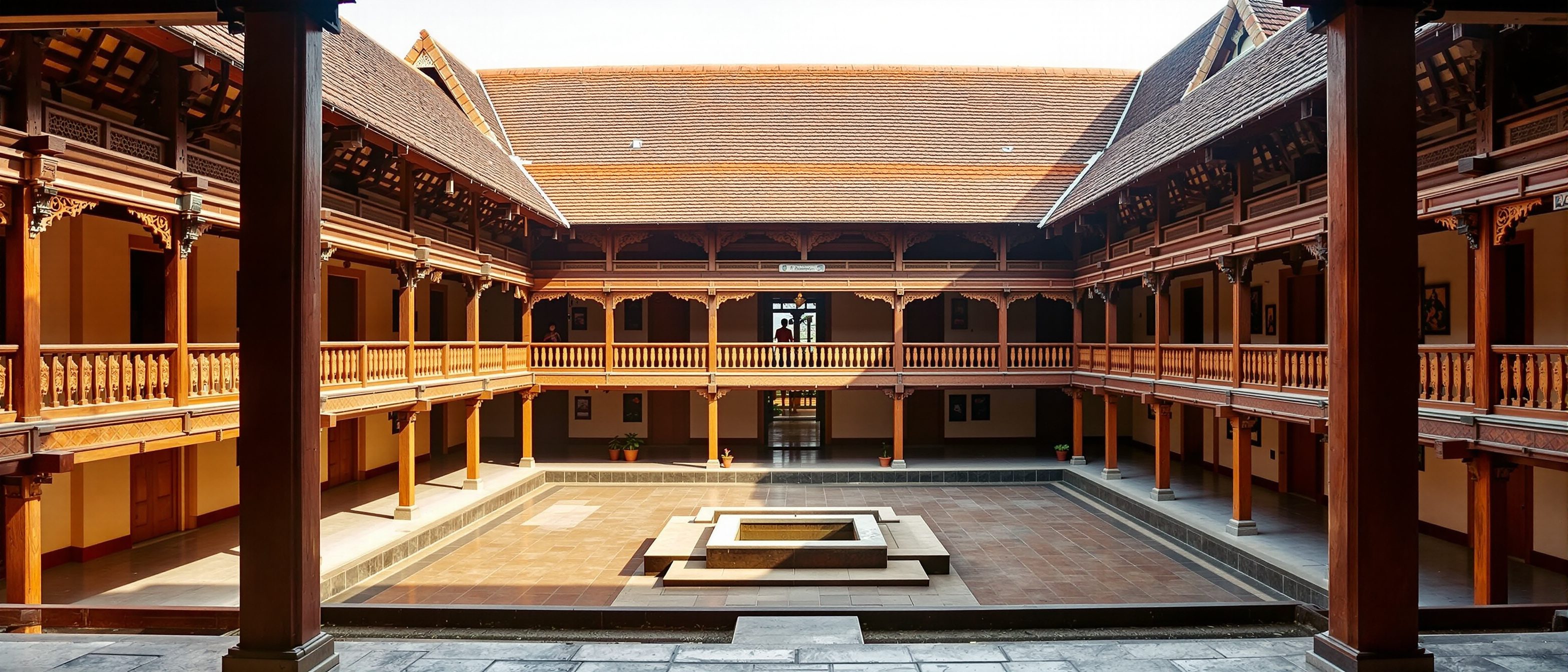
Measurement, Proportion & Planning
The cubit, the ayadi numerology, and the courtyard house.
Traditional Indian measure is anthropomorphic — built up from the angula (finger) to the hasta (cubit), the working design module, keeping buildings human-scaled. Learn the units and the tala proportional system; the ayadi/aaya-shadvarga checks (the traditional numerological dimensioning method, taught accurately and named as such); the directional zoning of the house (kitchen SE, water NE, master SW) with its climate reading; and the courtyard house — the clearest case of tradition and building science coinciding.
Learning objectives
By the end of this lesson, you will be able to — mapped to the course outcomes for Vastu & Traditional Indian Architecture:
Explain the anthropomorphic units (angula, hasta) and the tala proportional system.
Describe the ayadi/aaya-shadvarga checks and name them as numerology.
Apply directional room zoning and read the climate logic of each placement.
Separate the recoverable modular proportion and climate zoning from the belief layer.
Measure & proportion
Body-derived units keep buildings human-scaled (recoverable craft); the ayadi auspicious checks are numerology, taught accurately and named as belief.[1, 2]
Angula to hasta
Measure is derived from the body, keeping proportion human-scaled. The base unit is the angula (finger-breadth); a common scheme is 8 yava (barley-grains) ≈ 1 angula, 12 angula ≈ 1 vitasti (span), 2 vitasti ≈ 1 hasta (the cubit, elbow-to-fingertip) — the principal working module. (Exact ratios VARY by text and region — the 24-angula hasta is common but not universal.)[1, 2]
Directional planning & the courtyard
The house zoned by direction is mostly sound climate design; the courtyard house is where tradition and building science coincide.[1, 5]
The house by direction
Canonical room placement follows the directional scheme, and most reads as sound climate zoning: kitchen SE (Agni → morning light + heat/smoke exhaust), water/well NE (purity → water in the cool, gently-lit, draining quarter), master bedroom SW (stability → behind the heavy mass that shades the worst sun), heavy store SW (heavy quarter → mass as a thermal buffer). Belief assigns the deity; the climate reading explains the comfort.[1]
At a glance
| Element | Tradition | Honest reading |
|---|---|---|
| Angula / hasta measure | Tradition: sacred body-derived units | Honest reading: sound human-scaled module (recoverable) |
| Modular whole-number sizing | Tradition: auspicious dimensions | Genuine modular coordination (recoverable) |
| Ayadi / aaya-shadvarga | Tradition: a lucky remainder selects the size | Numerology; no building-science basis (belief) |
| Kitchen SE, water NE, master SW | Tradition: deity quarters | Mostly sound climate zoning for the Indian sun/wind |
| Courtyard house | Tradition: open centre honours Brahma | Daylight + cross/stack ventilation (recoverable) |
Key terms
Finger-breadth — the base unit of traditional measure.
The cubit (elbow-to-fingertip) — the principal working design module.
A proportional/iconometric module based on the face/palm, dividing a whole into equal parts.
The six auspicious dimensional checks — a numerological, belief-based method.
A dwelling planned around an open central court — the climate-functional traditional type.
Heavy material that stores and slows heat — the building-science benefit of thick traditional walls.
Studio task
Plan a small traditional house in hastas around a central courtyard, zoning the kitchen SE, water/well NE and master bedroom/store SW — and write the climate reading for each placement. Separately, describe the ayadi check honestly (how it works, and why it is numerology with no building-science basis). State which parts of the tradition you would keep and which you would name as belief.
Self-assessment
1. The principal working module for traditional plans is the —
2. The aaya-shadvarga (ayadi) formulae are best described as —
3. The building-science benefit of the traditional central courtyard is mainly —
Recap
References & further reading
- [1]P. K. Acharya, A Dictionary of Hindu Architecture and Indian Architecture according to Mānasāra — measurement & proportion.
- [2]Bruno Dagens (trans.), Mayamata — units, the ayadi checks and house planning in a primary source.
- [3]V. Ganapati Sthapati, Building Architecture of Sthapatya Veda — the living tradition (read critically for devotional framing).
- [4]Stella Kramrisch, The Hindu Temple — proportion and the open centre.
- [5]Indian vernacular-architecture literature on the courtyard house (climate function).
Further reading
- P. K. Acharya — A Dictionary of Hindu Architecture.
- Bruno Dagens (trans.) — Mayamata.
- V. Ganapati Sthapati — Building Architecture of Sthapatya Veda (read critically).
Sources gathered and fact-checked June 2026. Published values vary by source, sample and method — treat as indicative and confirm against the cited standard before structural use.
The author
Amogh N P
Architect, interior designer, and creative polymath. Studio Matrx began in his notebooks — his vision of design made honest, useful, and open to everyone. Its Academy is written and taught in his memory, and free, forever.
More about Amogh →