
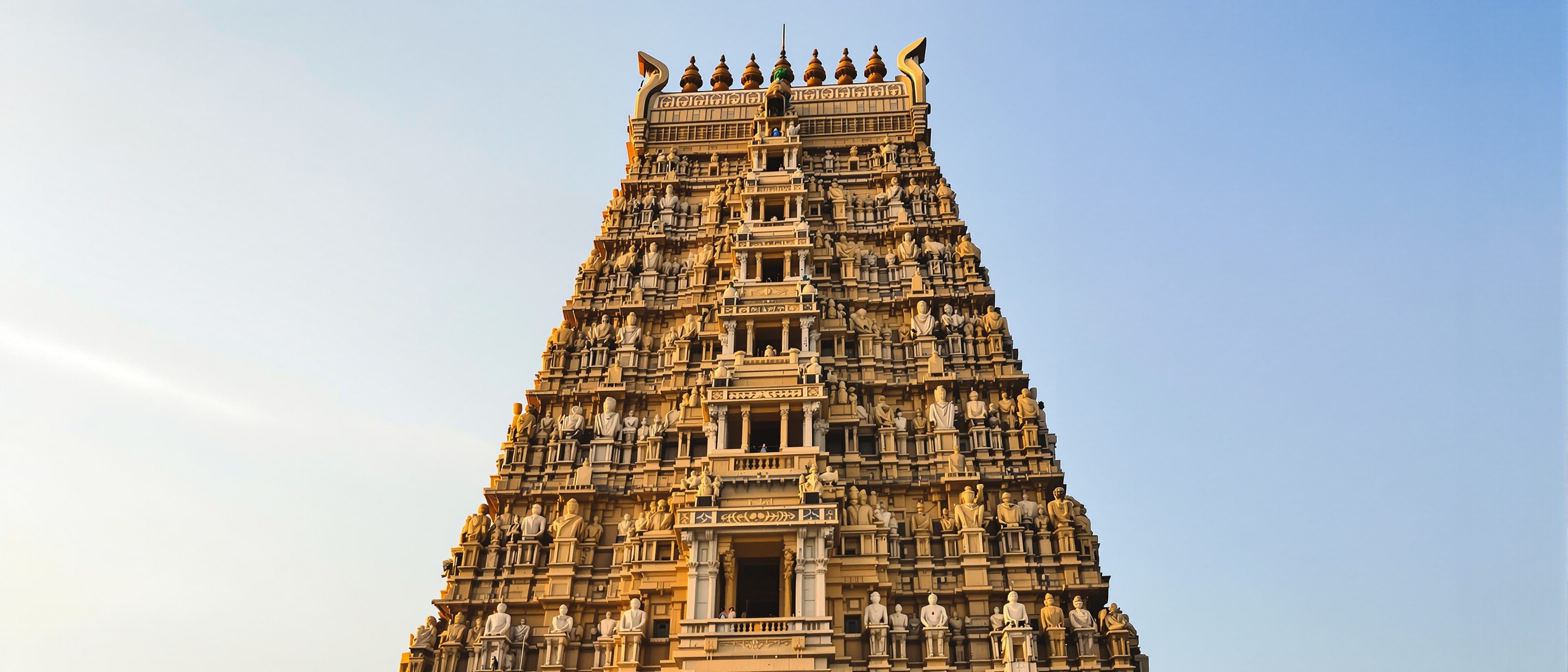
Classical & Vernacular Architecture
The temple (Nagara, Dravida, Vesara) and the regional vernacular.
In the classical tradition the temple is the supreme building type — a built image of the cosmos generated on the mandala, housing the deity in its garbhagriha. Learn the parts of a temple (garbhagriha, mandapa, antarala, shikhara/vimana, amalaka, kalasha, gopuram) and the three style families — Nagara (curvilinear shikhara), Dravida (pyramidal vimana + monumental gopuram) and Vesara (the Deccan hybrid). Then the regional vernacular — Kerala nalukettu, Chettinad, Rajasthan haveli, Himalayan timber, Bengal bangla — each read as a climate-and-craft response. Try the temple-style explorer.
Learning objectives
By the end of this lesson, you will be able to — mapped to the course outcomes for Vastu & Traditional Indian Architecture:
Name the parts of a temple and the path from entrance to garbhagriha.
Distinguish Nagara, Dravida and Vesara — keeping shikhara, vimana and gopuram distinct.
Identify the regional vernacular house types and read each as a climate response.
Read the vernacular as climate-and-craft, and the temple's meaning as religious.
The temple — parts & styles
From the garbhagriha out to the gopuram; keep the curvilinear shikhara (Nagara), the pyramidal vimana (Dravida) and the gateway gopuram distinct.[1, 2, 3]
Garbhagriha & halls
Every temple centres on the garbhagriha ('womb-chamber') — the small, dark, usually windowless innermost sanctum housing the principal image, at the mandala's heart. Approaching it, the worshipper passes an entrance porch, pillared hall(s) (mandapa) and a vestibule (antarala). The architecture stages a movement from the open, lit, public exterior to the dark, contained, sacred interior.[1, 3]
Compare the temple styles
Pick Nagara, Dravida or Vesara and read its tower, enclosure, regions and the distinguishing note.
Temple styles · pick one
Nagara (North)
- Tower
- Curvilinear shikhara, crowned by an amalaka (ribbed disc) and kalasha
- Enclosure
- Generally no great gateway-walls; often clustered subsidiary spires
- Regions
- Odisha, Central India (Khajuraho), Gujarat & Rajasthan
The soaring central spire is the signature; sub-types (Latina, Sekhari, Bhumija) differ in how the spire is composed.
Keep the vimana (tower over the sanctum) distinct from the gopuram (the gateway tower).
The regional vernacular
The nalukettu, the haveli, the Himalayan timber house and the Bengal bangla roof are each a material answer to a climate.[4]
Monsoon courtyard house
The nalukettu is the four-block courtyard house around a central open court (nadumuttam), with steep SLOPING tiled roofs and deep eaves on timber framing — an answer to heavy monsoon rain and humidity (the slope sheds water, the court ventilates, the eaves shade and keep rain off walls).[4]
At a glance
| Feature | Nagara | Dravida |
|---|---|---|
| Tower over sanctum | Nagara: curvilinear shikhara | Dravida: stepped pyramidal vimana |
| Crowning member | Nagara: amalaka + kalasha | Dravida: domical/octagonal cap + kalasha |
| Enclosure & gateway | Nagara: no great gateway-walls | Dravida: prakara walls + monumental gopurams |
| Core regions | Nagara: Odisha, Central India, Gujarat/Rajasthan | Dravida: Tamil Nadu & southern Deccan |
| Vesara | The Deccan hybrid (Chalukya/Hoysala) | Blends both; stellate plans; term debated |
Key terms
The 'womb-chamber' — the innermost sanctum housing the deity, at the mandala's heart.
A pillared hall preceding the sanctum.
The curvilinear North Indian temple spire (Nagara).
The stepped pyramidal South Indian tower over the sanctum (Dravida).
The monumental South Indian temple gateway tower — often taller than the vimana.
The Kerala four-block courtyard house with a central open court (nadumuttam).
Studio task
Sketch a temple in section, labelling the garbhagriha, mandapa, antarala, the tower (shikhara or vimana) and the gopuram, and state whether it is Nagara or Dravida and why. Then pick one vernacular house type (nalukettu, haveli, Himalayan timber or Bengal bangla) and explain how its form answers its climate — rain, heat, snow or glare.
Self-assessment
1. The curvilinear tower over the sanctum is characteristic of the —
2. A gopuram is —
3. The Kerala nalukettu's steep tiled roof and central court are primarily a response to —
Recap
References & further reading
- [1]George Michell, The Hindu Temple: An Introduction to Its Meaning and Forms (Univ. of Chicago Press, 1988).
- [2]Adam Hardy, The Temple Architecture of India (Wiley, 2007) — Nagara/Dravida/Vesara morphology.
- [3]Stella Kramrisch, The Hindu Temple — meaning, the garbhagriha, the mandala-generated plan.
- [4]Studies on Indian vernacular architecture (INTACH publications; regional monographs on Kerala, Chettinad, Rajasthan).
- [5]Christopher Tadgell, The History of Architecture in India — regional styles survey.
Further reading
- George Michell — The Hindu Temple.
- Adam Hardy — The Temple Architecture of India.
- Stella Kramrisch — The Hindu Temple.
Sources gathered and fact-checked June 2026. Published values vary by source, sample and method — treat as indicative and confirm against the cited standard before structural use.
The author
Amogh N P
Architect, interior designer, and creative polymath. Studio Matrx began in his notebooks — his vision of design made honest, useful, and open to everyone. Its Academy is written and taught in his memory, and free, forever.
More about Amogh →