
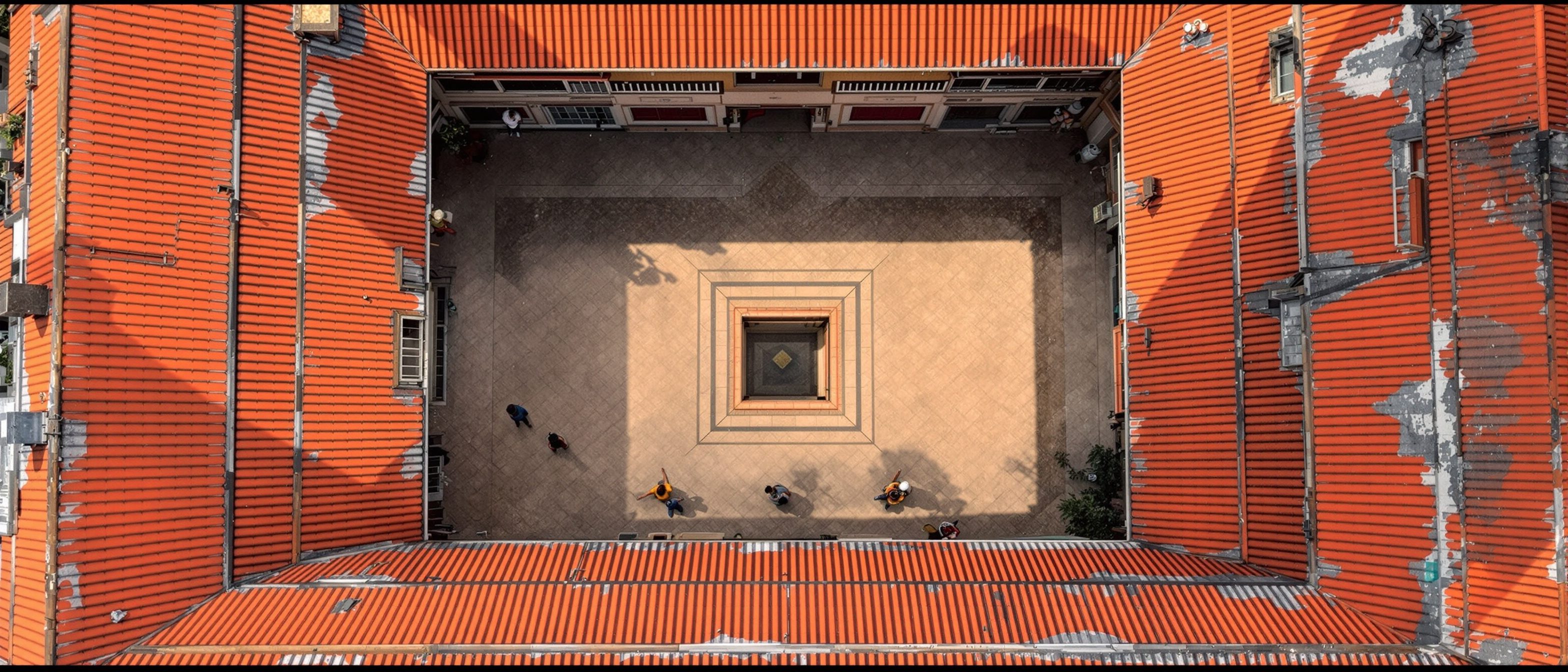
The Vastu Purusha Mandala
The cosmic grid — and the sun-and-wind logic hidden inside it.
The Vastu Purusha Mandala is the square site-diagram on which the cosmic being and the directional deities are mapped — the 64-pada Manduka and 81-pada Paramasayika grids, with the sacred open Brahmasthan at the centre. Learn the myth, the grids and the eight directions. Then the evidence-aware layer: how the NE-water / SW-heavy / open-centre scheme maps onto the Indian sun path and prevailing winds — why the canonical logic genuinely works as climate design, and where the deity assignments are cosmological belief. Try the direction explorer.
Learning objectives
By the end of this lesson, you will be able to — mapped to the course outcomes for Vastu & Traditional Indian Architecture:
Explain the Vastu Purusha myth and the mandala grids (64- and 81-pada).
Identify the Brahmasthan and the eight directions and their deities.
Read the climate logic behind the NE-water / SW-heavy / open-centre scheme.
Distinguish the deity assignments (belief) from the sun-and-wind facts they track.
The mandala & its grids
The Purusha myth is formalised as the square grid (64-pada temples, 81-pada dwellings) with the open Brahmasthan at the centre and the eight directions around the edge.[1, 5]
The Vastu Purusha
The Vastu Purusha is the cosmic being of the site. The legend: a formless ravenous being was pinned face-down to the earth by the gods, who each held down a part of him; Brahma occupied the centre. This MYTH explains why the site-diagram is imagined as a body within a square and why directions hold deities. It is a religious narrative, taught as such — not a structural account.[1]
The hidden climate logic
Read climatically, the NE-water / SW-heavy / SE-fire / open-centre scheme is largely sound for much of India — the deity assignments are belief; the sun and wind are what is real.[1]
Why the NE rule works
The north-east gets gentle early-morning sun and, over much of India, the cool/moist approach. Keeping it LOW, OPEN and WATERED (a well, tank or court) means morning sun strikes water and inflow air is evaporatively pre-cooled before crossing the house. TRADITION says a NE water body brings purity/prosperity; the BUILDING-SCIENCE reading is that it sits the water where morning sun and the incoming breeze cool the dwelling.[1]
Explore the directions
Tap a direction on the compass grid and read its deity/quality (the belief) beside its climate reading (the building science).
Direction explorer · tap the grid
N at top · ◧ = Brahmasthan
Centre (Brahmasthan)
Brahma · The sacred void
Tradition: Kept open / unbuilt
Climate reading: Becomes the central COURTYARD — the engine of cross- and stack-ventilation and daylight to a deep plan.
The deity assignment is cosmological belief; the climate reading is the building science the quality loosely tracks.
At a glance
| Prescription | Tradition says | Climate reading |
|---|---|---|
| NE low, open, watered | Tradition: Ishana's pure quarter | Climate: morning sun + inflow air cooled over water |
| SW heavy and tall | Tradition: Nirriti's seat of stability | Climate: shades the harsh afternoon/west sun |
| Kitchen in SE | Tradition: Agni's quarter | Climate: morning light + favourable heat/smoke exhaust |
| Open Brahmasthan | Tradition: Brahma must not be crushed | Climate: the central court ventilates & daylights |
| 81 / 64 grids | Tradition: sacred numerology | A practical planning module (numerology aside) |
Key terms
The cosmic being pinned to the building site in the founding myth.
A ritual diagram; here, the square site-grid of directions and deities.
A single cell/module of the mandala grid.
The sacred open centre of the mandala — practically, the courtyard void.
The eight directions — four cardinal and four intercardinal.
The 81-pada (9×9) grid, commonly used for dwellings.
Studio task
Draw the Vastu Purusha Mandala (81-pada) and mark the Brahmasthan and the eight directions with their deities. Then, for three prescriptions (NE water, SW heavy mass, open centre), write the climate reading beside the belief — explaining why the placement is comfortable in the Indian sun and wind, and noting where the deity assignment is cosmological rather than physical.
Self-assessment
1. The 81-pada grid commonly prescribed for dwellings is the —
2. The Brahmasthan is —
3. Placing the kitchen in the south-east has the building-science justification that —
Recap
References & further reading
- [1]Stella Kramrisch, The Hindu Temple, vol. I — the mandala, the Purusha myth, the pada grids.
- [2]George Michell, The Hindu Temple: An Introduction to Its Meaning and Forms.
- [3]Bruno Dagens (trans.), Mayamata — site, orientation and pada schemes in a primary text.
- [4]Adam Hardy, The Temple Architecture of India (Wiley, 2007) — the diagrammatic logic.
- [5]P. K. Acharya, A Dictionary of Hindu Architecture — mandala terminology.
Further reading
- Stella Kramrisch — The Hindu Temple (vol. I).
- George Michell — The Hindu Temple.
- Adam Hardy — The Temple Architecture of India.
Sources gathered and fact-checked June 2026. Published values vary by source, sample and method — treat as indicative and confirm against the cited standard before structural use.
The author
Amogh N P
Architect, interior designer, and creative polymath. Studio Matrx began in his notebooks — his vision of design made honest, useful, and open to everyone. Its Academy is written and taught in his memory, and free, forever.
More about Amogh →