
 Lesson 3.4
Lesson 3.4 · The Body of the House
When Mass Becomes Dogma
A good rule remembers what it was for; a dogma forgets the question and keeps the answer.
When mass becomes dogma
In Module 1 we found something real: heavy mass on a baking south-west wall genuinely buffers afternoon heat. It was a good rule. This lesson is about what happens next — when a good rule forgets why it was good, hardens into a directional law, and starts giving orders in climates and on sites where it has no business commanding anything.
The rule that earned its place
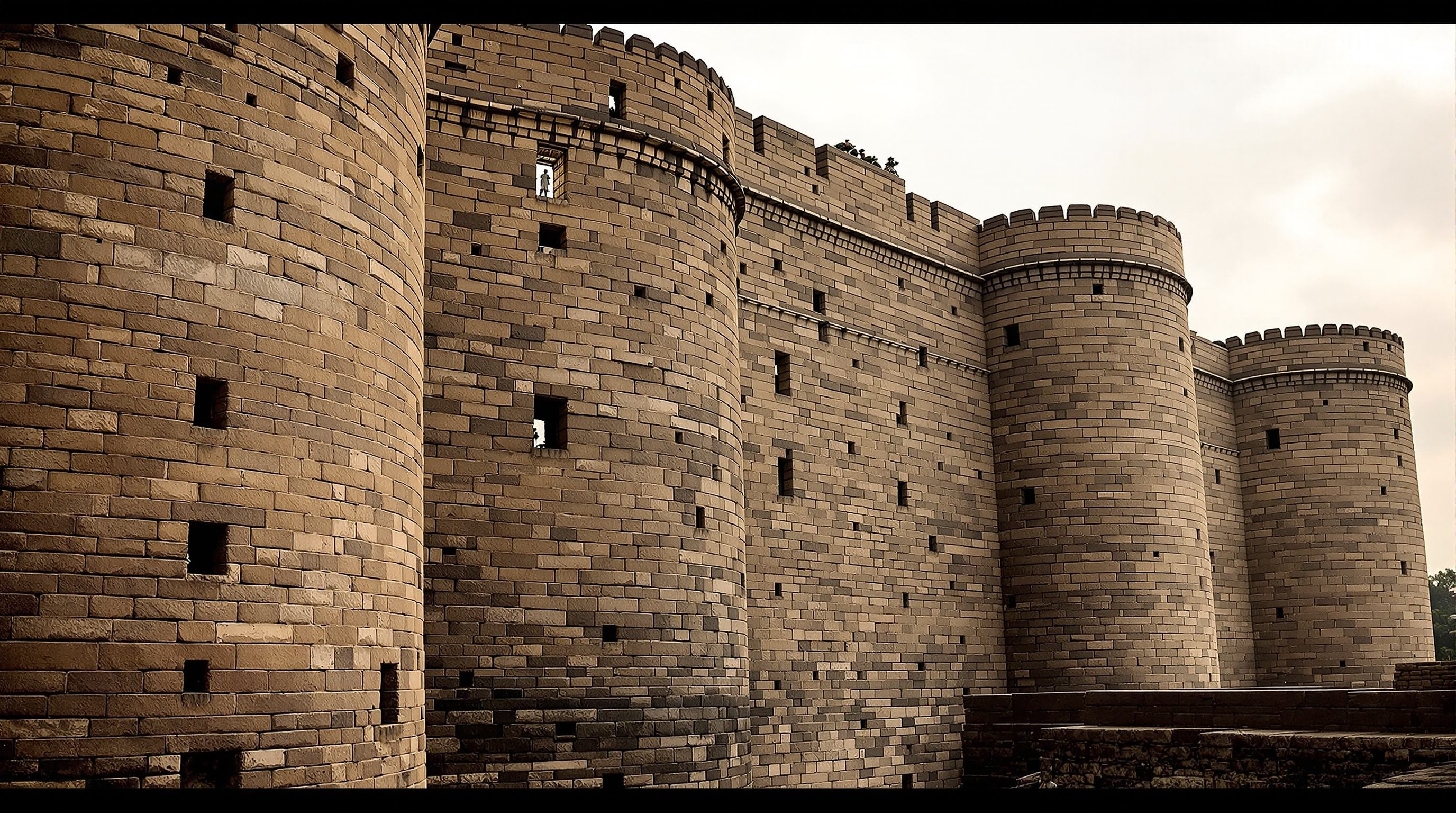
Back in Module 1.3 we gave the south-west a fair hearing and it passed. In a hot-dry climate, a thick, dense wall on the sun-beaten south-west and west façades soaks up the afternoon heat and releases it slowly. The physics has names: time lag (how long the heat takes to cross the wall) and the decrement factor (how much of the outdoor swing actually reaches the room). By the time the wall finishes re-radiating, the desert night has turned cold and the building flushes the stored heat back out. Free comfort, earned by mass.
So the instinct "put the heavier construction toward the south-west" is not superstition. In Jaisalmer or Bikaner, it is sound building science. This is exactly the kind of rule the course was built to celebrate — convention and climate logic pointing the same way.
The trouble begins the moment we stop treating it as an answer to a question (how do I tame a hot-dry afternoon?) and start treating it as a commandment that holds everywhere, for everyone, forever.
A heuristic is a compressed answer. Compress away the question and all you're left with is an order nobody can explain.
Three ways good mass turns into dogma
Climate-blind. Carry the same heavy south-west mass to a hot-humid coast — Kochi, Chennai, coastal Goa — and it backfires. There is no cold night to flush the stored heat into; humid nights stay warm. The mass simply soaks up the day's heat and radiates it inward all evening, making a stuffy room stuffier. The very wall that rescued the desert house punishes the coastal one. Same rule, opposite result — because the climate that justified it isn't there.
Structure-blind. The weight-hierarchy of Vastu asks the building to grow progressively heavier and taller toward the south-west, lighter and lower toward the north-east. Read as a law, it can start fighting the things structure actually answers to — the column grid, the spans, the soil, the brief, the view, the access. You end up thickening a wall or stacking a floor to satisfy a compass gradient rather than a load path. But structure has no compass sense. A beam doesn't know which way is south-west; it knows span, load and support. Mass should land where the loads, the soil and the use ask for it — not where a directional diagram prefers.
Symbol over sense. The deepest version: "heavy south-west, light north-east" obeyed as cosmic order — a moral shape for the house rather than a climate heuristic. Once it's cosmic, it overrules better, site-specific moves: it won't let you open the heavy corner to a sea breeze, or lighten it for a cantilever the view wants, because the symbol has stopped asking whether it still serves anyone.
Notice the pattern across all three: the rule survives, but its reason has quietly left the room.
The honest discipline: keep asking the question
There is nothing wrong with heuristics — designers run on them. "Heavy to the south-west" is a fine shorthand, the way "design to your actual sun and wind" from Module 1.4 is. The danger isn't the shortcut; it's forgetting it was a shortcut.
The cure is almost embarrassingly simple, and it's the same move that runs through this whole course: for every inherited rule, ask what it was for, and whether that reason holds here. Hot-dry with cold nights? The mass rule is yours, take it. Humid coast? Thank it and let it go. A symbolic gradient fighting your load path? The load path wins — every time.
Do that and the south-west rule doesn't get demoted; it gets restored. It goes back to being what it always was: a smart answer to a specific question, sincere and useful, instead of a law pretending to be engineering. Mass, proportion and material — everything Module 3 has been about — are superb servants. They turn into bad masters only when we let them give orders without a reason.
Respect the people who hold the gradient sincerely. The job isn't to ridicule the rule — it's to give the rule its reasons back.
How each rule sorts
The same rule, three readings — and the durable principle underneath.
Genuinely useful in hot-dry climates, where thermal mass on the hot façade buffers the afternoon via time lag and decrement factor and dumps the heat into cold nights. But it is climate-contingent: on a humid coast with warm nights there is no night flush, so the same mass traps heat. A heuristic, not a law.
There is no structural mechanism that ties mass to the compass. Loads, spans, soil and use decide where mass belongs; a beam responds to support and span, not to bearing. Treated as cosmic order, this is convention to respect as belief, not engineering.
Distributing mass by actual sun exposure, night temperatures, load paths, span and soil is the durable principle behind every honest version of the south-west rule. It is the same move as 'design to your real sun and wind' — site facts over inherited diagrams.
What Module 3 was really teaching
- A heuristic is a compressed answer to a question; lose the question and you're left with a dogma.
- The south-west mass rule is real in hot-dry climates and counter-productive on a humid coast — same rule, opposite verdict.
- Structure follows load, span, soil and use — never a compass weight-gradient.
- Proportion, material and mass are excellent servants and terrible masters; test every one against its own reason.
So far every rule we've weighed had _some_ physics underneath, even when it was thin. Next we cross into stranger territory — the things with no physics at all: directional defects, numbers and lucky shapes, and the genuinely interesting question of why so many people believe them so deeply.
The author
Amogh N P
Architect, interior designer, and creative polymath. Studio Matrx began in his notebooks — his vision of design made honest, useful, and open to everyone. Its Academy is written and taught in his memory, and free, forever.
More about Amogh →