
 Lesson 3.3
Lesson 3.3 · The Body of the House
Centre-Open & the Courtyard
The empty middle of the old house was never empty — it was working harder than any room around it.
The hole in the plan that cools the whole house
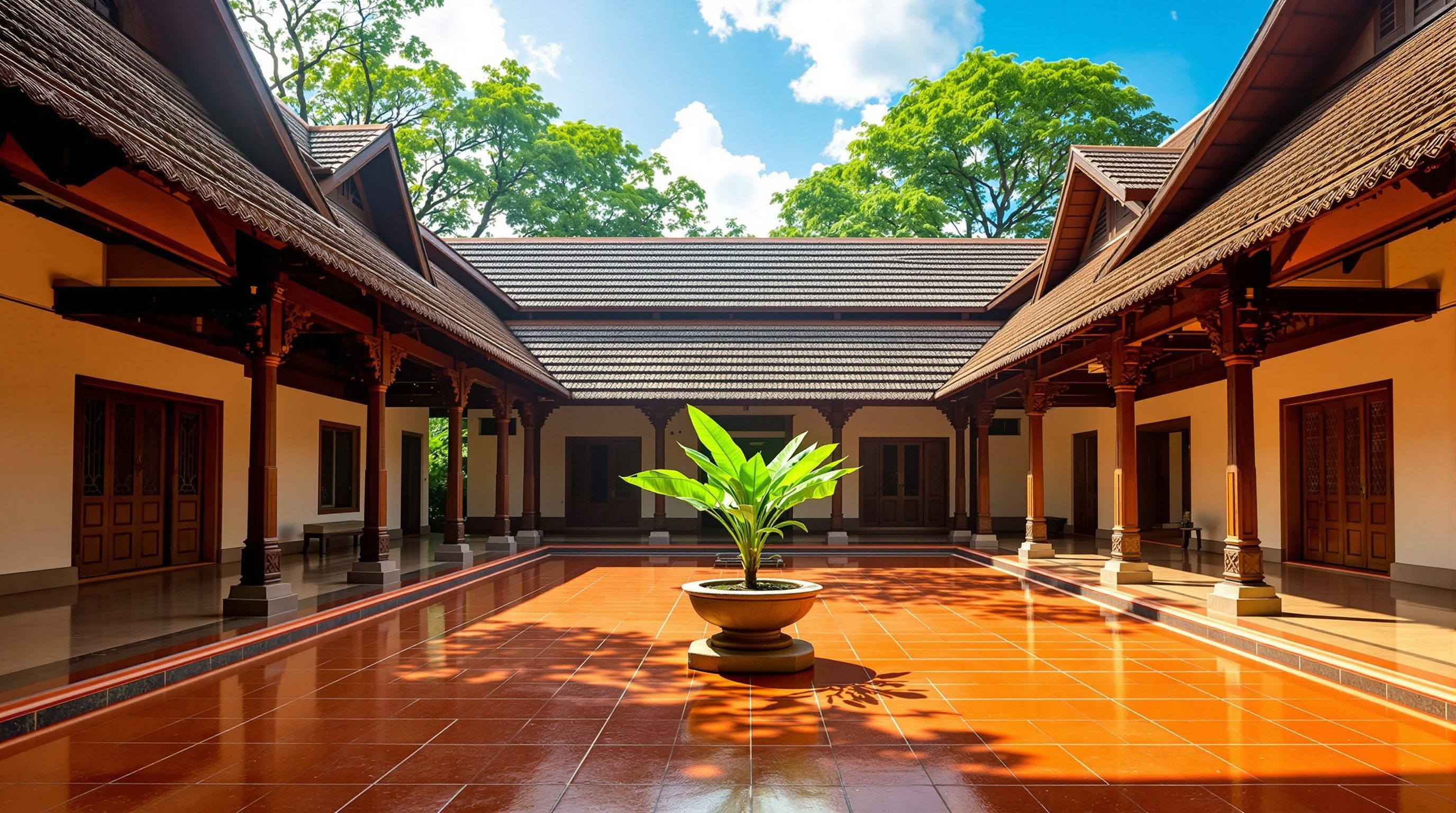
Stand in the centre of an old nalukettu at noon and the air moves past your ankles even when the lanes outside are dead still. By dawn the floor is cool enough to sleep on. Vastu calls this open middle the Brahmasthan and asks you to keep it void — and here, for once, the rule and the physics are almost in lockstep.
One void, six jobs
Lesson 2.1 introduced the courtyard as a stack-ventilation engine: the sun warms the court, warm air rises and escapes the open top, and that rising column pulls cooler air through the surrounding rooms. That alone would justify it. But the courtyard is doing five other things at the same time, and this is why the open core is among Vastu's strongest rules.
It is a daylight well, dropping even light into the deep middle of a plan that would otherwise need a dark, lamp-lit core. It is a night-sky radiator: on a clear night the court floor and walls have a near-uninterrupted view of the cold upper atmosphere and lose heat to it by longwave radiation, so a pool of cool air forms in the court and sinks into the rooms by morning. It is a microclimate — add a tree, a tulsi, a small tank or wet stone and you get shade plus evaporative cooling, an outdoor room several degrees below the street.
It captures rain straight into a tank or recharge pit, and historically it was the social and spiritual heart — a private, sky-open space, often the women's domain in the haveli, wada and nalukettu. Six functions, one piece of geometry. Few design moves earn their floor area so many times over.
Day trap, night gift
The honest complication is that the same court behaves very differently at noon and at midnight, and differently again by climate. In warm-humid coastal Kerala or Bengal, the court is mostly a winner — it ventilates and lights, and humidity blunts the daytime overheating.
In hot-dry Rajasthan or Gujarat the geometry matters enormously. A wide, shallow court left open to a 45°C sky becomes a sun-baked heat trap by day; the traditional answer is a deep, narrow court that shades its own floor for most of the day, then opens that floor to the night sky for radiant cooling. The haveli courtyard is small and deep for exactly this reason — it is tuned, not generic.
The wada and the nalukettu are not the same machine wearing different clothes — they are differently-shaped courts because Pune's dry heat and Kerala's wet heat ask different questions of the same void.
Same void, two shapes: the desert digs its court deep to hide from the sun; the coast spreads it wide to catch the breeze.
The price of a hole, and the myth of the empty cell
A courtyard costs plan area and perimeter. On a generous low-rise plot that cost is repaid many times by free ventilation, light and cooling. On a small, expensive, tightly-overlooked urban plot — three sides built against neighbours, four storeys to amortise the land — a real open court may simply be unaffordable, or shrink to a light shaft that ventilates but no longer functions socially. So the open centre is a brilliant default, not a universal law. This is the gap between "keep an open core" (excellent) and "keep the centre open on any plot" (contingent).
Then there is the stricter dogma: that the exact geometric centre — the Brahmasthan — must be structurally void, with no column, no beam, no toilet landing on that precise cell. Separate two claims here. The principle of an open core is sound building science. The literalism — that the single central cell must be empty of structure — has no physical mechanism behind it.
A column standing at the centre of a court that still reads as open blocks no air, casts a sliver of shadow, and lets a regular structural grid resolve cleanly overhead. The space being open does the work; the precise point being void does not. Treat the open core as engineering and the empty-cell rule as belief — respect it as belief if a client holds it, but never quote it as structure.
How each rule sorts
Vastu's strongest rule — and where even it stops being physics.
A real multi-function climate device: stack ventilation draws cool air through the rooms, the open top is a daylight well and a clear-night radiator that pools cool air, and a shaded, planted or watered court adds evaporative microclimate and rain capture.
Contingent on plot size, storeys and climate detail. A court costs area and perimeter and suits generous low-rise sites; in hot-dry zones it must be deep and self-shading or it overheats by day, and on small dense urban plots it may be unaffordable.
No structural or thermal mechanism supports the precise-cell rule. A column at the centre of an open court blocks no airflow and casts negligible shadow; the openness does the work, not the emptiness of one point. Convention, to respect as belief.
What survives the sort
- The open core is one of Vastu's strongest rules — back it as a six-in-one climate device, not as superstition.
- Tune the court to climate: deep and self-shading in hot-dry, wide and breezy in warm-humid; geometry is the whole game.
- “Open centre on any plot” is a default, not a law — small dense urban sites may only afford a light shaft, and that is honest.
- Let the open space do the work, not the empty point: a centred column harms nothing, so don't dress the Brahmasthan-void rule as engineering.
We have honoured mass and openness where the physics earns it. Next, 3.4 'When Mass Becomes Dogma' asks the harder question — what happens when a sound principle like thermal mass is applied past the point where its physics still holds.
The author
Amogh N P
Architect, interior designer, and creative polymath. Studio Matrx began in his notebooks — his vision of design made honest, useful, and open to everyone. Its Academy is written and taught in his memory, and free, forever.
More about Amogh →