
 Lesson 4.1
Lesson 4.1 · The Things With No Physics
Directional Doors & Defects
Most directional 'defects' carry no measurable mechanism at all — yet a careful designer can still honour the belief, and quietly fix the one or two things that were ever really worth fixing.
The door that faces the wrong way
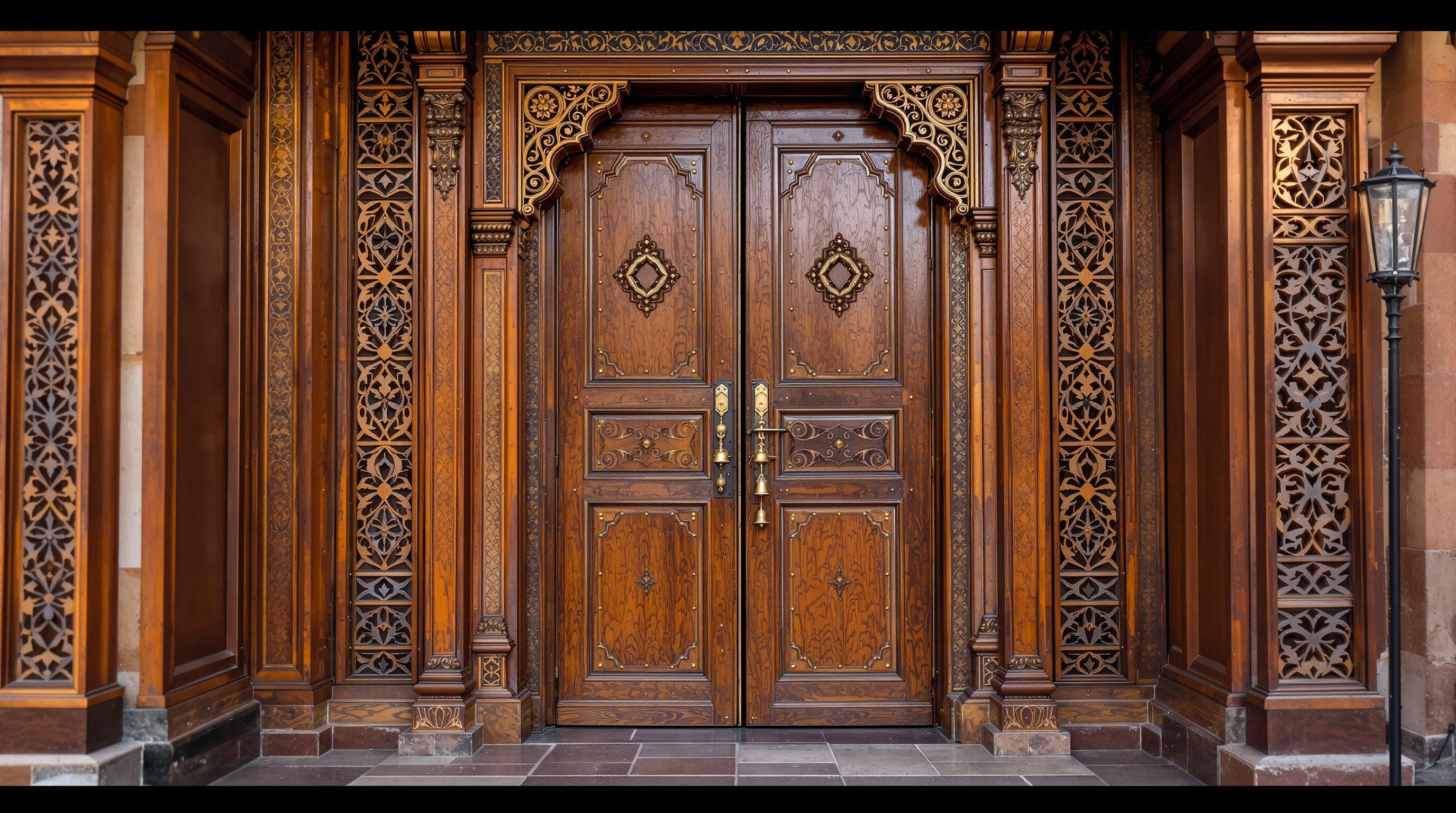
A family will sometimes shift an entire entrance — re-route the gate, rebuild a porch, lose a tree — because the main door faced a road head-on, or a beam crossed the bed. They are not foolish; they are careful people protecting their home the way they were taught. Our job is not to argue them out of it, but to find the small, true thing buried inside the rule, fix that because it is good design anyway, and let the belief keep its dignity.
What 'vedha' is asking us to look at
Vastu calls a directional defect a vedha — literally a piercing or obstruction. A door that faces a T-junction, a beam that runs over a bed, two doors that stare straight at each other, a staircase that meets a door, a toilet stacked over a prayer niche: each is named a defect said to invite misfortune. It is a remarkably consistent, ancient vocabulary of unease about how lines and openings align.
The honest starting point — the one we set in Module 0 — is that most of these defects have no measurable mechanism. There is no airflow, daylight, drainage or structural pathway by which a door's compass bearing changes a family's fortune. That makes them convention (🔴): belief, and belief deserves respect, not a physics lecture dressed up to flatter it.
But a careful reading finds that one or two vedha rules are pointing, in their own coded language, at something a good designer would notice anyway. The skill is separating that thin real kernel from the misfortune claim wrapped around it.
‘Vedha’ = a piercing. Notice it is a word about lines and sightlines — which is exactly where the small grain of truth hides.
The T-junction door — a thin but real basis
Of all the directional defects, the main door facing a T-junction or a road head-on is the one with a genuine, if modest, practical basis. Stand at that door after dark and you will meet oncoming headlight glare swinging straight into the entrance. By day, dust and noise carried down the road arrive at your threshold rather than glancing past it. And historically — before sealed roads and stormwater drains — surface run-off drained toward the lowest open mouth in the street wall, which was often that facing door.
None of this is misfortune. It is glare, grit, sound and water — ordinary nuisances with ordinary fixes. A screen wall or jali, a band of planting, a deep porch or set-back, a slight off-axis turn of the gate: any of these break the head-on line and the nuisance with it. Because the problem is real and the fix is cheap and design-led, this rule earns a 🟡 — contingent practical logic.
The move here is precise. We do not say 'Vastu is right, science agrees.' We say: there is a real comfort issue at a head-on entrance, we would soften it anyway, and doing so happens to satisfy the rule. The belief is honoured; the engineering is not borrowed to vouch for the rest.
Fix the glare because glare is real. Let that be a coincidence with the rule, not a proof of it.
The beam, the facing doors, the staircase
A beam over a bed is the classic anxious image — a heavy element looming over you as you sleep. The misfortune claim has no mechanism, so it stays 🔴 convention. Yet there is a small, honest aside worth keeping: a flush, uncluttered ceiling over a bed is simply tidier detailing, and a low boxed-in beam can produce real psychological unease for some sleepers. In a high seismic zone, heavy elements directly overhead are a minor design consideration. None of that is the 'defect' — it is mild good detailing, and we should say so without inflating it.
Two doors facing each other, a door opening onto a staircase, the auspicious compass bearing of the main door — here the fortune claim has no physical pathway at all (🔴). But notice the separate, legitimate concerns sitting beside them: a door straight onto a stair is a circulation and sightline question; two facing doors and the exposed entrance are privacy questions. Privacy and circulation are ordinary, respectable planning — not Vastu, and not misfortune.
So we honour both halves cleanly. We respect the client's belief as belief. And we fix the privacy or the sightline or the tidy ceiling because that is what good layout asks of us — never claiming the planning fix proves the rule, and never claiming the rule was secretly engineering.
Two doors facing isn't bad luck — it's a privacy and circulation note. Solve it as planning, and everyone is content.
How each rule sorts
Sort the practical kernel from the misfortune claim — and honour both honestly.
Thin but real: a head-on entrance meets night headlight glare, road-borne dust and noise, and (historically) run-off draining toward it. Mitigable with a screen, planting or porch — contingent practical comfort, not the misfortune claim.
The misfortune claim has no measurable mechanism; respect it as belief. A flush ceiling and avoiding a low looming overhead element is mild good detailing and psychology — and a minor seismic note — but that is not physics for fortune.
No physical pathway links a door's bearing or alignment to fortune; honour as belief. The real, separate concerns are privacy and circulation — legitimate planning matters, addressed as good layout rather than as Vastu.
Separate the kernel from the claim
- Most vedha defects are convention (🔴) — no airflow, daylight, drainage or structural mechanism; respect them as belief, never as engineering.
- The T-junction door is the honest exception (🟡): glare, dust, noise and run-off are real and cheaply mitigable — fix them as comfort, not as proof of the rule.
- Beam-over-bed, facing doors and door-to-stair are belief — but they sit beside genuine concerns (tidy detailing, privacy, circulation) you would address anyway.
- Fix the practical thing because it is good design; honour the belief because it matters to the client — and never let one stand in for the other.
If directional defects are belief wearing the language of design, the next lesson meets belief in its purest form: astrology, numerology and the remedies sold to 'correct' a home. Lesson 4.2 asks how a designer responds with the same dignity and the same honesty.
The author
Amogh N P
Architect, interior designer, and creative polymath. Studio Matrx began in his notebooks — his vision of design made honest, useful, and open to everyone. Its Academy is written and taught in his memory, and free, forever.
More about Amogh →