
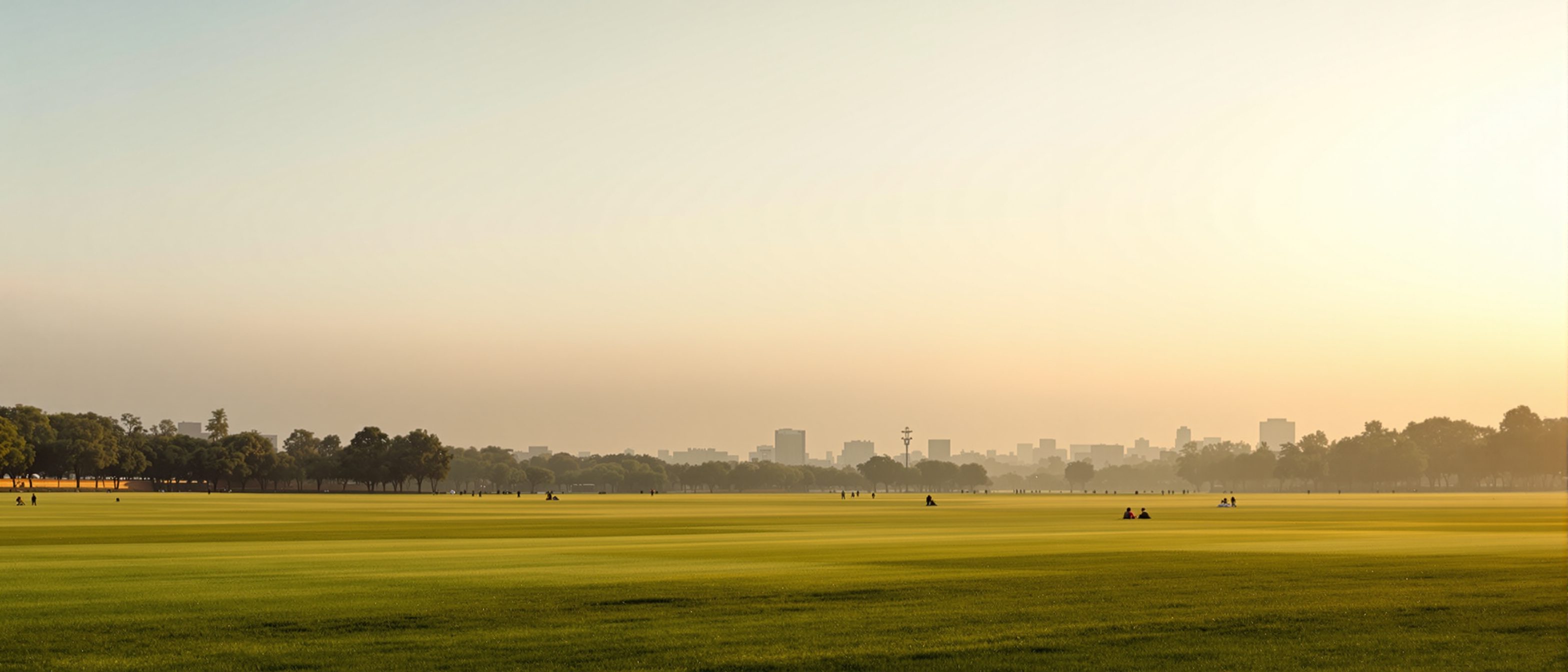
The Role of Public Space
The agora to the maidan — how the shared room of the city evolved.
Public space is the shared physical setting of collective life — the street, the square, the market, the park, accessible to all. It is the room the whole city owns. This unit traces its evolution from the Greek agora and the Roman forum through the enclosed medieval market square and the geometric Renaissance and Baroque piazza, to the Indian maidan, the bazaar street and the chowk. Then it turns to what gives a public space meaning today: place-making and identity, urban morphology — the study of city form over time — and how the image of the city shapes the way people perceive and value it.
Learning objectives
By the end of this lesson, you will be able to — mapped to the course outcomes for Urban Design:
Define public space and describe its main types — street, square, market, green and civic space.
Trace the evolution of public space from the agora and forum to the Indian maidan and bazaar street.
Explain place-making, identity and urban morphology.
Read a familiar public space in terms of its type, enclosure and the role it plays in city life.
The evolving room of the city
Public space has a long lineage — the Greek agora, the Roman forum, the medieval square, the Baroque piazza, and India's own maidan, bazaar and chowk.[4]
The assembly of the polis
The agora was the central open space of the Greek polis — the setting for assembly, market, politics and daily encounter, framed by stoas (colonnaded walks). It fused civic, commercial and social life in one accessible space, and is the western archetype of the democratic public realm.[4]
From space to place
A space becomes a place through identity, meaning and use. Morphology explains how city form is built up and transformed over time, and perception decides how the place is read.[1, 5]
The room everyone owns
Public space is space accessible to all — the shared physical setting of collective civic life. Its types span streets and boulevards, squares and plazas, markets, parks and green space, civic and monumental spaces, transit spaces, and incidental 'found' spaces. What unites them is access and shared ownership: the space the whole city, not one owner, can use.[1, 4]
At a glance
| Aspect | One | The other |
|---|---|---|
| Form | Medieval square: organic, enclosed | Baroque piazza: geometric, axial |
| Streets enter | Medieval: at the corners (space holds) | Baroque: on axis (space extends) |
| Indian type | Maidan: large open civic ground | Chowk: street-crossing node |
| Space vs place | Space: abstract, generic extent | Place: identity, meaning, use |
| Morphology changes | Slowest: the street/plan pattern | Fastest: buildings and land use |
Key terms
Space accessible to all — the shared setting of collective civic life (street, square, market, park, waterfront).
The central open assembly-and-market space of the Greek polis — archetype of the public realm.
The monumentalised civic centre of the Roman city — civic, commercial, judicial and religious.
The composed Renaissance/Baroque urban square — geometric, axial, read as an architectural set-piece.
The large open civic and recreational ground of the Indian city — its collective lung.
The crossing or square where Indian bazaar streets meet — an indigenous public node.
Giving a space identity, meaning and use so people value it — turning space into place.
The study of urban form and its transformation over time (plan, fabric and land use).
Studio task
Choose a public space in your city — a maidan, a chowk, a market street or a temple tank. Classify its type, sketch how streets enter it (do they hold the space or let it leak?), and list three things that give it identity. Then ask Whyte's question from the next unit in advance: is it actually used — by whom, and when?
Self-assessment
1. The central open assembly-and-market space of the Greek polis was the —
2. In a medieval market square, streets typically enter at the corners because —
3. Urban morphology is the study of —
Recap
References & further reading
- [1]Carmona, M., Heath, T., Oc, T. & Tiesdell, S. — Public Places, Urban Spaces (Architectural Press, 2003).
- [4]Morris, A.E.J. — History of Urban Form Before the Industrial Revolution (Prentice Hall, 1996).
- [5]Lynch, Kevin — The Image of the City (MIT Press, 1960).
- [6]Whyte, William H. — The Social Life of Small Urban Spaces (Conservation Foundation, 1980).
- [7]Bacon, Edmund N. — Design of Cities (Viking Press, 1967; rev. Penguin, 1976).
- [8]Sitte, Camillo — Der Städtebau nach seinen künstlerischen Grundsätzen (City Planning According to Artistic Principles, 1889).
Further reading
- A.E.J. Morris — History of Urban Form Before the Industrial Revolution (1996).
- Camillo Sitte — City Planning According to Artistic Principles (1889).
- Matthew Carmona et al. — Public Places, Urban Spaces (2003).
Sources gathered and fact-checked June 2026. Published values vary by source, sample and method — treat as indicative and confirm against the cited standard before structural use.
The author
Amogh N P
Architect, interior designer, and creative polymath. Studio Matrx began in his notebooks — his vision of design made honest, useful, and open to everyone. Its Academy is written and taught in his memory, and free, forever.
More about Amogh →