
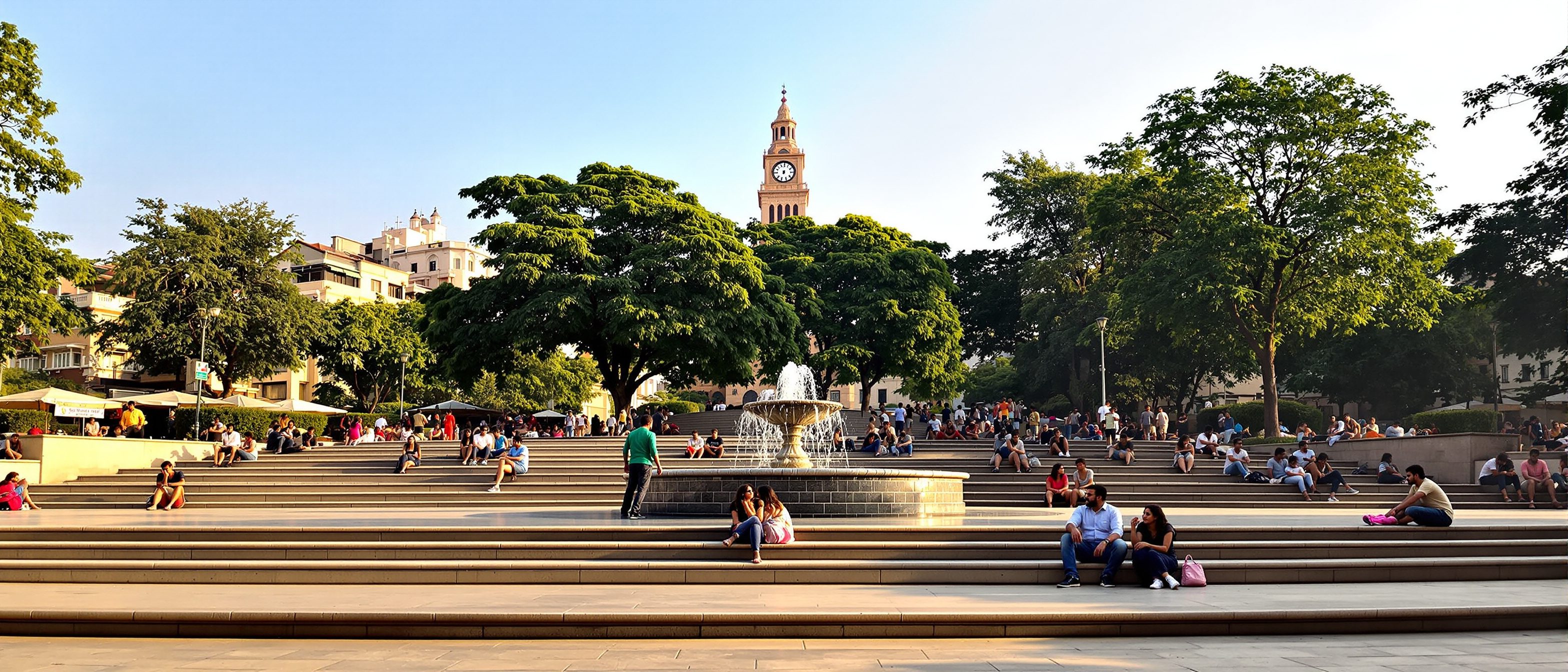
Organization of Space — the Canon
Lynch, Cullen, Rossi and the social life of the street.
This is the canon-heavy unit — the great ideas about how urban space is organized, perceived and given meaning. Kevin Lynch showed the city is read through five elements: paths, edges, districts, nodes and landmarks. Gordon Cullen showed it is experienced as serial vision, a moving sequence of revelations. Norberg-Schulz named the spirit of place, genius loci; Aldo Rossi found the city's collective memory in its persistent types and monuments. And Jane Jacobs and William H. Whyte turned from form to life — the four generators of diversity, 'eyes on the street', and the discovery that people sit where there are places to sit.
Learning objectives
By the end of this lesson, you will be able to — mapped to the course outcomes for Urban Design:
Name and apply Lynch's five elements of the city image and explain imageability and legibility.
Explain Cullen's serial vision, Norberg-Schulz's genius loci and Rossi's collective memory and type.
State Jacobs's four generators of diversity and 'eyes on the street', and Whyte's findings on what makes plazas work.
Read a real place through the canon — its image elements, its serial vision and its social life.
The image of the city
Lynch found people structure the city through five elements; Cullen read it as a moving sequence; Norberg-Schulz named its spirit of place; Rossi found its collective memory in type and permanence.[5, 3, 12, 13]
Paths, edges, districts, nodes, landmarks
In The Image of the City (1960), Kevin Lynch — after a five-year study of Boston, Jersey City and Los Angeles — found that people structure the city through five elements: PATHS (channels of movement), EDGES (linear boundaries not used as paths), DISTRICTS (areas with a common character one enters into), NODES (strategic points/foci one can enter), and LANDMARKS (external point references one does not enter). A legible city is one whose five elements form a clear pattern. Use the City Image Explorer below.[5]
Read the city through its elements
Toggle Lynch's five elements on the schematic map and read how each one structures the image of the city. Remember: they are perceptual categories — how people read a city — not a checklist of things to design.
The image of the city · toggle Lynch's five elements
Channels along which the observer customarily moves — streets, walkways, transit lines, canals. Usually the dominant element; the other four are arranged along them.
e.g. A main bazaar street, a riverside promenade, a metro line.
Linear boundaries NOT used as paths — shores, walls, rail cuts, the edge of a development. They hold districts together or hold them apart.
e.g. A riverfront, a fort wall, a railway line, a green belt.
Medium-to-large areas the observer mentally enters into, with a common identifying character — texture, use, age, people.
e.g. The old city, a university campus, an industrial estate.
Strategic points one can enter — junctions, squares, transit interchanges, concentrations. Often where paths cross or break.
e.g. A chowk, a roundabout, a station concourse, a town square.
Point references the observer does NOT enter — external reference points read from a distance, used for orientation.
e.g. A clock tower, a dome, a hill, a tall sign.
Lynch's elements are perceptual categories — how people read a city — not a checklist of things to design.
The social life of the street
Jacobs and Whyte turned from form to life: vitality comes from diversity and 'eyes on the street', and plazas live on seating, sun, food and triangulation — not size. Bacon read city form through movement.[14, 6, 7]
Four generators
Jane Jacobs's The Death and Life of Great American Cities (1961) attacked the clearance-and-tower planning of her day and argued city vitality comes from DIVERSITY, generated by four conditions: (1) MIXED PRIMARY USES, so people are present at different times of day; (2) SHORT BLOCKS, for permeability and mixing; (3) A MINGLING OF BUILDINGS OF VARYING AGE, so rents vary; and (4) SUFFICIENT DENSITY of people. Where all four are present, streets come alive.[14]
At a glance
| Aspect | One | The other |
|---|---|---|
| Lynch element you enter | Nodes & districts: entered into | Landmarks & edges: not entered |
| Imageability vs legibility | Imageability: an element evokes an image | Legibility: the whole reads as a pattern |
| Cullen's reading | Serial vision: moving sequence | Here & there: position and destination |
| Plaza success | Myth: size / grand design | Reality (Whyte): sittable, sunlit, social |
| Genius loci | Myth: a mystical 'vibe' | Reality: phenomenological character of place |
Key terms
The quality of a physical object that makes it evoke a strong, memorable image (Lynch's term).
The ease with which a city's parts can be recognised and organised into a coherent pattern.
Lynch's paths, edges, districts, nodes and landmarks — how people structure the city image.
Cullen's experience of the city as a moving sequence of unfolding views.
Norberg-Schulz's 'spirit of place' — the concrete character that makes a place itself (phenomenological, not mystical).
Rossi's idea that the city is the artifact and store of its people's shared memory.
Jacobs's natural surveillance by the people who use and watch a street — the basis of urban safety.
Whyte's external stimulus (performer, sculpture, sight) that prompts strangers in a plaza to interact.
Studio task
Draw a mental map of your campus or neighbourhood from memory — without looking at a real map — then label its paths, edges, districts, nodes and landmarks (use the City Image Explorer as a key). Which elements are strong and which are missing or confused? Then visit one public space and spend ten minutes counting, Whyte-style, where people actually sit and why. Compare your image-map to the lived reality.
Self-assessment
1. Kevin Lynch's five elements of the city image are —
2. William H. Whyte's central finding about why some plazas thrive was that —
3. Jane Jacobs's 'eyes on the street' describes —
Recap
References & further reading
- [3]Cullen, Gordon — The Concise Townscape (Architectural Press, 1971; first as Townscape, 1961).
- [5]Lynch, Kevin — The Image of the City (MIT Press, 1960).
- [6]Whyte, William H. — The Social Life of Small Urban Spaces (Conservation Foundation, 1980).
- [7]Bacon, Edmund N. — Design of Cities (Viking Press, 1967; rev. Penguin, 1976).
- [12]Norberg-Schulz, Christian — Genius Loci: Towards a Phenomenology of Architecture (Rizzoli, 1980).
- [13]Rossi, Aldo — The Architecture of the City (1966; English ed., MIT Press, 1982).
- [14]Jacobs, Jane — The Death and Life of Great American Cities (Random House, 1961).
Further reading
- Kevin Lynch — The Image of the City (1960).
- Jane Jacobs — The Death and Life of Great American Cities (1961).
- Gordon Cullen — The Concise Townscape (1971); Aldo Rossi — The Architecture of the City (1982).
Sources gathered and fact-checked June 2026. Published values vary by source, sample and method — treat as indicative and confirm against the cited standard before structural use.
The author
Amogh N P
Architect, interior designer, and creative polymath. Studio Matrx began in his notebooks — his vision of design made honest, useful, and open to everyone. Its Academy is written and taught in his memory, and free, forever.
More about Amogh →