
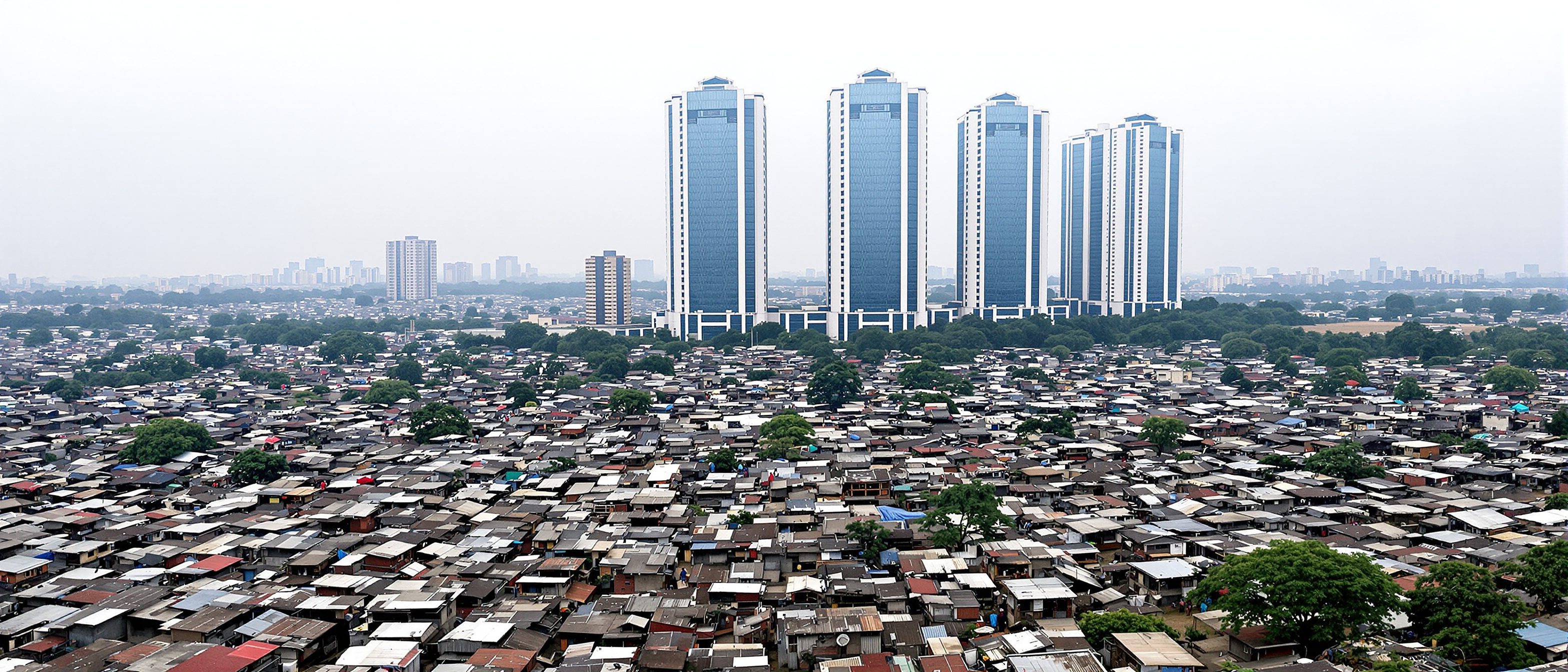
Issues in Urban Space
Blight, slums and sprawl — and the catalyst, the transit metropolis and survey.
Cities also decline, and urban design must read the failure as carefully as the success. This unit covers urban blight and obsolescence; the difference between a slum and a squatter settlement, and the UN-Habitat definition of a slum household by five deprivations; how urban surveys collect and present the data of decline; and the Indian debate between in-situ upgrading and peripheral relocation. Then three contemporary frames: the urban catalyst (a project that triggers further good development), the transit metropolis (transit and form that fit), and urban sprawl (the failure to avoid).
Learning objectives
By the end of this lesson, you will be able to — mapped to the course outcomes for Urban Design:
Distinguish urban blight and obsolescence, and slums from squatter settlements.
State the UN-Habitat five deprivations that define a slum household.
Describe how urban surveys collect, analyse and present the data of urban decline.
Explain the urban catalyst, the transit metropolis and urban sprawl as contemporary frames.
How cities decline
Blight is an area's downward spiral; obsolescence is loss of usefulness. UN-Habitat defines a slum household by five deprivations — and tenure is the line between a slum and a squatter settlement.[15, 16]
How areas decline
URBAN BLIGHT is the physical and economic decline of an area — deterioration, vacancy, disinvestment, a downward spiral where decay drives away investment which deepens decay. OBSOLESCENCE is the loss of usefulness: physical (the fabric wears out), functional (the layout no longer suits its use), locational (the area's advantages move elsewhere) or economic (it is worth more redeveloped than kept). Reading which kind of obsolescence an area suffers decides whether to repair, re-use or rebuild.[15]
Contemporary approaches
Three frames shape how urban design responds: the catalyst that triggers incremental growth, the transit metropolis where transit and form fit, and the sprawl the compact city must defeat.[17, 18, 1]
In-situ vs relocation
Preventing and improving slums is an Indian policy battleground. IN-SITU upgrading/redevelopment improves or rebuilds a settlement WHERE IT STANDS, keeping residents close to their livelihoods. RELOCATION moves them to (often peripheral) resettlement housing — which can sever the very job links that made the location valuable, and stand empty as a result. In-situ approaches (under PMAY-U and earlier schemes) are generally favoured over distant relocation, though land economics constantly pull the other way.[16]
At a glance
| Aspect | One | The other |
|---|---|---|
| Key distinction | Slum: degraded, may have tenure | Squatter: informal, no legal title |
| Living-area deprivation | Adequate: ≤ 3 persons / habitable room | Deprived: > 3 persons / habitable room |
| Improving a settlement | In-situ: improve where it stands | Relocation: move to (often distant) housing |
| Catalyst vs master plan | Catalyst: incremental, triggers growth | Master plan: fixed, comprehensive |
| Sprawl vs compact city | Sprawl: low-density, car-dependent | Compact: dense, mixed, walkable, transit-served |
Key terms
The physical and economic decline of an area — deterioration, vacancy and disinvestment in a downward spiral.
Loss of usefulness — physical, functional, locational or economic.
A degraded, overcrowded, under-serviced area (may hold legal tenure).
An informal settlement on land occupied without legal title (India: JJ cluster).
UN-Habitat slum test — lacking durable housing, living area, water, sanitation or tenure.
A project deliberately placed to trigger and shape further good development (Attoe & Logan).
A region where transit service and urban form are planned to fit each other (Cervero).
Low-density, car-dependent, single-use spread at the city edge.
Studio task
Identify a declining or informal area in your city. Diagnose it: which kind of obsolescence does it suffer, and against the UN-Habitat five deprivations, which does it lack? Then propose one urban catalyst — a single project (a market, a transit stop, a restored street) — that could trigger improvement without displacing the people who live there. Argue for in-situ upgrading or relocation, and say why.
Self-assessment
1. Under the UN-Habitat definition, a slum household lacks one or more of how many key deprivations?
2. The clearest distinction between a slum and a squatter settlement is —
3. An 'urban catalyst' (Attoe & Logan) is —
Recap
References & further reading
- [1]Carmona, M. et al. — Public Places, Urban Spaces (Architectural Press, 2003).
- [10]Watson, D., Plattus, A. & Shibley, R. (eds.) — Time-Saver Standards for Urban Design (McGraw-Hill, 2003) — survey & analysis methods.
- [15]Roberts, P. & Sykes, H. (eds.) — Urban Regeneration: A Handbook (SAGE, 2000) — blight, obsolescence and renewal.
- [16]UN-Habitat — The Challenge of Slums / SDG Indicator 11.1.1 metadata (the five-deprivation slum definition).
- [17]Attoe, Wayne & Logan, Donn — American Urban Architecture: Catalysts in the Design of Cities (Univ. of California Press, 1989).
- [18]Cervero, Robert — The Transit Metropolis: A Global Inquiry (Island Press, 1998).
Further reading
- Wayne Attoe & Donn Logan — American Urban Architecture: Catalysts in the Design of Cities (1989).
- Robert Cervero — The Transit Metropolis (1998).
- Peter Roberts & Hugh Sykes (eds.) — Urban Regeneration: A Handbook (2000).
Sources gathered and fact-checked June 2026. Published values vary by source, sample and method — treat as indicative and confirm against the cited standard before structural use.
The author
Amogh N P
Architect, interior designer, and creative polymath. Studio Matrx began in his notebooks — his vision of design made honest, useful, and open to everyone. Its Academy is written and taught in his memory, and free, forever.
More about Amogh →