
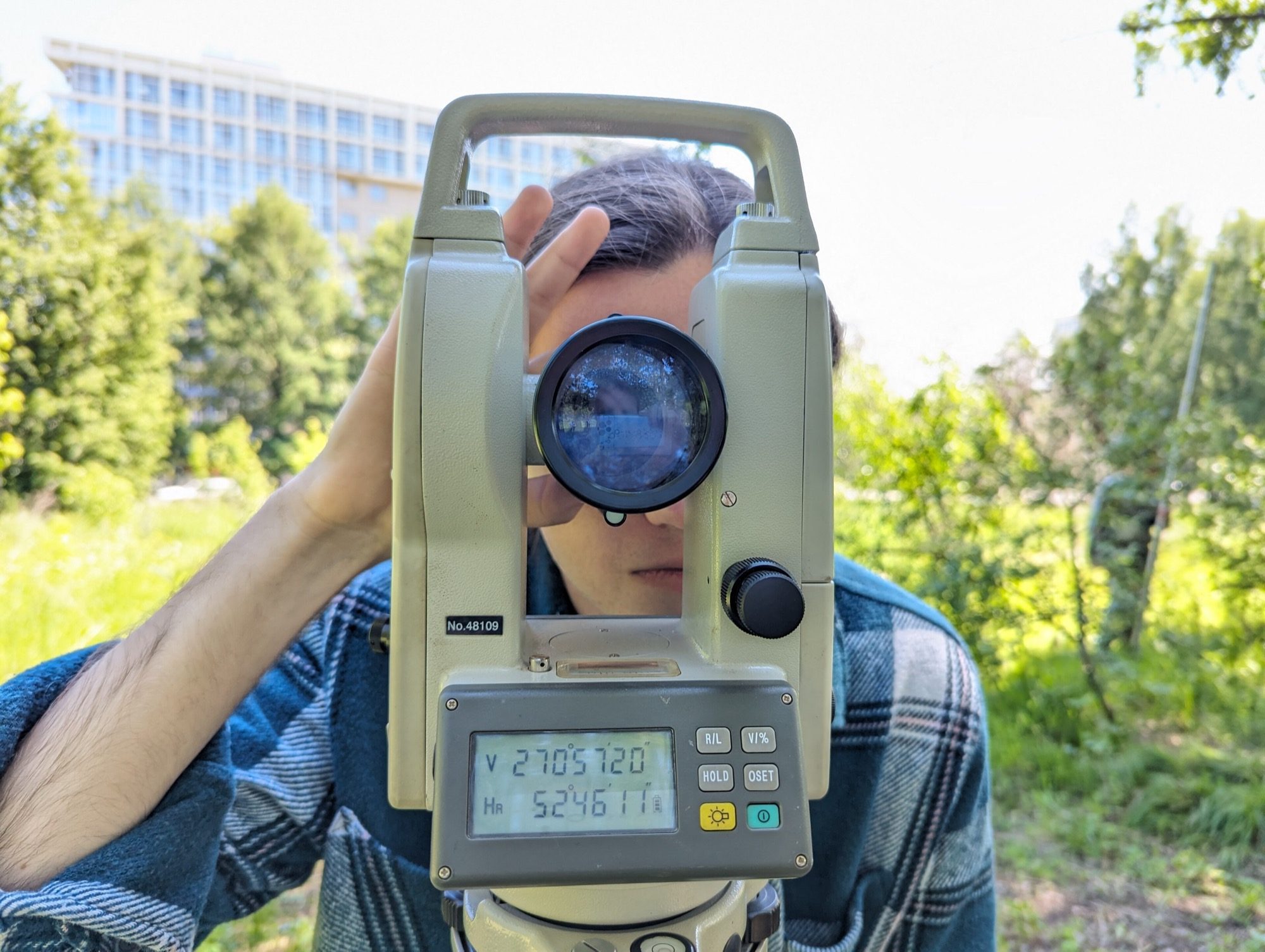
Theodolite Survey
Measuring angles precisely — and setting the building out on the ground.
The theodolite is the precision angle-measurer of surveying — and the instrument that puts the architect's drawing onto the ground. With it you measure horizontal and vertical angles, run a traverse, and set out the centre line of a building. This unit also covers bearings and their conversion, and the cutting and filling that levels a sloping site.
Learning objectives
By the end of this lesson, you will be able to — mapped to the course outcomes for Surveying, Levelling & Site Planning:
Describe the theodolite and how it measures horizontal and vertical angles.
Set out a building's centre line and turn angles on the ground.
Convert a whole-circle bearing to a reduced (quadrantal) bearing.
Explain cutting and filling and the balance of earthwork.
The theodolite at work
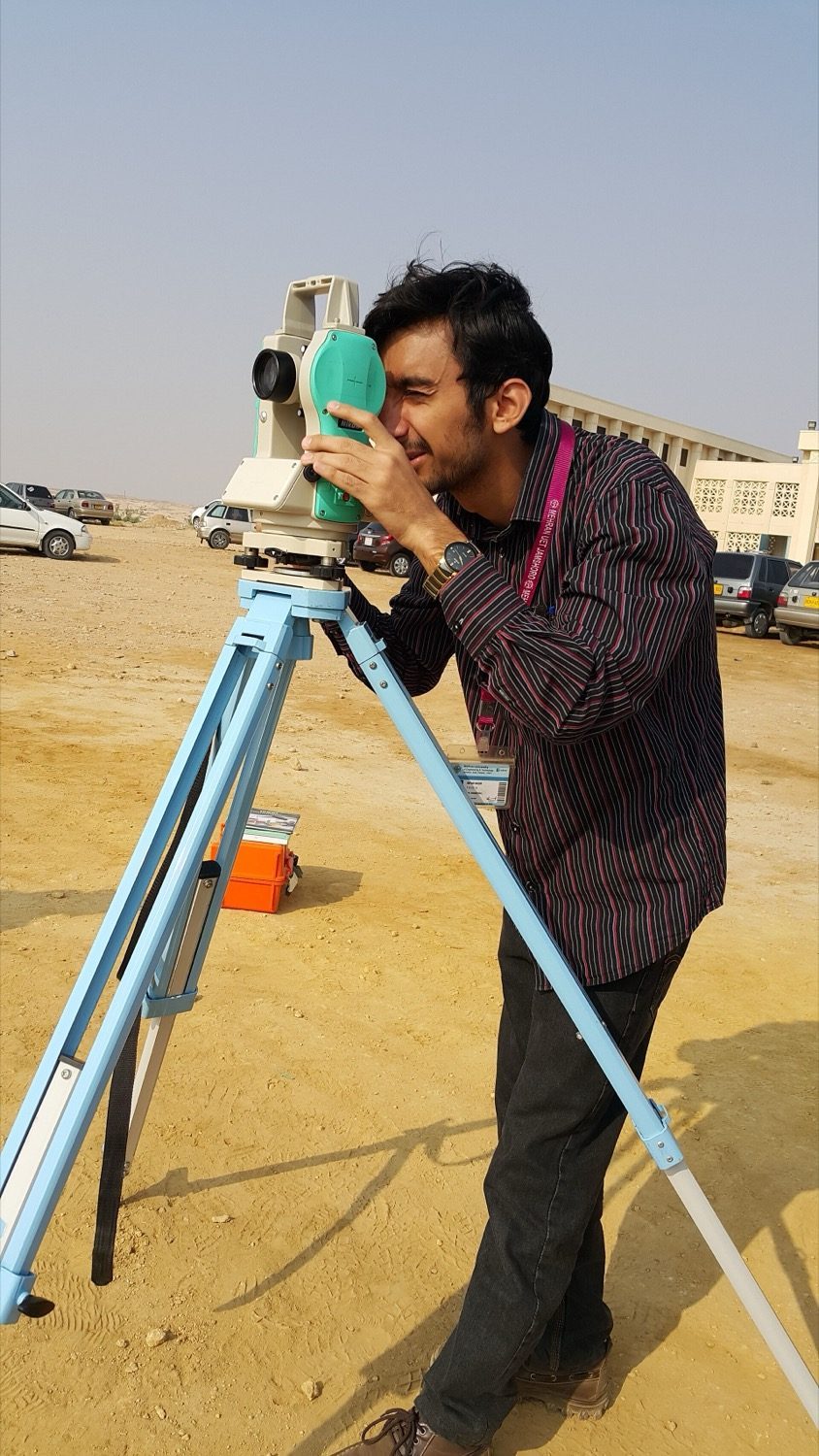
Set up, centred and levelled, the theodolite reads horizontal and vertical angles; from a reference line it sets out a building's corners, runs open or closed traverses, and guides cut-and-fill to the formation level.[1, 2]

Bearings
A whole-circle bearing is measured clockwise from north (0–360°); a reduced bearing is measured from north or south toward east or west (0–90°). Converting between them is a per-quadrant rule.[1]
Whole-circle vs reduced
A whole-circle bearing (WCB) is measured clockwise from north, 0°–360°. A reduced (quadrantal) bearing (RB) is measured from north or south toward east or west, 0°–90°, written like N30°E.[1]
Convert a bearing
Slide the whole-circle bearing and read off the reduced bearing: 120° becomes S 60° E, 210° becomes S 30° W, 300° becomes N 60° W.
Bearing converter · whole-circle → reduced
By quadrant: 0–90 → N(WCB)E · 90–180 → S(180−WCB)E · 180–270 → S(WCB−180)W · 270–360 → N(360−WCB)W.
S 60° E
Reduced (quadrantal) bearing
SE
Quadrant
120° → S 60° E · 210° → S 30° W · 300° → N 60° W · 45° → N 45° E.
The distinctions
| Aspect | One | The other |
|---|---|---|
| Reference | WCB: north only | Reduced: north or south |
| Range | WCB: 0°–360° | Reduced: 0°–90° |
| Notation | WCB: a single number | Reduced: N/S … E/W |
| Traverse | Open: no closure check | Closed: checkable |
| Earthwork | Cut: ground above formation | Fill: ground below formation |
Key terms
Instrument for precise measurement of horizontal and vertical angles.
Angles read on the horizontal and vertical graduated circles.
Temporary adjustments setting the vertical axis over the station and truly vertical.
A bearing measured clockwise from north, 0°–360°.
A bearing from N or S toward E or W, 0°–90° (e.g. N30°E).
A connected series of survey lines — open (no check) or closed (checkable).
The designed finished level of the ground or road.
Excavating ground above, and adding soil below, the formation level — ideally balanced.
Worked example
A line with a whole-circle bearing of 210° lies in the south-west quadrant, so its reduced bearing is S(210 − 180)W = S 30° W. Set out a right angle for a building corner by the 3-4-5 rule and check it on the theodolite. Try a few bearings in the converter.
Self-assessment
1. A theodolite is used chiefly to measure —
2. A whole-circle bearing of 210° converts to —
3. Soil is 'cut' where the existing ground is —
Recap
References & further reading
- [1]B.C. Punmia, A.K. Jain & A.K. Jain, Surveying Vol. I & II. Laxmi Publications.
- [2]S.K. Duggal, Surveying Vol. I & II. McGraw-Hill Education.
- [3]T.P. Kanetkar & S.V. Kulkarni, Surveying and Levelling. PVG Prakashan.
Further reading
- B.C. Punmia, Surveying Vol. I & II.
- S.K. Duggal, Surveying.
- B.F. Kavanagh, Surveying: Principles and Applications. Pearson.
Sources gathered and fact-checked June 2026. Published values vary by source, sample and method — treat as indicative and confirm against the cited standard before structural use.
The author
Amogh N P
Architect, interior designer, and creative polymath. Studio Matrx began in his notebooks — his vision of design made honest, useful, and open to everyone. Its Academy is written and taught in his memory, and free, forever.
More about Amogh →