
 Lesson 0.2
Lesson 0.2 · Foundations: How Architects Read Structure
Forces, Loads & Equilibrium
A building standing still is not doing nothing - it is holding a perfect, invisible balance of forces, and equilibrium is the law that keeps it there
A building that is standing perfectly still is doing something extraordinary - it is holding every force acting on it in exact, silent balance.
A structure at rest is not inert; it is in equilibrium - a state where every push is met by an equal push back, and every twist by an equal untwist, so that nothing moves. The floor you are standing on is pressing up on you exactly as hard as gravity pulls you down. The soil is pushing up on the foundations exactly as hard as the whole building bears down. Remove that balance anywhere - one force unanswered, one moment unbalanced - and something accelerates, which for a building means it deflects, cracks, tips, or falls.
This lesson is the intuitive heart of structural behaviour, and it needs no heavy mathematics. You will learn what a force is and what makes a load, and the two simple conditions of equilibrium - that all forces cancel and all turning effects cancel - which together explain why a building stands. Grasp these and you can look at any structure and ask the only two questions that ever really matter: are the forces balanced, and are the moments balanced?
Loads press in, reactions push back. Where they cancel, the building stands still.
Force, and its three properties
A force is simply a push or a pull - an interaction that tends to change the motion or shape of the thing it acts on. In a building nothing is moving, so forces show up instead as internal effort: the squeezing, stretching and bending inside members as they resist being deformed. To describe any force completely you need three things, and all three matter to how a structure behaves.
Magnitude - how big it is, measured in newtons (N) or kilonewtons (kN); a kilonewton is very roughly the weight of a 100 kg mass. Direction - which way it acts; a downward force and a sideways force of the same size do utterly different things to a column. Point of application - where on the structure it acts; the same load near a beam's support is gentle, while at its mid-span it is far more demanding. Because a force has both magnitude and direction, it is a vector, which is why we draw it as an arrow: the arrow's length is the magnitude, its slant is the direction, and its tail sits at the point of application.
Forces also come in two geometric flavours you will meet constantly. A point (concentrated) load acts at a single spot - a column landing on a beam, a machine bolted to a floor. A distributed load is spread along a length or over an area - the self-weight of a slab, snow on a roof, a crowd on a floor - and is measured per metre or per square metre. Reading whether a load is concentrated or spread, and where it sits, is the first move in understanding what any member must endure. The same total weight behaves very differently depending on how it is spread: a tonne carried on one small point punishes a beam far more than the same tonne laid evenly along it, which is why concentrated loads deserve a designer's respect.
Every force is an arrow: how big, which way, and where. Miss any of the three and you misread the structure.
From forces to loads: what a building must carry
A load is a force (or a family of forces) that a structure is expected to carry. Codes such as India's IS 875 classify them, because you cannot design a load path until you know honestly what will travel down it. The families are worth knowing by name.
Dead loads are the permanent, unchanging weight of the building itself - the slabs, beams, walls, finishes, fixed services. They never leave, and they are the most predictable. Live (imposed) loads are the movable, variable weights the building is used by - people, furniture, vehicles, stored goods - which come and go and so are estimated statistically as a worst credible case. Together these are the gravity loads, and they act downward.
Then come the loads that do not simply press down. Wind loads push and suck on the faces and roof of a building, acting sideways and sometimes upward (uplift). Seismic loads are not really an external push at all but the inertia of the building's own mass as the ground shakes beneath it - which is why a heavier building attracts a bigger earthquake force. There are also thermal effects (materials expand and contract), earth and water pressure on basements and retaining walls, and dynamic effects from moving machinery or dancing crowds. The crucial design habit is that these loads combine: a building must survive dead-plus-live in ordinary use, and dead-plus-wind or dead-plus-earthquake in extremes, and codes prescribe the combinations to check. Underestimating a load, or forgetting a whole family of it, is how a load path that looked adequate turns out not to be.
Equilibrium: the two conditions that keep it still
Here is the entire secret of why a building stands, and it fits in two lines. For any object at rest, the forces must balance and the turning effects must balance. Written compactly they are the equations of static equilibrium: the sum of all forces equals zero, and the sum of all moments equals zero. In symbols, the sum of F is zero and the sum of M is zero. You do not need to solve them to use them; you need to feel them.
The first condition - all forces sum to zero - means that in every direction, the pushes one way exactly equal the pushes the other way. If a beam carries 100 kN of load pressing down, its two supports must push up with a total of exactly 100 kN. If they pushed up with less, the beam would fall; with more, it would fly. Those upward pushes from the supports are called reactions, and the whole art of the simplest structural analysis is finding the reactions that make the forces balance.
The second condition - all moments sum to zero - is about turning rather than sliding. A moment is the turning effect of a force, and it equals the force multiplied by its perpendicular distance from a pivot (the lever arm). This is why a small child can balance a heavier adult on a seesaw by sitting further out: a smaller force with a longer arm can equal a larger force with a shorter one. A building must not rotate or overturn, so about every point the clockwise moments must exactly cancel the anticlockwise ones. Wind trying to tip a tower is resisted by the building's own weight acting through its base - a moment answered by a moment. When you look at a structure and sense whether it will slide or topple, you are feeling these two conditions at work.
Two questions, always: do the forces cancel, and do the twists cancel? If both, it stands.
Why a building at rest is a balance of forces
Put the pieces together and the still, silent building reveals itself as a busy negotiation. Every load that lands enters the load path, and at every junction the members generate exactly the internal forces and reactions needed to keep both equilibrium conditions satisfied - no more, no less. The structure is, in effect, solving those two equations continuously, in real time, with steel and concrete instead of algebra.
This is also the deep meaning of Newton's third law in a building: for every action there is an equal and opposite reaction. You press down on the floor; the floor presses up on you. The column presses down on the footing; the footing presses up on the column. The building presses down on the soil; the soil presses up on the building. Nowhere in a standing structure is a force left without its equal and opposite partner - and the moment one is, that spot is accelerating, which is the physicist's word for failing.
This intuition is quietly powerful for a designer. It tells you that a load never disappears - it can only be passed on, so you had better know where it goes next. It tells you that a heavy roof needs a genuine path down to genuinely stiff supports, and that a tall thin building leaning against the wind needs real weight or real anchorage to answer the overturning moment. And it tells you why stability is not automatic: a structure can be perfectly strong in every member and still overturn or sway if the global balance of moments was never resolved.
There is one more layer worth naming, because it separates the calm building from the shaky one: equilibrium can be stable, neutral or unstable. A marble at the bottom of a bowl is in stable equilibrium - nudge it and it returns; a marble on a flat table is neutral; a marble balanced on top of a dome is in unstable equilibrium, poised but ready to run away at the first disturbance. Buildings must aim for stable equilibrium, where any small push is quietly resisted and the structure settles back, rather than the knife-edge balance that a gust or a tremor can tip into collapse. A wide base, weight low down, and members braced against sideways movement are all ways of making the balance a stable one. Equilibrium is the frame on which every later topic - beams, columns, frames, foundations, lateral systems - is hung. Learn to see it, and structure stops being mysterious and starts being a balance you can read.
IS 875 (Parts 1-5)
Design loads for buildings and structures (India)
Defines dead, live, wind, snow and other loads and the combinations to check - the numbers you feed the load path.
IS 1893
Criteria for earthquake resistant design of structures (India)
Turns ground shaking into the seismic (inertia) load a building must resist; central to the resist and stabilise duties.
ASCE 7
Minimum design loads for buildings (United States)
The global counterpart to IS 875; same idea of load families and combinations, different national values.
Static equilibrium (sum F = 0, sum M = 0)
The two conditions every structure at rest must satisfy
Not a code but the physical law beneath them all; finding reactions is just solving these two conditions.
Workshop - find the balance in a simple beam
Equilibrium becomes real the moment you find the reactions that make a load balance. This is a paper exercise - no engineering software, just the two conditions and a bit of arithmetic you can do in your head.
Paper and pencil only. A calculator is optional; the point is the reasoning, not the decimals.
Goal: prove a beam is in equilibrium by finding its reactions
Inputs: paper, pencil, and the willingness to draw an arrow for every force
Time: ~25 minutes
- 1Draw a simple beam resting on two supports, one at each end, spanning (say) 4 metres. This is your free body.
- 2Place a single point load of 100 kN exactly at the mid-span and draw it as a downward arrow at that point.
- 3Apply the first condition (forces balance): the two upward reactions must together equal 100 kN. Because the load is central and the beam symmetric, reason that each support carries half - 50 kN up - and draw those arrows.
- 4Now move the load to one-quarter span and reason again: the nearer support must carry more. Use the moment condition (turning effects balance about one support) to argue which reaction grows and roughly by how much.
- 5Write one sentence stating why the beam is in equilibrium in both cases - forces sum to zero and moments sum to zero - and one sentence on what would happen if a support could only push up 30 kN.
You’ll walk away with
A one-page free-body sketch of a beam under a point load in two positions, with the reactions found and labelled, and a short written statement of why each case is in equilibrium.
Three altitudes on the same idea
Read the band that fits you — or all three.
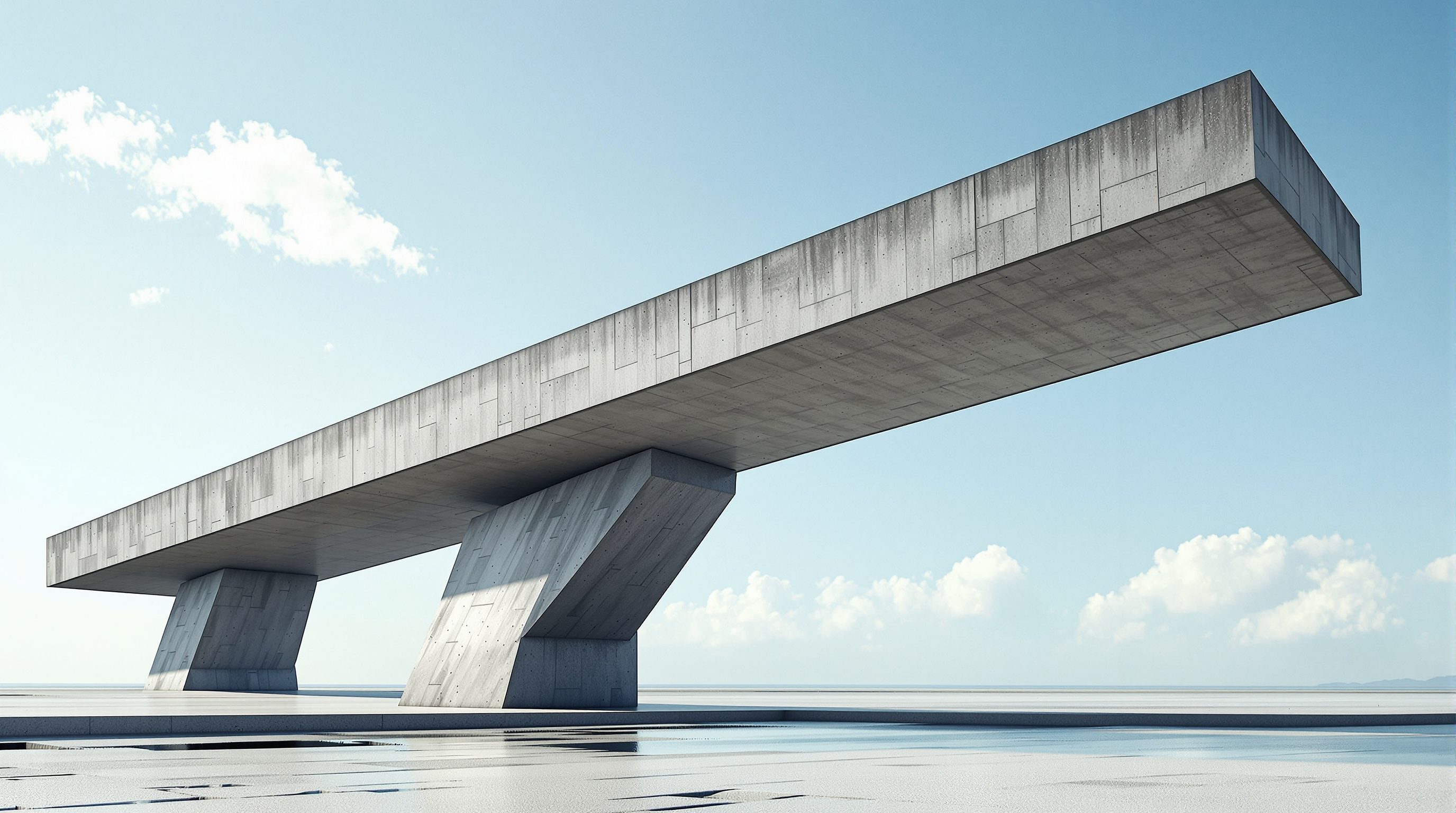
Equilibrium is your reality check on any bold form. A cantilever, a leaning tower, a great clear span - each is a statement about balance, and you should be able to feel, before any calculation, where the load goes and what answers the overturning it invites. When you propose a dramatic move, ask immediately: what force, and what weight or anchor, balances it? Designing with that instinct means your daring forms are already structurally plausible when they reach the engineer.
Loads are the reason weight placement is never neutral. A heavy stone island, a wall of full bookshelves, a planted terrace, a water feature - each adds real live and dead load to a floor that was designed for an assumed limit. Before you place concentrated weight, ask what member is underneath and whether it was ever meant to carry it. When in doubt, distribute the load or have the floor checked; a floor in equilibrium under its design load is not automatically in equilibrium under yours.
Make the two conditions of equilibrium your constant companions. For any structure you study, sketch a free body, mark every load as an arrow, and check that forces balance and moments balance. You will not always solve them by hand in this course, but the habit of asking will make columns, beams and foundations feel obvious later. Equilibrium is the one idea that, truly internalised, makes the rest of structures click into place.
“A building that is just standing there, not moving, has no forces acting on it - it is at rest, so it can relax.”
Do it yourself
Reason it through - no tools needed.
- 1State the three properties needed to fully describe a force.
- 2Give one dead load and one live load in a room you are sitting in.
- 3State the two conditions of static equilibrium in plain words.
- 4Explain, using the seesaw idea, how a small force can balance a large one.
- 5Why does a heavier building attract a larger earthquake force?
The one line to carry out
Peer-reviewed journals & authoritative standards
- 01IS 875: Design loads for buildings and structures — Bureau of Indian Standards, 2015.
- 02Salvadori, M. - Why Buildings Stand Up — W. W. Norton, 1990.
- 03Mechanics & Materials / Structures — MIT OpenCourseWare, 2024.
- 04Schodek & Bechthold - Structures — Pearson, 2013.
We can now read the forces and the balance they must keep. Next we follow a single load on its whole journey - roof to beam to column to foundation to soil - and meet the idea of the load path as a design decision in its own right.
The author
Amogh N P
Architect, interior designer, and creative polymath. Studio Matrx began in his notebooks — his vision of design made honest, useful, and open to everyone. Its Academy is written and taught in his memory, and free, forever.
More about Amogh →