
 Lesson 9.3
Lesson 9.3 · Growing, Sustaining & Protecting
Managing Risk
You cannot prevent every shock, but you can make your homestay resilient enough to survive them.
The hosts who last are not the ones who avoid every problem - they are the ones whose business can take a hit and keep going.
Run a homestay long enough and things will go wrong: a guest will have an accident, a monsoon will wash out a season, a booking wave will cancel overnight, a rule will change, a review will be unfair. The goal is not to eliminate risk - that is impossible - but to build a business resilient enough that no single shock can sink it. That is a skill, and a mindset, and it is what separates the host still going in year ten from the one who quit after a bad year two.
Resilience has three moves, and this lesson covers all three: see the risks clearly and honestly, prevent the ones you can at low cost, and cushion the ones you cannot - through insurance, reserves and simple policies - so that when a shock lands, it is a setback and not a catastrophe. None of this is glamorous. All of it is what keeps the lights on.
Resilience = see + prevent + insure + reserve + plan. Ordinary home insurance won't cover guests.
See the risks: a simple matrix
You cannot manage a risk you have not named, so start by listing them and sorting by two questions: how likely is it, and how badly would it hurt? That simple sort - a risk matrix - tells you where to spend your attention and money.
- Low-likelihood, high-impact: a fire, a serious guest injury, a natural disaster. Rare, but potentially ruinous - the domain of prevention and insurance. - High-likelihood, high-impact: a bad season, a prolonged slump. Likely and costly - the domain of reserves and a resilient cost base. - High-likelihood, low-impact: the occasional cancellation, a minor complaint, a maintenance niggle. Frequent but survivable - the domain of good policies and routines. - Low-likelihood, low-impact: minor, rare annoyances - just absorb them.
The common host mistakes are to obsess over the dramatic-but-rare while ignoring the likely-and-costly bad season, or to carry no cushion at all. Mapping your own risks onto this matrix, honestly, is the first and most clarifying step. It turns a vague anxiety into a short list of specific, manageable things.
Sort every risk by likelihood x impact. Spend on prevention+insurance for rare-severe, reserves for likely-costly, policy for frequent-small.
Prevent what you can - safety first
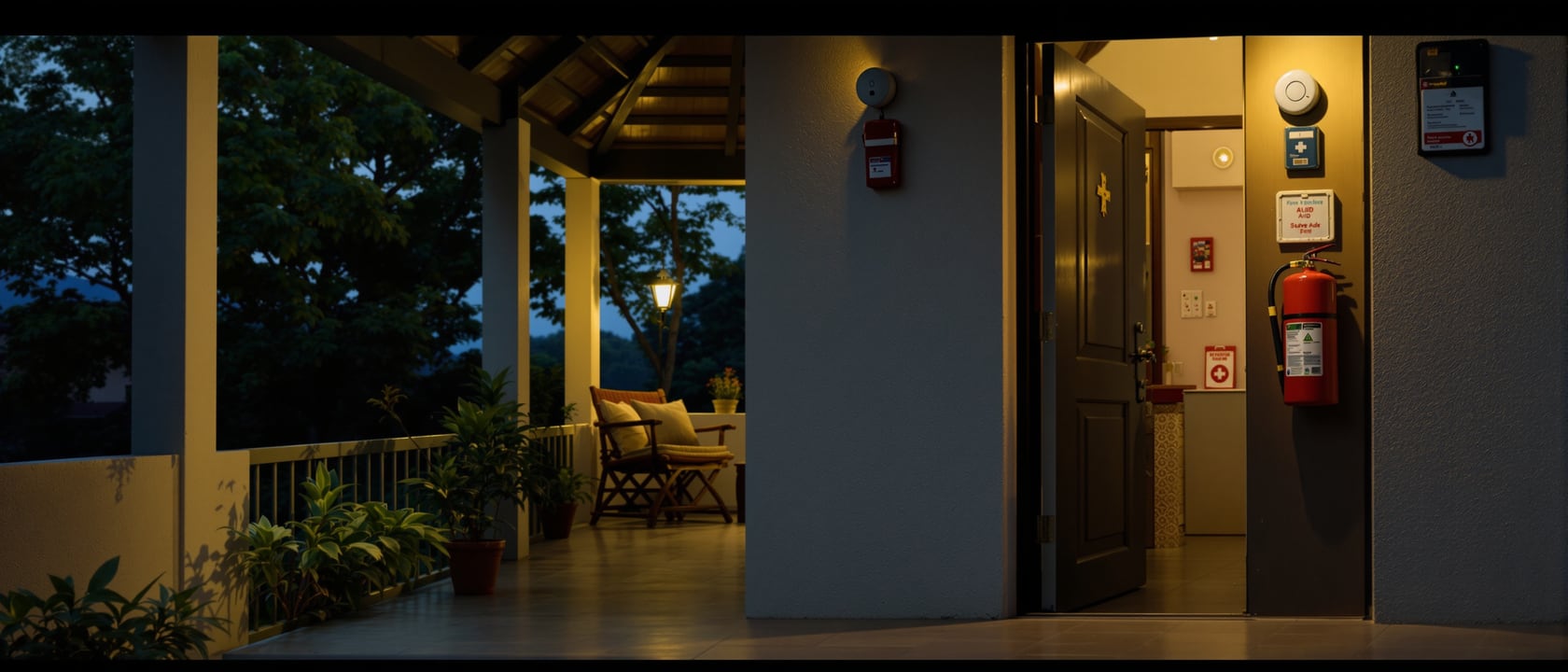
The cheapest risk is the one that never happens, and the highest-stakes category - guest safety and your resulting liability - is also the most preventable. You carry a genuine duty of care to guests in your home, and most of it is designed and maintained in, not bolted on after an incident: working smoke and gas-leak alarms, a serviced fire extinguisher you know how to use, clear unobstructed exits, safe electrics with an RCCB, non-slip wet-area floors, secure railings and stairs, and a stocked first-aid kit. Keep basic records too - a guest register as your state requires, and a note of any incident.
The same preventive instinct applies beyond safety: good screening and clear house rules prevent many difficult-guest situations; solid maintenance prevents the breakdown mid-stay; honest listings prevent the furious 'not as described' review. Prevention is unglamorous and it is where resilience is cheapest to buy. For the design side of safety, revisit [Accessibility & Safety](/students/start-and-run-a-homestay/accessibility-and-safety); for the compliance side, the [Three-Layer Compliance Stack](/students/start-and-run-a-homestay/the-three-layer-compliance-stack).
Cushion the rest: insurance and reserves
Some risks you cannot prevent, only cushion - and the two great cushions are insurance and cash.
Insurance is the transfer of ruinous, rare risk to someone who pools it. Crucially, an ordinary home insurance policy usually does not cover paying guests, so you need the right cover: property insurance that recognises the commercial use, and - importantly - public liability cover in case a guest is injured and you are held responsible. Talk to an insurer who understands homestays and read what is and is not covered; this is a defer-to-a-professional area, and being under-insured is a quiet, serious risk.
Reserves are the cushion for the likely-and-costly risks that insurance will not touch - above all the bad season. Because almost every Indian homestay region has a long, lean trough, a resilient operation keeps several months of fixed costs in reserve, built up during the peak, so a weak season or a sudden slump is survived rather than fatal.

Together, insurance caps your worst-case loss and reserves carry you through the lean stretches - the two together are most of financial resilience.
Ordinary home insurance does NOT cover paying guests. Get property + public-liability cover. Keep months of fixed costs in reserve.
Plan for the predictable shocks
Beyond the one-offs, a few shocks are predictable enough to plan for directly. Cancellations are a constant in hospitality: set a clear, fair cancellation policy, consider a sensible deposit, and diversify across booking channels and guest types so no single cancellation wave empties your calendar. The bad season is not an if but a when: price into the peak, hold the reserve, keep your fixed costs lean, and decide in advance whether you will market the off-season, close for maintenance, or ride it out. Regulatory change - a new rule, a changed room cap, a fresh registration requirement - is also a when: stay registered, keep in touch with your state tourism department, and build on the right side of the law so a change is an adjustment, not an existential threat.
The thread through all of it is the same: you will not see every shock coming, but you can make the business one that bends rather than breaks. A host who has named the risks, prevented the preventable, insured the ruinous, reserved for the lean, and planned for the predictable is about as resilient as a small business can be - and free, as a result, to enjoy the hosting.
In practice: one host's resilience plan on a page
Here is what the whole lesson looks like assembled into one host's actual plan - the deliverable this lesson builds toward.
Prevented: smoke and gas alarms in every room and the kitchen, a serviced extinguisher by the stairs, an RCCB on the board, non-slip tiles in the bathrooms, railings checked each season, a stocked first-aid kit, a guest register kept as the state requires, and clear house rules shared before arrival. Cost: small and mostly one-off. Effect: the high-impact safety risks are made genuinely unlikely, and the duty of care is met.
Insured: a property policy that declares the homestay use, plus public-liability cover for guest injury, arranged with a broker who understood homestays and reviewed annually. Cost: a modest yearly premium. Effect: the rare, ruinous risks are transferred rather than carried.
Reserved: four months of fixed costs banked during the two-month peak and held untouched. Effect: the long monsoon trough is survived every year without panic or debt.
Planned: a clear cancellation policy with a deposit; bookings spread across two OTAs plus direct so no single wave empties the calendar; a decision, made in advance, to run a reduced off-season rather than close; and a standing note to re-check state rules each year. Effect: the predictable shocks are handled by routine, not crisis.
That single page - prevent, insure, reserve, plan - is the difference between a host rattled by every setback and one who sleeps soundly. Build yours against the [registration and safety framework](/guides/homestay-registration-and-licensing-india) and your own numbers.
Risk matrix
Sorting risks by likelihood and impact
Tells you where to spend attention: prevent+insure the rare-severe, reserve for the likely-costly, policy for frequent-small.
Public liability insurance
Cover if a guest is injured and you are held responsible
Essential for a homestay and usually absent from ordinary home policies. Defer to an insurer who knows homestays.
Duty of care
A host's legal/moral responsibility for guests' safety
Met mostly through designed-in and maintained safety: alarms, extinguisher, safe electrics, clear exits, first-aid.
Cash reserve
Months of fixed costs kept to survive a slump
The cushion insurance will not provide - above all for the inevitable lean season. Build it during the peak.
Workshop - your resilience audit
The skill is turning a vague worry about 'things going wrong' into a clear, sorted list with a concrete action against each - the difference between anxiety and preparedness.
A notebook; then a conversation with an insurer and a CA to confirm cover and reserves.
Goal: a risk register and resilience plan for your homestay
Inputs: honesty about your situation + a notebook
Time: ~35 minutes
- 1List every risk you can think of: safety incident, difficult guest, cancellations, bad season, maintenance failure, rule change, disaster.
- 2Tag each by likelihood (low/high) and impact (low/high), and place it in the matrix quadrants.
- 3For each rare-but-severe risk, note the prevention step AND the insurance that would cover it - then check whether you actually have that cover.
- 4For the bad-season risk, calculate how many months of fixed costs you would want in reserve, and whether you are building it.
- 5For the frequent-small risks (cancellations, complaints), write the policy that would handle them routinely.
- 6Pick the three most important gaps (e.g. no public-liability cover, no reserve, a missing smoke alarm) and make them your action list.
You’ll walk away with
A risk register sorted by likelihood and impact, with a prevention / insurance / reserve / policy action against each, and your top three gaps as an action list.
Three altitudes on the same idea
Read the band that fits you — or all three.
As the owner-host, resilience is your job and nobody else's - build it deliberately. Run the risk matrix on your own operation, fix the cheap preventable hazards now, get properly insured for property and public liability (ordinary home cover will not do), and discipline yourself to bank a reserve of several months' fixed costs during the peak. It is unglamorous work that you will be deeply grateful for the first time a season goes wrong or a guest has an accident.
If you design the homestay, you design out a large share of its risk. Safe electrics and RCCBs, non-slip wet areas, secure railings and stairs, clear exits, smoke and gas alarms, good maintenance access - these are design and specification decisions, cheapest built in. A home designed for safety protects the guest and shields the owner from liability, and advising the client on insurance and the compliance stack rounds out a genuinely professional service.
If you are new, learn to think in likelihood and impact rather than fear. Beginners either ignore risk entirely or are paralysed by it; the professional habit is to name risks, sort them by likelihood and impact, and act proportionately - prevent, insure, reserve, or absorb. Learn what insurance actually covers, why reserves matter against the seasonal trough, and what a host's duty of care involves. This calm, structured way of handling risk is a transferable skill far beyond homestays.
“Risk management means buying insurance - once I have a policy, I'm covered.”
Do it yourself
Reason it through for your own place.
- 1What two questions sort risks in a risk matrix, and what should you do with a likely-and-costly risk?
- 2Why is an ordinary home insurance policy often inadequate for a homestay?
- 3What is a host's duty of care, and name three ways it is met.
- 4Why is a cash reserve essential even if you are well insured?
- 5Name two predictable shocks and the standing plan each one calls for.
The one line to carry out
Peer-reviewed journals & authoritative standards
- 01Hospitality industry — Wikipedia, 2026.
- 02Homestay Registration & Licensing (Studio Matrx) — Studio Matrx, 2026.
- 03Homestay Profitability (Studio Matrx) — Studio Matrx, 2026.
Having protected the business against shocks, the final question of the module is a happier one: whether, and how, to grow it - or to keep it deliberately small.
The author
Amogh N P
Architect, interior designer, and creative polymath. Studio Matrx began in his notebooks — his vision of design made honest, useful, and open to everyone. Its Academy is written and taught in his memory, and free, forever.
More about Amogh →