
 Lesson 1.3
Lesson 1.3 · Reveal the floor
The Open-Plan Question for Indian Homes
Open plan is the small-home dream — and the place Western advice fails us hardest. The deciding factor isn't taste or trend. It's what you cook, and how much of it.
An open kitchen looks beautiful in a magazine shot. Then you temper mustard seeds in hot oil, and within a week a fine film of it coats your sofa, your curtains, and the television across the room.
In the last two lessons you learned to remove walls and zone the open space that's left. The kitchen is where that ideal collides with physics — specifically, the physics of Indian cooking.
Western open-plan content is written for kitchens that boil pasta and bake. Indian kitchens fry, temper, and flame-roast — producing oil aerosols, smoke and powerful aromas that an open plan spreads through the entire home. So the open-plan question can't be answered by style. It has to be answered by your stove.
It's not smoke — it's oil in the air
The reason an open Indian kitchen misbehaves isn't visible smoke; it's aerosolised oil. High-heat tempering (tadka), deep-frying and dry-roasting throw microscopic oil droplets into the air. They drift, settle, and turn into a sticky film on every surface they reach — and they carry smell with them.
| Cooking style | What it puts in the air / open plan? |
|---|---|
| Boil / steam / bake | Mostly steam — disperses, doesn't stick. Usually fine. |
| Sauté / light fry | Some oil aerosol + aroma. Manageable with extraction. |
| Tadka / deep-fry / roast | Heavy oil aerosol + strong aroma + smoke. Spreads through the home. |
The honest answer is usually a third thing
This is why the honest answer is rarely “open” or “closed” — it's usually a third thing that keeps sightlines and light open while stopping the oil. The decision tool below finds your answer.
What each answer actually means
Open — for light cooking and tight flats. No barrier; kitchen flows into living. Maximum space, light and sightline. Right when your cooking is mostly steam-and-sauté, or when the flat is so tight that openness outweighs the occasional smell. Pair with strong extraction (a powerful chimney) to manage the rest.
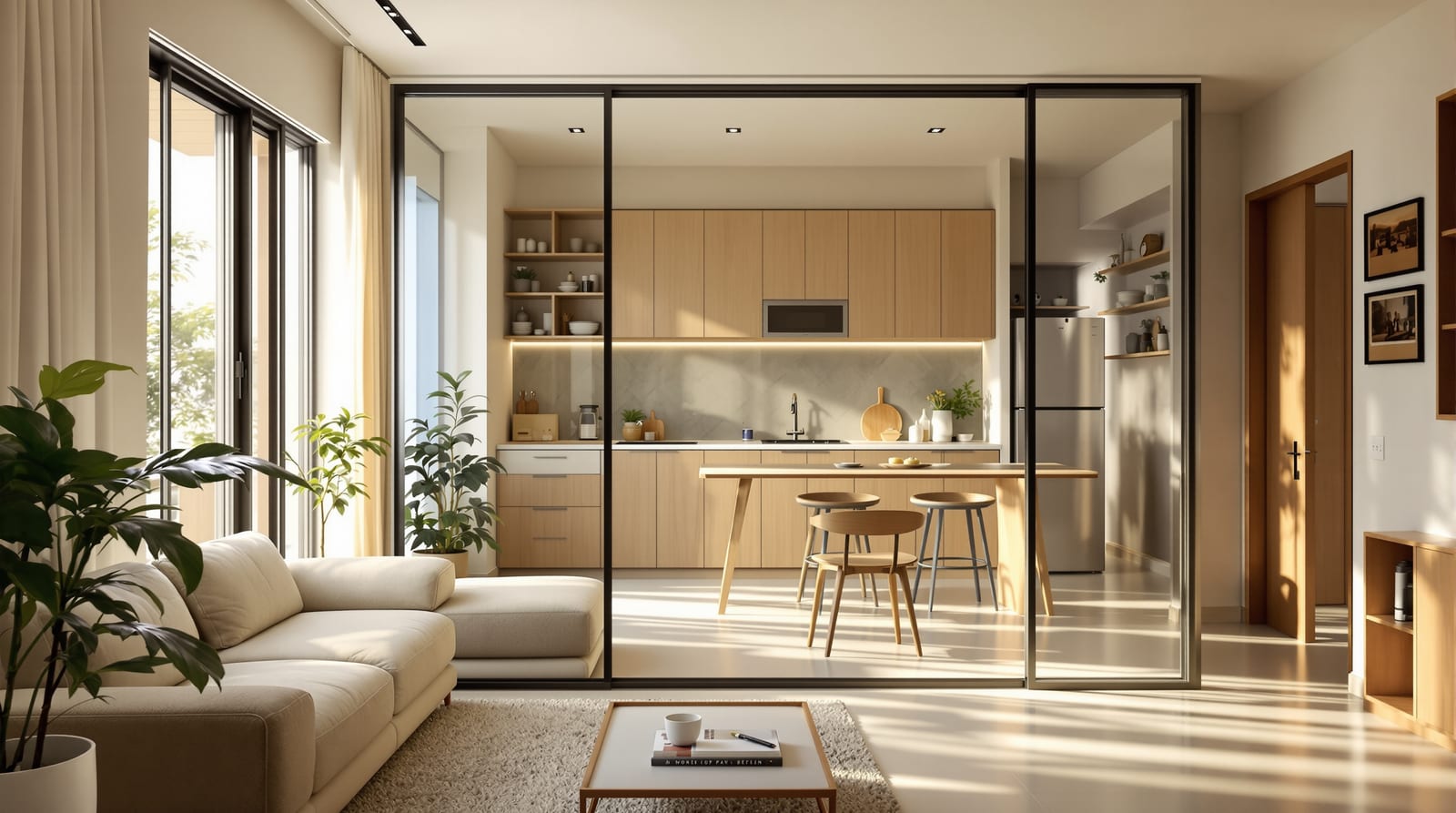
Glass partition — the Indian sweet spot. A glass wall or sliding glass door: light and sightlines pass through, oil and smoke don't. You keep the visual openness that makes a small home feel large, and contain the tadka. For most Indian compact homes that fry daily, this is the honest answer — open to the eye, closed to the air.
Closed — for heavy cooking and entertaining. A real wall and door. Right when you fry and roast daily, host crowds, or simply value a contained kitchen. You lose openness, but a borrowed-light window or an internal glass panel can give some of it back. Closed need not mean dark.
Go deeper — extraction is half the decision
The open-vs-closed choice is really a choice about how much you trust your extraction. A high-suction chimney (look for 1200+ m³/hr for serious Indian frying), ducted to the outside rather than recirculating, removes most oil aerosol at source. With genuinely good extraction, an open kitchen becomes viable for cooking that would otherwise demand a wall.
The professional sequence: decide the cooking intensity first, then spec extraction to match, then choose the boundary. A common mistake is choosing an open plan for looks, under-speccing the chimney to save cost, and ending up with the worst of both — grease everywhere and no way to contain it. Extraction is not an accessory to this decision; it's part of it.
Open, glass, or closed? Find your kitchen's answer
Answer three questions about how your home actually cooks and lives. The tool weighs them and recommends the kitchen boundary that fits — the same logic a designer applies, made explicit.
Fig 1.3 — Three boundaries, one logic: keep openness wherever the oil allows, close only where it must.
Fig 1.3 — Three boundaries, one logic: keep openness wherever the oil allows, close only where it must.
A family that makes daily tadka and deep-fries pakoras falls in love with an open-kitchen photo and removes the kitchen wall in their compact flat. What's the most likely outcome?
Run the method yourself
Run the real version of the tool above on your own home, honestly.
- 1Watch yourself cook for three days. Note how often you do high-heat tadka, frying or roasting versus boiling and sautéing. Be honest about the real pattern, not the aspirational one.
- 2Check the light. Stand in your living area at midday. How much of its light comes through or past the kitchen? If a lot, lean toward glass over a solid wall.
- 3Pick your boundary. Heavy frying + tight flat → glass partition. Light cooking → open with good extraction. Heavy frying + you host crowds → closed, with a borrowed-light window.
- 4Spec the extraction to match before you finalise the boundary — it can move the decision a whole step toward open.
- The open-plan question for Indian homes is decided by cooking intensity, not style. Tadka and frying throw aerosolised oil that an open plan spreads everywhere.
- Three boundaries: open (light cooking / very tight flats), glass partition (the Indian sweet spot — open to light, closed to oil), closed (heavy frying / entertaining).
- The glass partition is usually the honest answer for compact homes that fry daily.
- Extraction is part of the decision — good ducted suction can move an open kitchen from impossible to viable.
You can now subtract circulation, zone without walls, and decide the kitchen boundary. Time to put it together — what does it look like to re-plan one whole flat with the Subtract lever, start to finish?
The author
Amogh N P
Architect, interior designer, and creative polymath. Studio Matrx began in his notebooks — his vision of design made honest, useful, and open to everyone. Its Academy is written and taught in his memory, and free, forever.
More about Amogh →