
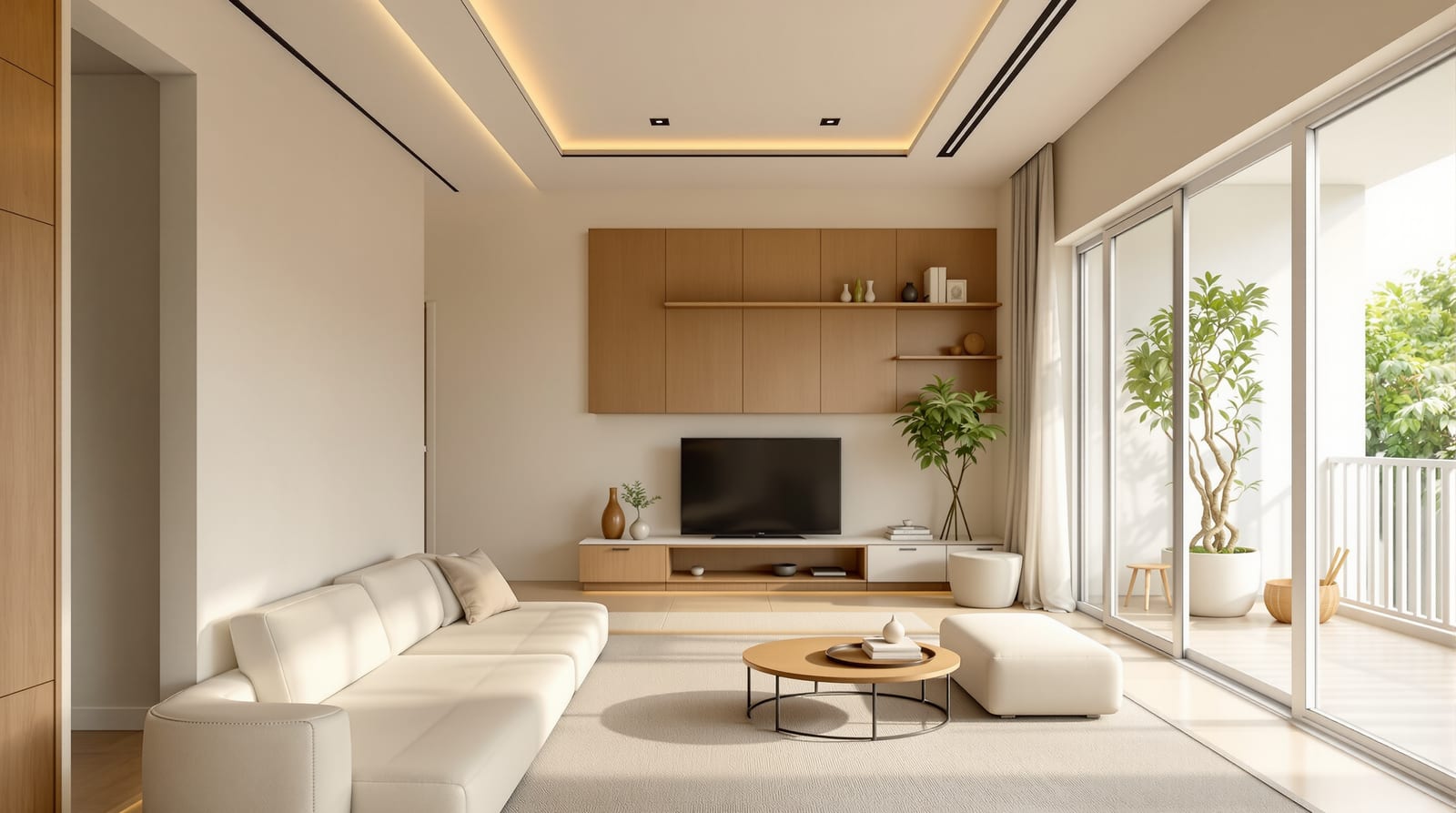
 Lesson 2.1
Lesson 2.1 · Reach outward
The Extend Principle: Borrowing Space You Don't Own
Subtract revealed the floor; Layer multiplied it. The third lever reaches past the walls entirely — borrowing light, air, depth and the view to make a room feel larger than its measured size. Because how big a room _feels_ is a thing you can design.
Two rooms can measure exactly the same on the floor plan, and one feels like a cell while the other feels like a retreat. The difference isn't square feet. It's everything the room borrows from beyond its own four walls.
The first two levers worked on the floor you have. The Extend lever is different in kind: it doesn't add or rearrange a single square foot. It changes how large the space you already own feels — by borrowing what lies beyond the walls.
And perceived space is not a trick or a consolation prize. To the person living there, a room that feels open and bright is more spacious in every way that matters day to day. Extend is the lever that makes a genuinely small home stop feeling small.
Measured space and felt space
Every room has two sizes. One you can measure with a tape; the other you feel the moment you walk in. The Extend lever works entirely on the second.
Measured space — The number on the plan — carpet area in square feet. Fixed by the walls. Subtract and Layer stretch how much function this number holds, but the number itself doesn't move without construction.
Felt space — How large the room seems to the body — driven by light, sightlines, depth, air and the view out. Two rooms of identical carpet area can feel a third larger or smaller. This is what Extend designs, and it costs no floor at all.
The whole Extend lever rests on one claim, which the interactive below will let you feel directly: the size a room seems is something a designer controls — through what the room borrows from light, distance, and the world outside its walls.
Four things to reach for
The Extend lever has four sources of borrowed space. The rest of this module takes the first two deep; the others belong to Module 3 and beyond. All of them add felt space without adding floor.
1 · Light — A bright room reads as larger and more open; a dim one closes in. Borrowing light — pulling it deeper into the plan, bouncing it off pale surfaces, sharing it between rooms through glass — is the single most powerful Extend move. (Lesson 2.2.)
2 · Air & the long view — A room you can see through — to a far wall, a window, a balcony, the sky — feels deeper than its walls. Cross-ventilation and sightlines extend a room into the space beyond it. (Lesson 2.3.)
3 · Height — Most small Indian homes have more vertical room than they use. Drawing the eye upward, and using the volume above head height, extends a room into space that was always there. (Module 3.)
4 · The outside — The balcony, the threshold, the view itself — bringing the outdoors into the room's felt boundary makes the whole flat live larger than its sealed footprint. (Lesson 2.4.)
Go deeper — why Extend comes last, and needs the other two
Extend is third in the sequence for a reason. Borrowed light and long sightlines only work in a room that has been cleared (Subtract) and isn't crammed (Layer). A heavy cupboard blocking the window kills borrowed light; a clutter of mismatched furniture breaks the long view. You cannot extend a room you haven't first subtracted and layered — the borrowed space has nothing to travel through.
This is why the full lever stack compounds. Subtract opens the floor, Layer keeps it from re-filling, and Extend then makes the cleared, well-used space feel larger still than its true size. A room that has had all three levers pulled — cleared, multiplied, and extended — can live like a home half again its carpet area. That is the whole method, and this module is its final move.
One room, identical floor, two feelings
Here is the same ~120 sq ft room twice — the carpet area never changes. Toggle between “closed in” and “extended” and watch how borrowing light, a long sightline, and the view makes the identical floor feel markedly larger.
Fig 2.1 — Same 120 sq ft. Borrowed light, a long diagonal sightline, a widened view and a mirror make the identical floor feel markedly larger.
Fig 2.1 — Same 120 sq ft. Borrowed light, a long diagonal sightline, a widened view and a mirror make the identical floor feel markedly larger.
A designer says they can make a 120 sq ft room “feel much bigger” without changing its carpet area. Is this a real design outcome, or just a sales line?
Run the method yourself
Stand in the room of your home that feels smallest. The goal: find what it could borrow that it currently doesn't.
- 1Rate the light. Is the room bright or dim at midday? What blocks its light — a heavy curtain, furniture in front of the window, dark walls? Note every blocker.
- 2Find the longest possible view. Stand at the door. What's the farthest point you can see? Could rearranging furniture or a glass panel let your eye travel further — to a window, a balcony, the next room?
- 3Look up, and out. Is there height above head level going unused? Is there a balcony or threshold the room turns its back on?
- 4List three things to borrow. Pick the three highest-impact moves — more light, a longer sightline, the view. That's your Extend brief for the rest of this module.
- The Extend lever adds felt space, not floor — it reaches past the walls for light, air, depth and the view.
- Every room has two sizes: measured (the plan) and felt (how big it seems). Extend designs the second.
- Felt space is real, not a gimmick — to the person living there, a bright, open room is genuinely more spacious.
- Four things to borrow: light, air & the long view, height, the outside.
- Extend comes last and needs the other levers: you can't extend a room you haven't cleared and layered first.
Light is the most powerful thing a small room can borrow. So how do you actually pull daylight deeper into a flat, share it between rooms, and make the light you have travel further?
The author
Amogh N P
Architect, interior designer, and creative polymath. Studio Matrx began in his notebooks — his vision of design made honest, useful, and open to everyone. Its Academy is written and taught in his memory, and free, forever.
More about Amogh →