
 Lesson 3.2
Lesson 3.2 · Reach upward
Lofts, the Atta & Going Up
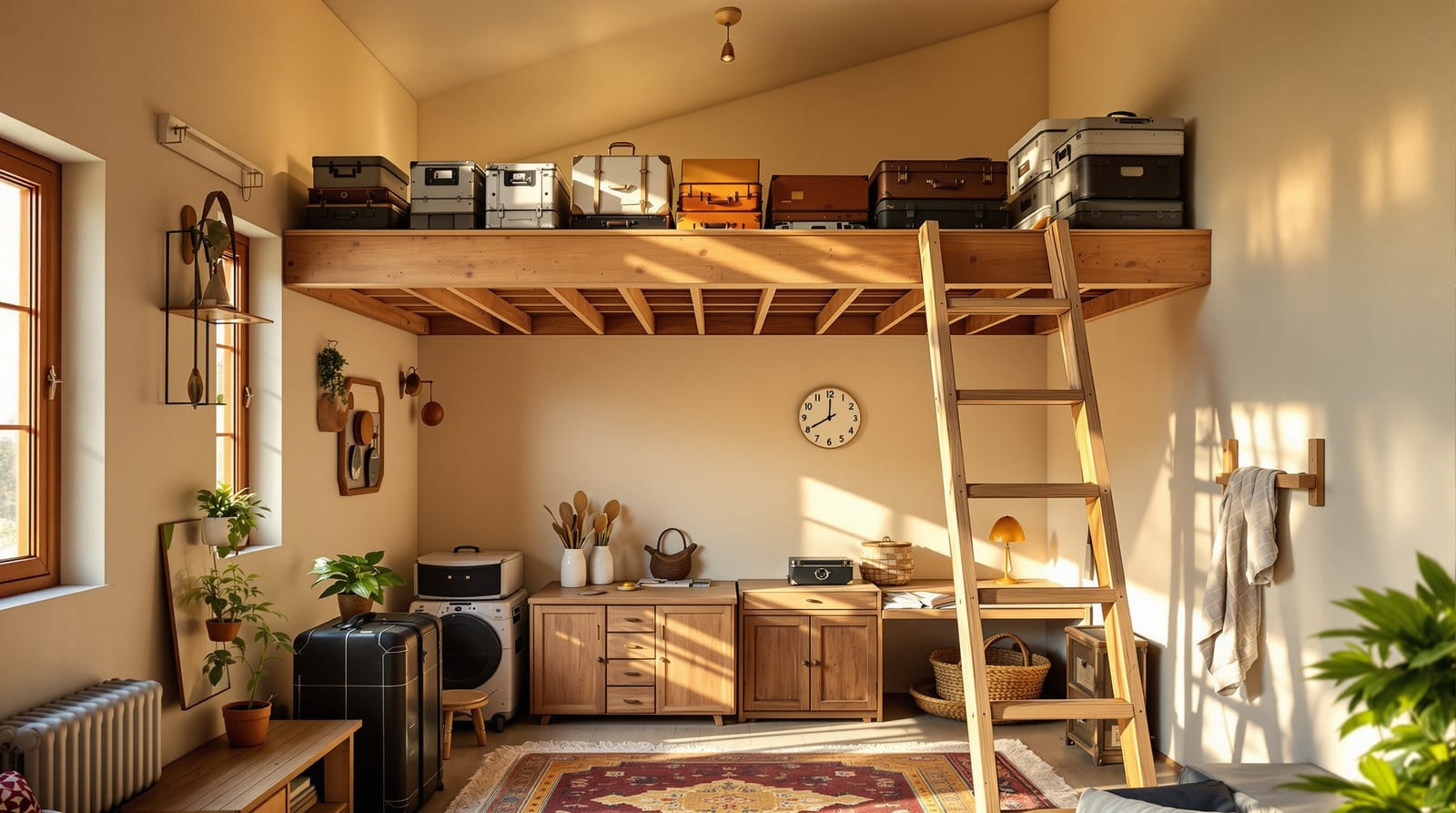
India already knows how to build upward — the atta loft has stored a billion households' suitcases for generations. This lesson is about doing it well: the four ways to go up, and the headroom, access and safety realities that decide which one your home can take.
The atta is the most quietly successful piece of space-saving design in Indian homes — a loft over the bathroom or passage where the trunks and the spare bedding have lived for decades. Going up isn't a new idea here. Doing it deliberately, beyond the bathroom, is.
In Lesson 3.1 you found the idle volume above your head. This lesson builds into it. The good news is that Indian homes have a head start: the atta — the built-in high loft — is already vernacular, already trusted, already in most homes.
The work now is to go up well and more widely: to know the four kinds of vertical move, and to match each honestly to the headroom, access, and safety your home actually allows. Going up fails when it's forced onto a ceiling that can't spare the height, or built without thinking about how you'll reach it.
Three realities that decide everything
Any vertical move lives or dies on three things. Get them right and a loft serves for decades; ignore one and it becomes a daily hazard or a dead shelf nobody uses.
1 · Headroom — above and below
Two clearances, not one. Below the loft, you need enough to stand or sit comfortably (a passage or a seating zone needs less than a kitchen you work in). On the loft itself, you need enough to use it — crawl-in for storage, sit-up for a bed, stand for a mezzanine. Measure both before you commit to a height.
2 · Access — how you get up there
A loft you can't reach safely is a loft you won't use. A fixed ladder, a sturdy step-stool, a built-in staircase with storage in its treads — the access must match how often you go up. Daily-use lofts need easy, safe, permanent access; once-a-season storage can tolerate a stool fetched from below.
3 · Safety — the load and the edge
A loft holds real weight — trunks, a sleeping adult — so it must be built to carry it, anchored properly into the structure, never improvised on brackets. A sleeping or sitting loft needs an edge rail or lip so nothing (and no one) rolls off. This is the part where a carpenter's word isn't enough; for anything load-bearing or slept-on, get it engineered.
The atta, rethought beyond the bathroom
Answer three questions about your room. The tool points to the vertical move your height and use can honestly support — and warns you off the ones that won't fit.
Go deeper — the atta, rethought beyond the bathroom
The traditional atta is almost always placed over the bathroom or the kitchen passage — low-use spots where you never need full standing height beneath. That instinct is exactly right, and it generalises: a loft belongs over whatever you do sitting, passing through, or briefly, never over where you stand and work for hours. The professional move is to map your room by how tall each zone needs to be, then float the loft over the shortest-need zone.
Extended deliberately, this opens up more than storage. A loft over the entry passage becomes a reading nook; a deck over the back of a long living room becomes a child's study; the band above a row of wardrobes becomes a continuous high shelf running the length of the room. The atta proved Indians will happily live with a loft overhead for generations — the design opportunity is to bring that proven, trusted move out of the bathroom and into the rest of the home, matched honestly to where the height genuinely exists.
Four ways to go up
The four vertical moves, from the everyday atta to a full sleeping loft. Tap each to see what it needs from your ceiling — and the safety or comfort point to design for. The right one depends entirely on the height you have.
The atta
Almost no extra height — it sits in the dead band above a bathroom, passage or kitchen where you never stand full. The most forgiving vertical move, which is why it's in nearly every Indian home.
Access is the weak point — most attas are reached by an awkward stool. Keep it for genuinely seasonal things, or the reach becomes a deterrent and it fills with forgotten junk.
Suitcases, off-season bedding, festival and gathering items — the rarely-touched, over a low-use zone.
Fig 3.2a — The same wall, four heights of ambition. Match the move to the metres you actually have.
Fig 3.2a — The same wall, four heights of ambition. Match the move to the metres you actually have.
A family with a standard 2.7 m ceiling wants a full sit-up sleeping loft to free their floor. A contractor offers to build it. What's the honest answer?
Run the method yourself
Take the idle volume you found in Lesson 3.1, and plan one honest move into it.
- 1Pick the zone with the most spare height. Above the bathroom, the passage, a row of wardrobes — wherever you don't need full standing room below. Float the loft there.
- 2Measure both clearances. Headroom below (stand / sit / pass) and headroom on the loft (crawl / sit-up / stand). Both must work, or pick a humbler move.
- 3Decide the access to match how often you'll go up — step-stool for seasonal storage, a safe fixed ladder or stair for anything daily.
- 4Name the safety check. For anything load-bearing or slept on, write “engineer to confirm” and “edge rail.” A carpenter's eye isn't enough for weight or sleep.
- The atta already proved Indians will live with a loft overhead — the move now is to do it deliberately, beyond the bathroom.
- Four vertical moves: the atta, high storage, the sleeping loft, the mezzanine — each needs a different amount of height.
- Three realities decide everything: headroom (above and below), access, and safety.
- The honest answer is set by your shortest clearance, not your biggest ambition — a sit-up loft wants ~3.2 m.
- For anything load-bearing or slept on, get it engineered, and add an edge rail. A carpenter's word isn't enough.
You know the idle volume, and the moves to claim it. Time to put it together — what does it look like to take one real room with a generous ceiling and use its full height, top to bottom?
The author
Amogh N P
Architect, interior designer, and creative polymath. Studio Matrx began in his notebooks — his vision of design made honest, useful, and open to everyone. Its Academy is written and taught in his memory, and free, forever.
More about Amogh →