
 Lesson 3.3
Lesson 3.3 · Reach upward
Worked Plan: The Double-Height Opportunity
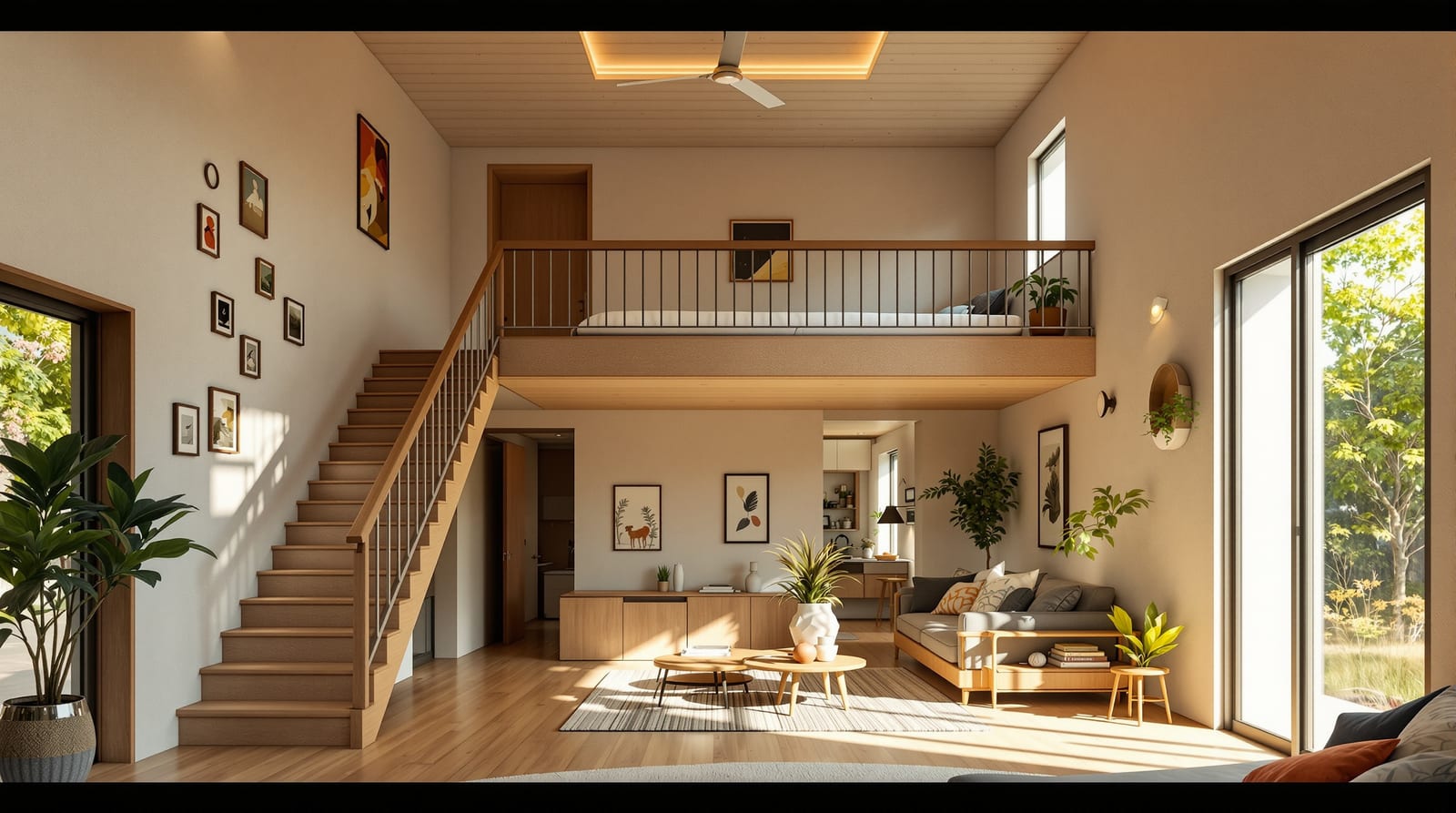
One real room with a 3.4 m ceiling, used top to bottom. Watch a single 130 sq ft room in an old Bengaluru flat gain a sleeping loft, a high study shelf and a storage deck — roughly half its floor area again, found entirely in the air it already owned.
Old Indian flats have a gift their owners rarely unwrap: tall ceilings. The same 3.4 metres that makes a room feel grand also hides, above head height, the equivalent of a second small room — if you read the section instead of the plan.
You've worked through the vertical lever: the idle volume, the four ways to claim it, the realities that decide which fits. This lesson assembles them on one home — the Rao family's 130 sq ft room in a 1980s Bengaluru flat, blessed with a 3.4 m ceiling and, until now, using only the bottom 2 m of it.
By the end, the same footprint holds a sleeping loft, a high study shelf, and a deep storage band — roughly 60 sq ft of extra usable area, claimed entirely from height. Step through the section.
How one tall room became one-and-a-half
Each move claims part of the 1.4 m of idle air above head height, matched to what the height there allows.
1 · A high storage band over the entry. Above the door and the wardrobe run, the idle band becomes a continuous high shelf for suitcases, seasonal bedding and the gathering vessels — the rarely-touched, reached by a safe step. Pure atta logic, run the length of the wall. + deep seasonal storage
2 · A study shelf on the opposite side. A compact deck at ~2 m on the far wall — reached by a few steps — holds a study nook clear of the living floor, lit by the room's upper window. A loft over a sit-down activity needs less height than one you stand in. + a study, zero floor lost
3 · A sleeping loft — the headline move. The 3.4 m height finally pays off: a proper sleeping loft, sit-up room above and full standing room below, lifts the bed entirely out of the room. The whole floor is freed for daytime life. Engineered for the load, with an edge rail along the open side. + a bedroom, floor freed below
4 · Safe access and a high vent. A fixed ladder safe for a half-asleep climb serves the loft; a small high vent (roshandan logic from Lesson 2.3) lets the heat that rises off the loft escape, so the sleeping platform stays liveable through a Bengaluru summer. safe, and cool up top
The room measures 130 sq ft on the plan. Read in section and built top to bottom, it now holds a living room, a study, a bedroom and deep storage — roughly 60 sq ft of extra usable area, every inch of it found in the air the Raos already owned and never used.
Go deeper — why height is the lever you can't fake
Of the three levers, Extend-vertical is the one most bounded by what you're given. Subtract and Layer work on almost any plan; borrowed light and the long view help almost any room. But going up needs height that is simply present or absent — no amount of cleverness conjures 3.4 m out of a 2.7 m flat. That's why this finale is set in an old flat: the generous ceilings of older Indian construction are a genuine, under-exploited asset, and the single biggest reason to think twice before assuming a newer, lower-ceilinged flat is 'better'.
The lesson for any home is to read the section early. Before furnishing, before assuming a room is full, look at its height and ask what the air above 2 m could become. In a tall room that question is transformative; in a standard one it still yields a high storage band. Either way, the volume above your head is the last frontier of a small home — and the one most people never even look at.
One room, read in section
Here's the Rao room drawn in section — from the side, full height. Step through the build and watch the idle air above head height fill with use, while daily life stays at the bottom. The gain counter tracks the floor you're finding in the air.
Fig 3.3 — ~60 sq ft of use, found entirely in the air above 2 m. The floor where the Raos stand and sit is untouched.
Fig 3.3 — ~60 sq ft of use, found entirely in the air above 2 m. The floor where the Raos stand and sit is untouched.
The Rao room gains ~60 sq ft of use from its 3.4 m ceiling. What single condition made the headline sleeping loft possible — and what would you do without it?
Run the method yourself
Bring the idle volume and the one vertical move you planned in Lessons 3.1 and 3.2. Now assemble the full vertical plan for your tallest room.
- 1Draw it in section. A simple side-on sketch, to scale, with the 2 m line marked. Everything above that line is your canvas.
- 2Place moves by height-need. Storage and sit-down uses where there's less height; the sleeping loft only where the full ~3.2 m+ genuinely exists. Match each to its zone.
- 3Solve access and safety once, for all of it. One safe ladder or stair, edge rails on anything slept or sat on, and "engineer to confirm" on anything load-bearing.
- 4Add the high vent. Heat rises into lofts — a small high opening keeps the upper level liveable. Your room now lives top to bottom.
- A real 130 sq ft room with a 3.4 m ceiling gained ~60 sq ft of use — a study, a bedroom loft and deep storage — all from height.
- The build: high storage band, study shelf, sleeping loft, safe access + high vent — each matched to the height in its zone.
- Height is the lever you can't fake — it's present or absent, which makes the tall ceilings of older flats a real, under-used asset.
- Read the section early — before furnishing, ask what the air above 2 m could become.
You've cleared, layered and extended. But every one of those moves kept running into the same question — where do the things go? It's time to face storage head-on: the system that makes all three levers actually hold.
The author
Amogh N P
Architect, interior designer, and creative polymath. Studio Matrx began in his notebooks — his vision of design made honest, useful, and open to everyone. Its Academy is written and taught in his memory, and free, forever.
More about Amogh →