
 Lesson 3.1
Lesson 3.1 · Reach upward
The Volume Above Your Head
There is one direction almost every Indian home ignores entirely: straight up. The metre or more of empty air above your cupboards and doors is floor you already own — measured on the plan, but never used.
Look up in any room you're in right now. The space between the top of your wardrobe and the ceiling is paid-for volume, doing nothing. Across a whole flat, that unused band of air can add up to a small room's worth of storage — or a whole sleeping platform.
You're still in Extend, the third lever — but turned upward. Module 2 reached outward for light, air and the view. This module reaches up, into the height you already own. Both borrow space the plan doesn't show.
Most of small-space design happens in plan — we move walls and furniture around on the floor. But a room has a third dimension that the floor plan never shows, and that almost nobody designs: its height.
Indian flats are often built with generous ceilings — 2.7, 3, sometimes 3.5 metres. We furnish the bottom 2 metres and leave the rest as empty air. This module is about claiming that air: the volume above head height that is, quite literally, free space you have already paid for.
The dimension the plan hides
A floor plan is a horizontal slice — it shows length and breadth, but flattens height to nothing. So when we design only in plan, we literally cannot see the volume we're wasting. The architect's term for the vertical slice is the section, and thinking in section is what unlocks the third dimension.
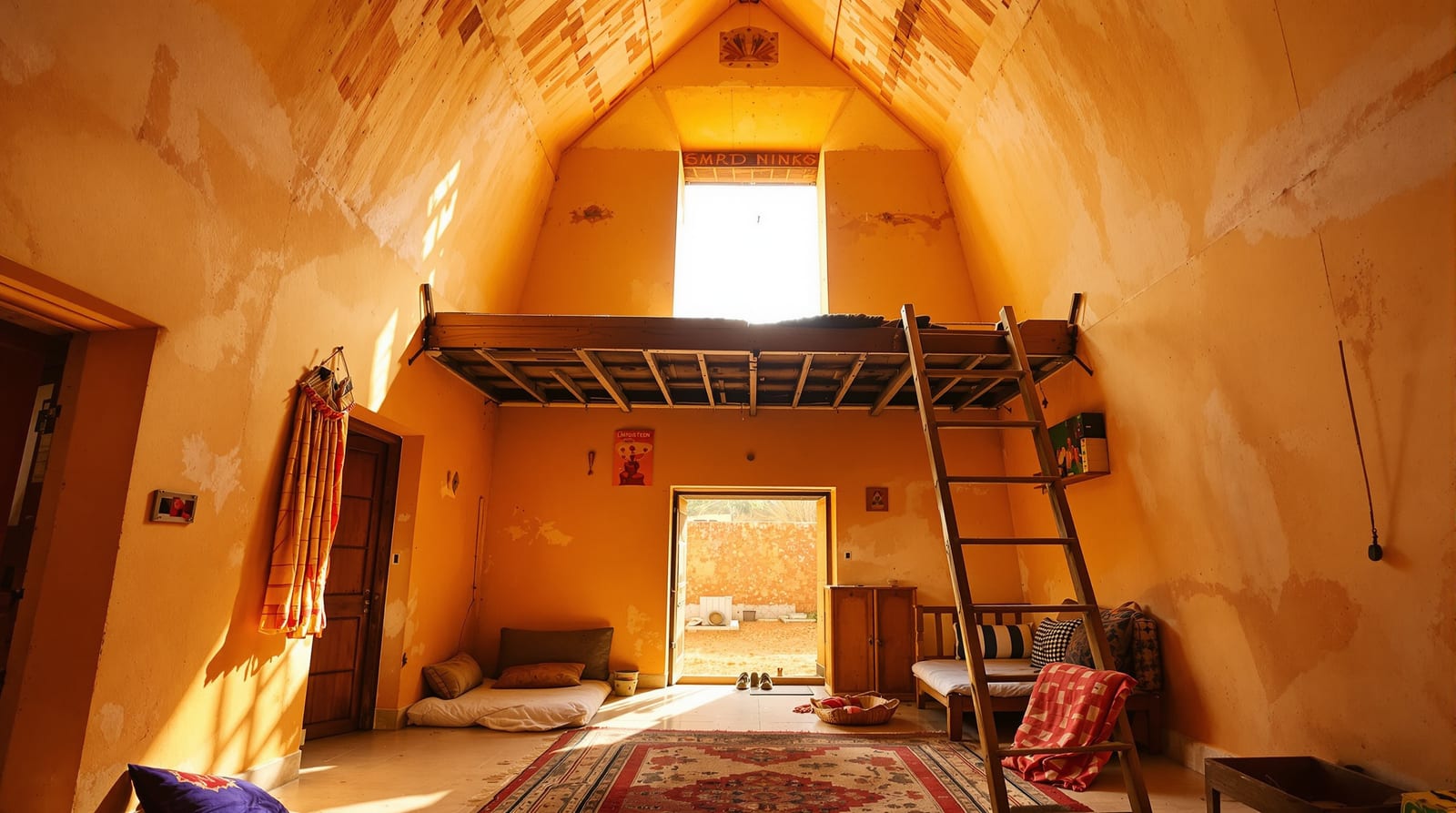
Consider a typical room with a 3-metre ceiling. You use the floor and the air up to about 2 metres — reaching height. Above that sits a full metre of volume across the entire room footprint, used for nothing but the occasional cobweb. In a 100 sq ft room, that's 100 cubic feet of paid-for space, completely idle.
The taller your ceiling, the more space you're leaving on the table. The interactive below lets you see that idle volume — and claim it.
| Ceiling height | Used (to ~2m) / Idle volume above |
|---|---|
| 2.7 m (standard flat) | Bottom ~2 m — ~0.7 m band, whole footprint |
| 3.0 m (older / better builds) | Bottom ~2 m — ~1.0 m band, loft territory |
| 3.5 m+ (heritage, some new) | Bottom ~2 m — ~1.5 m, a half-floor |
Put the rarely-touched things up high
Vertical space has one iron rule: height is for the things you reach for least. The higher a thing lives, the more effort it takes to get to — so the volume above head height is perfect for what you use rarely, and wrong for what you use daily.
Belongs up high
Suitcases, seasonal bedding, festival decorations, the big vessels used only for gatherings, archive boxes, off-season clothes. Things touched a few times a year, that can live on a high shelf or in a loft and be fetched with a step-stool when needed.
Stays down low
Everyday clothes, kitchen things in daily use, the children's school bags, anything reached for every day. Forcing daily items up high just relocates the friction — you'll fight a ladder every morning and the system fails, the same way a slow furniture switch killed the layered room in Lesson 4.3.
The sleeping exception
A sleeping loft breaks the “rarely used” rule — you use it nightly — but works because sleep is a once-a-day trip and the loft frees the entire floor below for waking life. It's the highest-value vertical move when the ceiling allows it, and the subject of Lesson 3.2.
Go deeper — the height you need, and the height you have
The feasibility of going vertical comes down to one subtraction. A person needs roughly 2 m to stand and move comfortably; a loft platform plus its own usable space needs perhaps another 1–1.2 m above it. So a true walk-under, sit-up-in loft wants around 3.2 m+ of total height — which is why full sleeping lofts suit older builds, heritage flats, and the rare generous new one, but not a standard 2.7 m flat.
Below that, you scale the ambition to the height: a 2.7 m flat won't take a sit-up loft, but it easily takes a storage deck above a doorway, high cabinets in the idle band, or a low sleeping platform you crawl onto (common and comfortable in many compact homes). The professional move is to measure your real floor-to-ceiling height first, subtract the 2 m you need to live in, and design only with the genuine remainder. Going vertical fails when it's wished onto a ceiling that can't spare the height; it succeeds when it's matched honestly to the section you actually have.
The same room, seen from the side
Here's a room drawn in section — from the side, so you can see its full height. Toggle between “as used” and “full height claimed,” and watch the idle band above head height turn into storage, a loft, and display. The room's footprint never changes.
Fig 3.1 — No floor added. The idle metre of air becomes a loft and high storage; daily life still happens at the bottom, where you stand.
Fig 3.1 — No floor added. The idle metre of air becomes a loft and high storage; daily life still happens at the bottom, where you stand.
A family builds a high loft and, to “save the most space,” puts their everyday clothes and daily kitchen items up there. Why will this backfire?
Run the method yourself
One measurement and one look, in the room with the most clutter or the highest ceiling.
- 1Measure floor to ceiling. The real number, not a guess. Subtract ~2 m for standing-and-living. The remainder is your idle band — your vertical opportunity.
- 2Look at the air above everything. Above the wardrobe, above the doors, above the kitchen cabinets. How much of that band is empty? Mark the biggest idle pockets.
- 3List your rarely-touched things. Suitcases, seasonal bedding, festival items, gathering vessels. These are what will go up. If the list is long, you need the height more than you thought.
- 4Match ambition to height. Under ~3.2 m? Think high storage and decks, not a sit-up loft. Over it? A loft is on the table. Design only with the height you actually measured.
- Almost every Indian home ignores its height — the idle band of air above head level is paid-for volume doing nothing.
- Design the section, not just the plan — the floor plan flattens height to nothing, hiding the wasted volume.
- The golden rule: height is for the things you reach for least — seasonal and archive items up, daily items down.
- The sleeping loft is the exception that works — a once-a-day trip that frees the whole floor below.
- Measure your real height first, subtract the ~2 m you live in, and design only with the genuine remainder.
You can see the idle volume now. So how do you actually build into it — the loft, the atta, the high deck — safely, comfortably, and in a way that suits how Indian homes really live?
The author
Amogh N P
Architect, interior designer, and creative polymath. Studio Matrx began in his notebooks — his vision of design made honest, useful, and open to everyone. Its Academy is written and taught in his memory, and free, forever.
More about Amogh →