
 Lesson 6.1
Lesson 6.1 · The method in action
One Room, Every Lever
The hardest test of the method: a single 300 sq ft room that must be living room, bedroom, kitchen, study and store — all at once, for one young professional in Bengaluru. Watch all four threads work in one space.
A studio has nowhere to hide. There are no other rooms to absorb the overflow, no door to close on the mess. Every one of the four levers has to work, in one space, at once — which makes the studio the purest test of whether you've really learned the method.
Until now you've learned each lever on its own. This module does the opposite: it takes whole, real homes and applies everything at once. We start with the hardest case — a single room that must do every job a home does.
The home: 300 sq ft studio. Who: Aditi, 26, works from home 3 days. Where: Koramangala, Bengaluru. The brief: Live, sleep, cook, work, host — in one room.
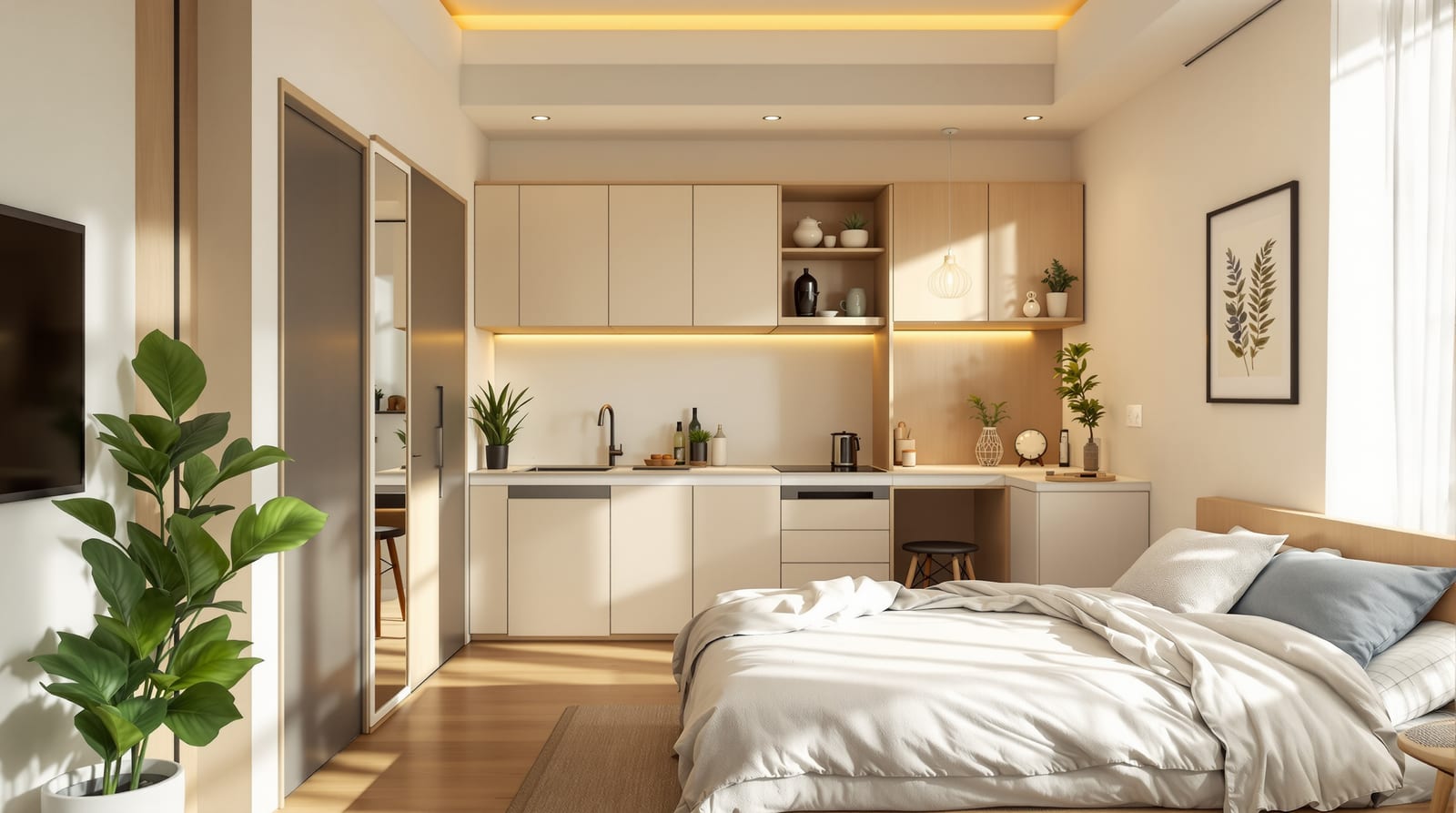
Aditi's studio has one window, a kitchenette along one wall, a 3 m ceiling, and a tiny balcony. It came furnished like a cramped bedsit: a double bed eating half the floor, a dining set she never used, and not a clear surface in sight. Here's the method, applied in order.
How every lever earned its place
In a studio nothing is optional — each lever solves a problem the others can't. Here's what each did for Aditi.
01 · Subtract — Cleared the half-room the bed and dining set stole. The never-used dining set left; the floor-eating double bed was the next to go. Subtracting first revealed how much room was actually there — and made everything downstream possible. Aditi edited her things too: a studio punishes excess hardest.
02 · Layer — Made the one room be five rooms across the day. A wall bed turns the sleeping zone into open living floor by day; a fold-down desk by the window becomes the office on work-from-home days; the sofa seats guests. One room, time-shared between five functions — the only way a studio holds a whole life.
03 · Extend — Borrowed light, air and the height the room had spare. A mirror and pale surfaces pull the single window's light to the back wall; the balcony door stays clear for the long view and a cross-breeze; and the 3 m ceiling gives a loft over the entry. The room feels twice its size and uses air it was wasting.
04 · Storage — Gave every displaced thing a decided home. The wall bed's base swallows bedding; the loft takes the suitcase and seasonal things; a niche by the kitchenette holds daily items; a slim pooja shelf gets its dignity. Nothing the levers displaced is left homeless — the system that makes the rest hold.
The result: a 300 sq ft room that lives, sleeps, cooks, works and hosts — and feels calm doing it. Not because Aditi owns little, but because all four threads are pulling together in one space. That is the method, whole.
Go deeper — why the order matters most in a studio
In a multi-room home you can apply the levers loosely — a misstep in one room is absorbed by the others. A studio has no slack, so the sequence becomes critical. Subtract must come first: layer a cluttered studio and you just get organised clutter; extend it and you brighten a cramped room. Only a cleared room reveals what's genuinely there to work with. Layer comes second because the time-sharing of functions is what creates the space Extend and Storage then act on. Extend third, working on the now-defined volume. Storage last, housing what the first three displaced.
Run the levers out of order in a studio and they fight each other; run them in order and each hands the next a better room. This is the deepest lesson of the case-study module: the method isn't four tricks you pick from, it's a sequence that compounds. The studio, with no room for error, is what makes that visible — which is exactly why we started here.
Aditi's studio, lever by lever
Step through the four levers as they're applied to the one room. Each builds on the last — Subtract clears, Layer multiplies, Extend reaches, Storage houses. Watch a cramped bedsit become a room that does five jobs.
Fig 6.1 — One 300 sq ft room, four levers, five jobs — the whole method on a single space.
Fig 6.1 — One 300 sq ft room, four levers, five jobs — the whole method on a single space.
Someone tackles their cramped studio by first buying a clever wall bed and smart storage units — layering and storing before anything else. Why does this often disappoint?
Run the method yourself
Whether your home is a studio or you're reading one room of a larger flat, trace the whole method on it.
- 1Subtract first. What in this room is never used, or could leave? Clear it on paper before anything else — you can't design what you can't see.
- 2Layer for time. List the jobs the room must do across a day. Which can time-share through one convertible piece, instead of each claiming its own floor?
- 3Extend the felt space. Where's the light, the long view, the spare height? Borrow all three before assuming the room is as big as it gets.
- 4Store what's displaced. For every prop the convertibles move, name its decided home in the spaces the first three levers opened. Nothing left homeless.
- A studio is the purest test of the method — every lever must work in one room, with no other space to hide overflow.
- Subtract cleared the half-room the dining set and double bed stole — and had to come first.
- Layer made one room be five across the day — wall bed, fold desk, sofa, time-shared.
- Extend borrowed light, the long view, a cross-breeze and a loft from the 3 m ceiling.
- Storage gave every displaced thing a decided home — the system that makes the rest hold.
- The method is a sequence that compounds, not four tricks — run in order, each lever hands the next a better room.
One person in one room is the purest test. But most Indian homes hold a family — children, elders, the joint-family rhythm. What changes when the same method must serve many people at once?
The author
Amogh N P
Architect, interior designer, and creative polymath. Studio Matrx began in his notebooks — his vision of design made honest, useful, and open to everyone. Its Academy is written and taught in his memory, and free, forever.
More about Amogh →