
 Lesson 6.2
Lesson 6.2 · The method in action
Designing for Many
One room held one life. Now four people share two bedrooms: two parents, a school-age child, and a grandmother who lives with them. The same method — but every move must serve people whose needs compete.
A studio answers to one person. A family flat answers to everyone at once — and they want different things at the same time. The child needs to study while the grandmother prays and the parents host. The method now has to choreograph people, not just furniture.
Case study one was the purest test: one room, one person. This one is the most common test — the Indian family 2BHK, where the method must serve four people whose routines overlap and collide.
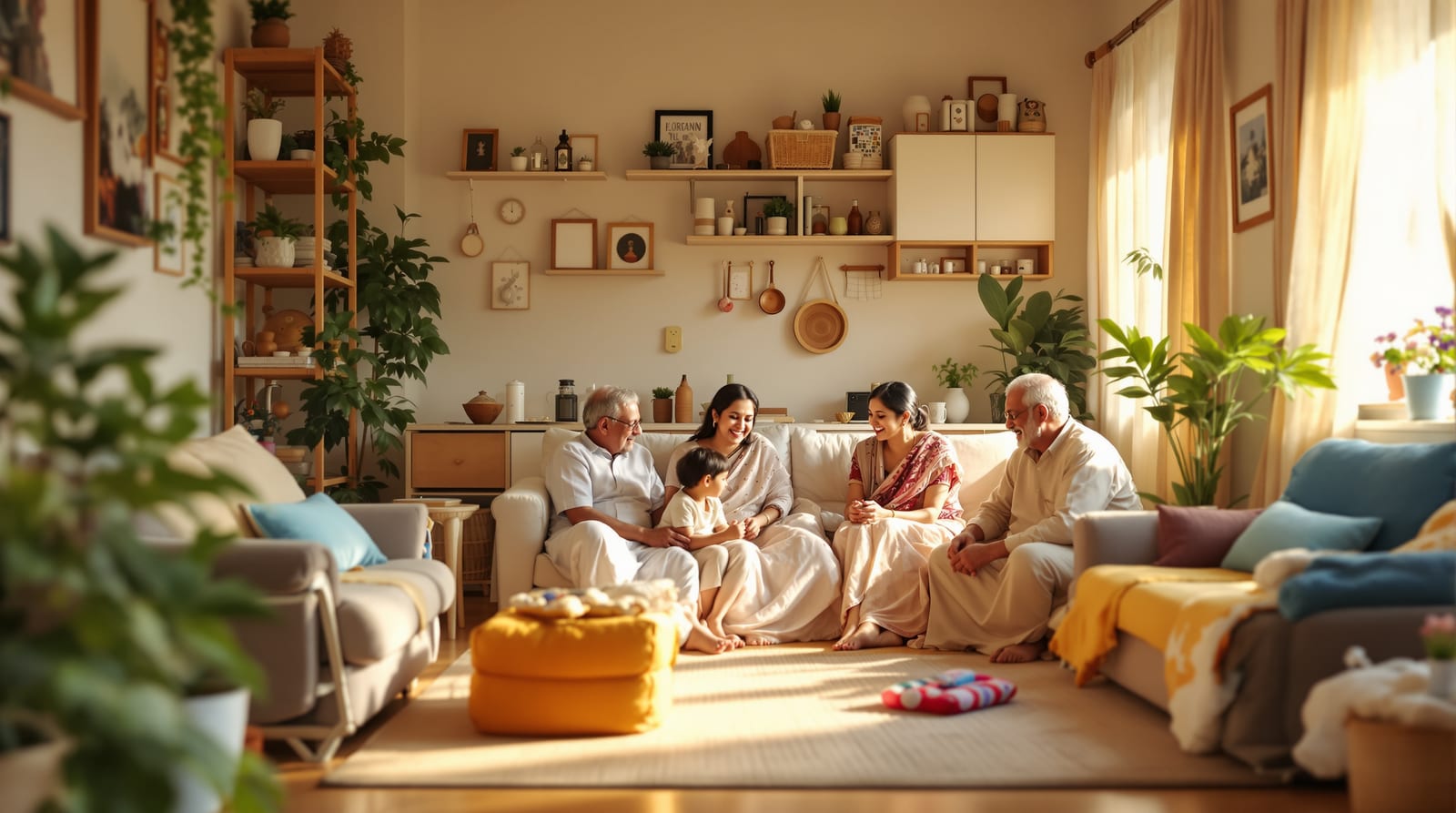
The home: 620 sq ft 2BHK. Who: The Kulkarnis — 2 parents, child (9), grandmother. Where: Hubballi, Karnataka. The brief: study, prayer, hosting, sleep — four people, two rooms.
The shift from the studio is profound: the constraint is no longer just space, but people and time. The same room must serve different members at different hours, and sometimes the same hour. The method holds — but now it choreographs a household.
When the same room serves different people
In a family flat, the hardest problem isn't fitting furniture — it's that people's needs overlap in time. The living room is the child's study in the evening, the family's TV room at night, the guest space on Sunday, and near the grandmother's prayer corner throughout. Layer's time-sharing now applies to people, not just functions.
Stagger the routines
The first design move is to map who needs what, when — and stagger it. The child studies at the dining table after school, before dinner reclaims it. The grandmother's prayer happens at dawn and dusk, framing the day around the living room rather than fighting it. Designing the schedule is as important as designing the space.
Protect one quiet zone
Even staggered, a family needs at least one spot where one person can withdraw — the child to focus, the grandmother to rest. A nook carved by Subtract, a corner the long view doesn't cross, a curtain that closes off a bed. In a shared home, a single defensible quiet zone is worth more than another shared surface.
How each lever served the household
The same four threads as the studio — but every move now weighs competing needs across the family.
01 · Subtract — Cleared a quiet study nook for the child. Removing a bulky cabinet from the hall opened a corner the long view doesn't cross — a defensible quiet zone where the nine-year-old can study while life continues around them. In a family flat, Subtract often buys privacy, not just floor.
02 · Layer — Let two rooms serve four people across the day. The dining table is the child's desk before dinner; the living diwan is the grandmother's daytime seat and a guest bed at night; the child's and grandmother's shared room uses a partition curtain for sleep. Time-sharing choreographs the whole household.
03 · Extend — Kept a shared home from feeling crowded. Cross-ventilation and a protected long view through to the balcony keep the busy flat from feeling stuffy and small with four people in it. When many share a space, the felt-space lever does double duty — it buys breathing room, literally and visually.
04 · Storage — Gave every member — and the household — its homes. The child's low hooks, the grandmother's things within easy reach (not up high), the pooja niche by dignity, the festival load peak-sized in the loft for the joint-family gatherings. Storage here respects age and ability, not just frequency.
620 sq ft, four people across three generations, every need met — because the method choreographed not just the space, but the people moving through it. The same four threads, now weaving a household together.
Go deeper — designing for the grandmother changes the rules
A multi-generational home quietly rewrites two of the course's rules. The reach rule assumed an able adult — but the grandmother can't safely use a step-stool to reach the high band, or climb to a loft, or bend deep into an under-bed drawer. Her daily things must live in the easy middle zone, between knee and shoulder height, even if that “wastes” prime storage by the able-adult logic. And the loft, so valuable in the studio, is wrong for her room — a fall risk, not a feature.
This is the deepest point of the family case: the method's rules are servants, not masters. Frequency and reach are defaults that bend to the actual bodies in the home — a child's height, an elder's mobility, a pregnant member's reach. Good small-space design for a family starts from who lives there and what their bodies can do, then applies the levers in service of that. Designing for many means designing for each.
The Kulkarni flat, person by person
Seven markers across the 2BHK, each solving one person's need with one lever. Tap each to see whose life it serves and how. Together they show the method choreographing a whole family through a shared, small home.
Fig 6.2 — Seven needs, four people, two rooms — each met by a lever, choreographed through the day.
Fig 6.2 — Seven needs, four people, two rooms — each met by a lever, choreographed through the day.
By the reach rule, rarely-used things go high and deep, freeing the easy middle zone for daily items. The grandmother's daily medicines are used often — but a planner puts them on a high shelf “to save the good storage.” What's wrong?
Run the method yourself
If your home holds more than one person, design for the people before the furniture.
- 1List each person and their key needs. Study, prayer, rest, work, play — and any body constraints (a child's height, an elder's reach, anyone's mobility).
- 2Map needs against time. Who needs what, when? Find the clashes — the same room wanted by two people at once — and stagger or separate them.
- 3Protect one quiet zone. Carve at least one defensible spot (Subtract) where one person can withdraw. In a shared home it's worth more than another shared surface.
- 4Apply the levers in service of bodies. Bend the reach and frequency rules to the actual people — elder's daily things in the middle zone, child's at child height, no loft where a fall is a risk.
- A family flat answers to everyone at once — the constraint shifts from space to people and time.
- Layer's time-sharing now applies to people: stagger routines so a room serves different members at different hours.
- Subtract often buys privacy, not just floor — protect at least one defensible quiet zone.
- Extend does double duty when many share a space — light and air buy breathing room.
- Storage respects age and ability — the elder's daily things in the easy middle zone, the child's at child height.
- The method's rules are servants, not masters — they bend to the actual bodies in the home.
Both homes so far let you change the building — move walls, build lofts, carve niches. But most urban Indians rent, and can change nothing structural. Can the whole method still work when you can't touch the walls?
The author
Amogh N P
Architect, interior designer, and creative polymath. Studio Matrx began in his notebooks — his vision of design made honest, useful, and open to everyone. Its Academy is written and taught in his memory, and free, forever.
More about Amogh →