
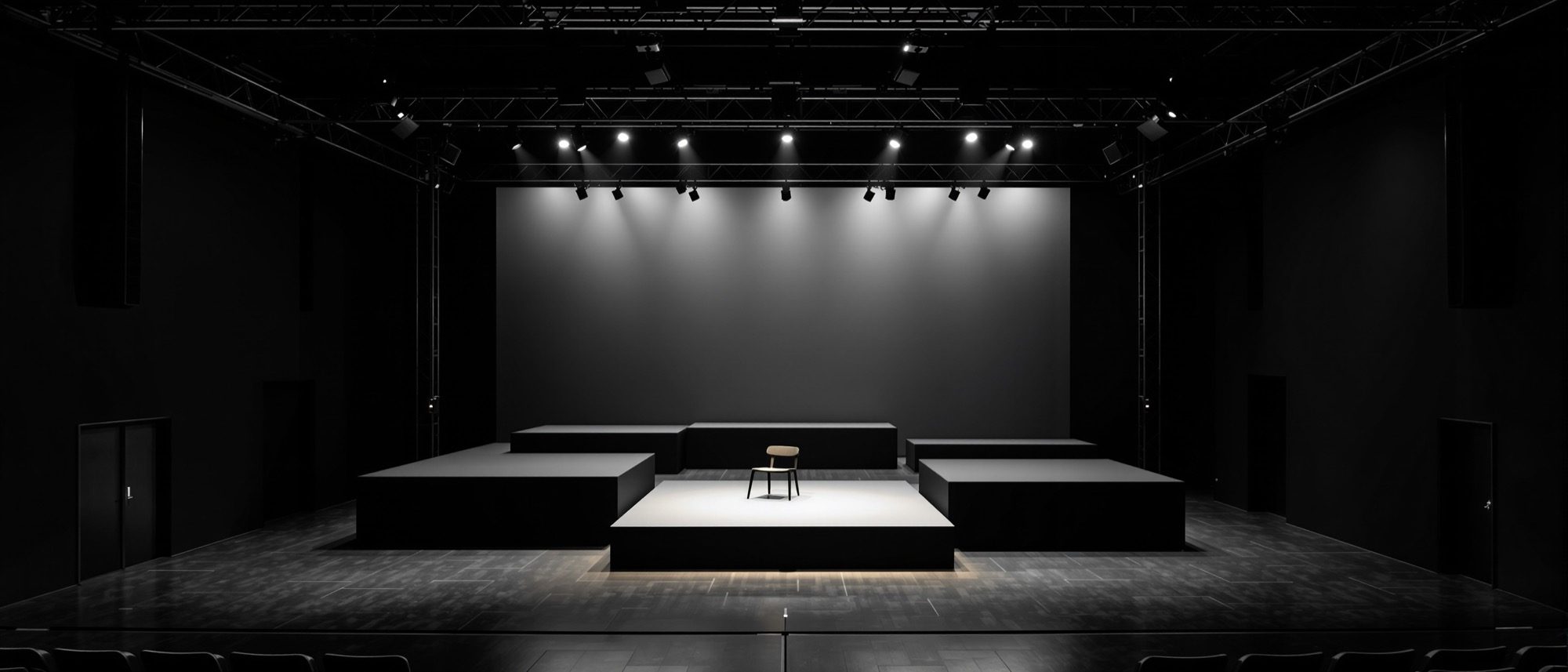
Stage, Space & Process
The stage types, the geography of the stage, and from script to model.
The first decision in set design is the stage itself — the relationship between actor and audience. A proscenium frames the action on one side; a thrust pushes into the audience; an arena surrounds it; a black box reinvents itself. Each carries its own sightlines. Learn the geography of the stage and the design process from script to scale model. Try the stage-type explorer below.
Learning objectives
By the end of this lesson, you will be able to — mapped to the course outcomes for Set Design:
Compare the stage types and the actor–audience relationship.
Use the geography of the stage and sightlines.
Follow the design process from script to ground plan and elevation.
Build a scale model to communicate a set.
Stages & geography
The stage type sets the whole design; the geography of the stage (up/down, left/right from the actor's view) and sightlines govern it.[4]
Stage types · pick the actor–audience relationship
Proscenium
Audience: One side, through the 'picture-frame' arch
Traditional and illusionistic — supports large painted and flown scenery and a clear 'fourth wall'; backstage is easily hidden.
Sightlines: The most remote actor–audience relationship; the arch can read as a barrier.
The pink block is the stage; the grey dots are the audience. More sides → lower, more minimal scenery.
Where the audience sits
The stage type sets the whole design. PROSCENIUM (picture-frame) puts the audience on one side and supports large, illusionistic scenery. THRUST pushes the stage into the house with the audience on three sides — intimate, scenery low. ARENA (theatre-in-the-round) surrounds the action 360° — minimal scenery, entrances through the aisles. BLACK BOX is a flexible neutral room. TRAVERSE runs a strip between two facing banks. Try the explorer below to see each.[4]
The design process
Design from the script through ground plan and elevation to the scale model that everyone builds from — the set serves the story.[4, 1]
Read, research, imagine
Design starts with the SCRIPT — a scene-by-scene breakdown of needs, entrances, period and mood — then RESEARCH and a concept developed with the director. The set is never autonomous art: it serves the story and the staging. From the concept come the drawings: the GROUND PLAN (a bird's-eye view of the set on the stage) and the ELEVATIONS (front views of each scenic element), drawn to scale exactly as in architecture.[4, 1]
At a glance
| Aspect | One | The other |
|---|---|---|
| Audience position | Proscenium: one side | Arena: all four sides |
| Scenery | Proscenium: large, illusionistic | Thrust / arena: low, minimal, 3D |
| Up vs down | Downstage: near the audience | Upstage: far (and once higher) |
| Left & right | From the ACTOR's viewpoint | Stage right = the audience's left |
| The deliverable | White card model: tests the idea | Finished 1:25 model: the final look |
Key terms
A picture-frame stage with the audience on one side — supports illusionistic scenery.
A stage projecting into the house with the audience on three sides — intimate.
A stage surrounded by the audience on all sides — scenery must stay minimal.
A flexible neutral room that can be reconfigured each production.
Far from / near the audience — named from the historically raked (sloped) stage.
From the actor's point of view facing the audience (stage right = the audience's left).
The tall space above the stage from which scenery and lights are flown.
The scaled bird's-eye and front-view drawings of the set.
Studio task
Take one scene and design it for two different stage types using the explorer above — note how the scenery must change as the audience moves from one side to all around. Then sketch a ground plan for your favourite.
Self-assessment
1. In a theatre-in-the-round (arena) stage, scenery must be —
2. 'Stage right' means the —
3. The British standard scale for a finished theatre set model is —
Recap
References & further reading
- [1]Pamela Howard, What is Scenography? Routledge, 2019.
- [4]J. Michael Gillette, Theatrical Design and Production (7th ed.). McGraw-Hill, 2012.
Further reading
- J. Michael Gillette, Theatrical Design and Production. McGraw-Hill.
- Darwin Reid Payne, The Scenographic Imagination. SIU Press.
- Pamela Howard, What is Scenography? Routledge.
Sources gathered and fact-checked June 2026. Published values vary by source, sample and method — treat as indicative and confirm against the cited standard before structural use.
The author
Amogh N P
Architect, interior designer, and creative polymath. Studio Matrx began in his notebooks — his vision of design made honest, useful, and open to everyone. Its Academy is written and taught in his memory, and free, forever.
More about Amogh →