
Introduction to Scenography
The art of designing space for a story — and its long history.
Set design — scenography — is the design of the physical world of a performance, and it is far more than painting backdrops. Pamela Howard calls it the synthesis of space, text, light, performers and audience into one creation. Learn the difference between designing for theatre, film and exhibition, the film art department, and the history from the Greek skene to Appia and Craig.
Learning objectives
By the end of this lesson, you will be able to — mapped to the course outcomes for Set Design:
Define set design and scenography and their scope.
Distinguish set design for theatre, film and exhibition.
Describe the production designer and the film art department.
Trace the history from the skene to modern scenography.
The discipline
Scenography synthesises space, light, sound and costume; the medium (theatre, film, exhibition) sets the brief; and a film art department has a clear hierarchy.[1, 4]
More than a backdrop
SET DESIGN (scenic design) is the design of the physical environment of a performance; SCENOGRAPHY is the broader, holistic term — Pamela Howard calls it 'the seamless synthesis of space, text, research, art, actors, directors and spectators'. It treats set, light, sound and costume as equal partners. FLAG THE MYTH: set design is NOT just decoration or painted backdrops — modern scenography is three-dimensional SPACE and LIGHT, the shift Appia and Craig made a century ago.[1, 7]
A short history
The discipline runs from the Greek skene through Renaissance perspective and the proscenium to Appia and Craig, who made three-dimensional space and light the medium.[2, 7]
Skene to perspective
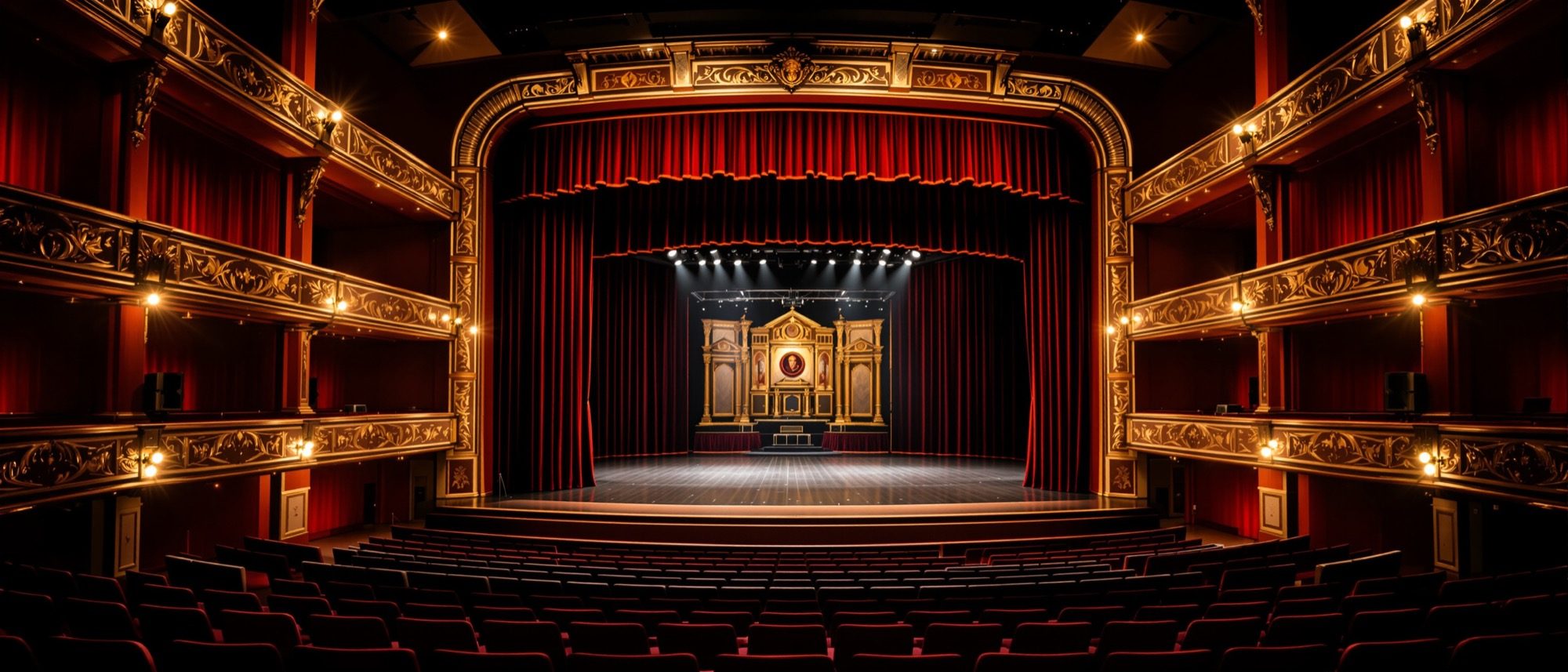
The word 'scene' comes from the Greek SKENE — the hut behind the playing area where actors changed; the Romans elaborated it into the scaenae frons. The Renaissance brought PAINTED PERSPECTIVE scenery — Sebastiano Serlio codified the tragic, comic and pastoral scenes on a raked stage; Palladio's TEATRO OLIMPICO (1580, completed 1585 with Scamozzi's perspective streets) survives as its monument. The PROSCENIUM ARCH — the picture-frame — became dominant to support this illusion.[2, 7]
At a glance
| Aspect | One | The other |
|---|---|---|
| Design vs scenography | Set design: the physical environment | Scenography: space + light + sound + costume |
| Theatre vs film | Theatre: fixed live viewpoint, sightlines | Film: serves the camera, partial sets |
| Film roles | Production designer: the look | Art director: builds & budgets |
| Old vs modern | Painted perspective (Serlio) | 3D space + light (Appia, Craig) |
| Illusion vs exposure | Proscenium: hides the stagecraft | Brecht: exposes it deliberately |
Key terms
The holistic design of a performance's space — set, light, sound and costume as one (Howard).
The design of the physical environment of a performance.
The head of a film's art department, owning the overall visual look.
Who dresses the set — furniture, drapery and the lived-in detail.
The Greek hut behind the playing area — the origin of the word 'scene'.
The 'picture-frame' opening that frames the stage and supports illusionistic scenery.
The founders of modern scenography — three-dimensional space and light over painted backdrops.
Theatre that exposes its own stagecraft to keep the audience critically aware.
Studio task
Choose a play or film and write what its set must communicate before a word is spoken — then say how the brief would differ if you designed it for theatre versus for the camera.
Self-assessment
1. Scenography, per Pamela Howard, is best described as —
2. Appia and Craig changed modern stage design by championing —
3. In a film art department, the head who owns the overall visual look is the —
Recap
References & further reading
- [1]Pamela Howard, What is Scenography? (3rd ed.). Routledge, 2019.
- [2]Darwin Reid Payne, The Scenographic Imagination. Southern Illinois University Press.
- [4]J. Michael Gillette, Theatrical Design and Production (7th ed.). McGraw-Hill, 2012.
- [5]Jane Barnwell, Production Design for Screen: Visual Storytelling in Film and Television. Bloomsbury, 2017.
- [7]Adolphe Appia & Edward Gordon Craig — the founders of modern scenography (Britannica overview). https://www.britannica.com/art/theater-building/The-influence-of-Appia-and-Craig
Further reading
- Pamela Howard, What is Scenography? Routledge.
- J. Michael Gillette, Theatrical Design and Production. McGraw-Hill.
- Jane Barnwell, Production Design for Screen. Bloomsbury.
Sources gathered and fact-checked June 2026. Published values vary by source, sample and method — treat as indicative and confirm against the cited standard before structural use.
The author
Amogh N P
Architect, interior designer, and creative polymath. Studio Matrx began in his notebooks — his vision of design made honest, useful, and open to everyone. Its Academy is written and taught in his memory, and free, forever.
More about Amogh →