
 Lesson 6.2
Lesson 6.2 · Designing for Robots & Printing
The Freedom & the Constraints
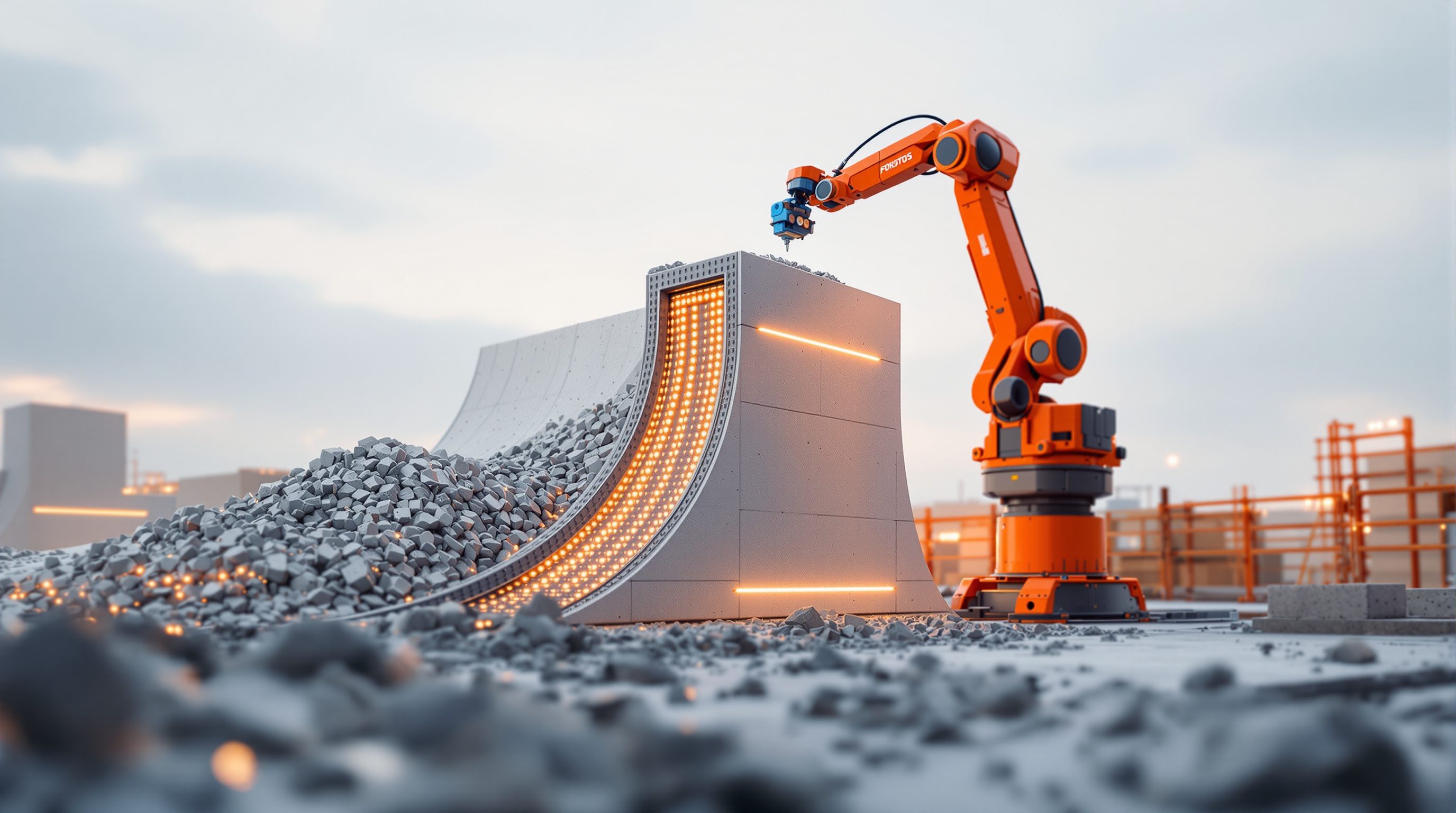
Robotic fabrication hands the designer a startling new freedom - curves, complexity and endless variation for almost nothing - and in the same breath imposes a strict new set of constraints, and learning to design well means holding both truths at once and working with the grain of the process rather than against it
The sales pitch says robotic fabrication sets form free - print anything. The workshop floor says every layer must sit on the one below. Both are true. Designing well means living inside that contradiction.
There is a seductive story about 3D printing and robotic fabrication: that they dissolve the old limits, that geometry is now free, that anything you can imagine you can build. And there is a cold reality on the workshop floor: that fresh concrete slumps, that a nozzle can only reach so far, that a layer laid too far out over the one below simply collapses. The temptation is to pick a side - to be a breathless enthusiast or a weary sceptic. The truth, and the skill, is to hold both at once.
Because both are genuinely real. Robotic fabrication really does unlock freedoms that conventional construction cannot touch: curves that cost no more than straight lines, every component different from the last at little extra cost, complexity that formwork could never justify. And it really does impose a strict new grammar of constraints: build direction, overhang limits, the behaviour of a material that must flow then hold, a finite machine envelope. The designers who do remarkable work with these tools are not the ones who ignore the constraints in pursuit of the freedom, nor the ones who let the constraints kill the ambition - they are the ones who design with the grain of the process, letting its real freedoms and real limits shape a form that could only have been made this way.
Two truths at once. FREEDOM: curves, variation, complexity nearly free. CONSTRAINT: no overhang, layer grain, material flow-then-hold, finite envelope. Design WITH the grain. Make complexity earn its place.
What genuinely gets easier: complexity and variation
Start with the freedom, because it is real and genuinely exciting. In conventional construction, geometry is expensive. A curved wall needs curved formwork; a hundred different window surrounds need a hundred moulds; ornament and complexity cost labour and time at every turn. The whole economic logic of modern building pushes toward the rectilinear, the repeated and the standard, because that is what is cheap to make. Robotic fabrication loosens that grip in two profound ways.
The first is that complexity is nearly free. A printer tracing a curve costs essentially the same as one tracing a straight line; a robot arm does not find an intricate path harder than a simple one in the way a human mason would. The cost driver shifts away from geometric complexity and toward material, time and machine hours. This is sometimes called the 'complexity paradox' of additive manufacturing: the thing that was most expensive to make conventionally - intricate, non-standard form - is no longer the expensive thing. Curves, tapers, flowing surfaces and elaborate profiles become design options rather than luxuries.
The second, and arguably more powerful for building, is variation at no extra cost - often called mass customisation. Because the machine works straight from a digital model, making the next part different from the last costs almost nothing: no new mould, no re-tooling. A facade of a thousand panels can have a thousand subtly different panels; a set of columns can each be tuned to the load it carries; a screen can vary its porosity across its surface in response to sun or view. Conventional prefabrication gives you cheap repetition of the identical; robotic fabrication gives you cheap production of the varied. That is a genuinely new thing in building.
Together these open a design space conventional construction cannot reach: form tuned to performance (shaping an element to where the load or the light actually is), internal voids and channels and lattices that save material or carry services, and an expressive, non-standard architecture that is nonetheless buildable. Used well, this is not decoration for its own sake but form that earns its complexity. Used badly, it is novelty for novelty's sake - which is why judgement, not just capability, is what matters. And all of it still sits on the binding engineering: a clever shape is not a safe one until the structural engineer, the material data and the codes say so.
The new grammar of limits
Now the other truth, held just as firmly. Robotic fabrication does not remove constraints; it swaps the old ones for a new set, and designing well means knowing the new grammar cold. Four constraints do most of the work.
No unsupported overhang. This is the big one, met in the last lesson and worth repeating because so much follows from it. Additive fabrication builds layer on layer from the bottom up, and each layer must land on the one beneath. A layer can step outward a little - a gentle corbel - but past a material- and machine-specific angle, fresh material slumps and the print fails. You cannot print a flat roof, a big cantilever or a deep ledge into thin air. This single fact is why 3D concrete printing makes walls and vertical elements so much more readily than horizontal spans, and why a 'printed building' is usually printed walls plus a conventional roof and floors.
Layer direction and build orientation. Because the thing is built in stacked layers, it has a grain, like timber. The direction the layers run affects the finish, and - this is an engineering matter to verify - how the element behaves under load and where its weak planes lie. Which way to orient a part for printing is therefore a real design decision with real consequences, not an afterthought.
Material behaviour. Printable materials live a difficult double life: they must flow easily enough to be pumped and extruded, then stiffen fast enough to hold their own shape and bear the next layer, without cracking or slumping. This 'pumpable yet buildable' balance governs how fast you can print, how tall before a pause, how sharp a detail survives. Material behaviour is not a backdrop; it is an active constraint shaping what geometry is achievable.
The machine envelope. As covered, every machine reaches only so far; anything larger must be decomposed. Size is a hard limit, not a soft preference.
Notice that these constraints are not failures of an immature technology that will simply vanish - they are intrinsic to building things up additively with a machine and a flowing material. They will ease and shift as the field matures, but the grammar of layers, support, direction, material and reach is fundamental. The competent designer treats them as the rules of a game worth playing well, and treats every quantitative limit as system-specific and to be verified, never assumed.
Freedom: curves free, variation free, complexity free. Constraints: no overhang, layer grain, material must flow-then-hold, finite envelope. BOTH are true.
Designing with the grain of the process
The resolution of the contradiction is a phrase worth tattooing on the mind: design with the grain of the process. A woodworker does not fight the grain of the timber; they read it and work with it, and the result is both stronger and more beautiful for it. Designing for robotic fabrication is the same. The freedoms and the constraints are not opposites to be balanced; they are two faces of the same process, and the best forms come from letting the process's own logic generate the design rather than imposing a shape conceived for some other way of building.
Concretely, designing with the grain means letting the constraints suggest the form. Because overhang is limited, you lean into shapes that corbel gently, that taper, that are self-supporting - and those shapes have a characteristic look that is honest to the process. Because layers are visible, you treat the bead texture as an expressive surface rather than a defect to hide. Because variation is free, you let elements differ in response to real forces - sun, load, acoustics, view - so the variation means something. Because material must flow then hold, you design details the material can actually achieve. The form that results could only have been printed, and it looks it - the way a thrown pot looks thrown and a welded frame looks welded. That honesty is a large part of why the best robotically fabricated work is compelling.
The anti-pattern is designing a form in the abstract - or worse, a form conceived for concrete formwork or steel - and then demanding the machine reproduce it. That fights the grain: it runs into overhang failures, needs endless supports, prints badly, and usually ends up more expensive and uglier than either a purpose-designed printed form or a conventionally built version would have been. 'Make the printer do this' is the wrong posture; 'what does this process want to make?' is the right one.
This is also where robotic fabrication meets computational and parametric design, the subject of the next lesson. The reason those tools are so tied to fabrication is that they let you encode the constraints as rules and the freedoms as variables, and then explore forms that live naturally within the grain - generating geometry that respects overhang and layer logic by construction, and varies meaningfully across a surface. Designing with the grain at any real scale almost demands computational tools, because the designer is no longer drawing a single fixed shape but defining a space of shapes the process can make well.
Real but bounded - and where judgement lives
It would be easy to finish on the romance of new form, but honesty is the spine of this course, so two cautions close the lesson. First, the freedom is real but bounded. Yes, complexity and variation are nearly free in a way conventional construction cannot match - but 'nearly free' is not 'free', and the bounds are the constraints we have just named plus the ones this course keeps returning to: reinforcement is still the central unsolved problem of printed concrete, so a clever printed form is not a finished structure; printing mostly makes vertical elements, so the freedom applies to part of the building, not all of it; and codes and approval for novel forms are still maturing. The design freedom is genuine within a process that is itself early, niche and limited in scale. Celebrate the freedom; do not mistake it for a solved, general capability.
Second, capability is not judgement. Because complexity and variation are cheap, it becomes dangerously easy to produce elaborate, twisty, hyper-varied forms simply because you can - the fabrication equivalent of using every font on the first day you discover them. The discipline is to make complexity earn its place: let form follow a real performance, a real site response, a real idea, not the mere thrill of the machine's ability. Some of the most respected work in this field is restrained, letting the process's honest expression and a few well-judged moves carry it, rather than maximising novelty. The constraint that matters most, in the end, is the designer's own taste and purpose.
And, as ever, the binding matters sit outside the designer's freedom entirely. However expressive or optimised a form, whether it is structurally safe, how it is reinforced, whether it meets code and can be approved - these are decided by qualified structural engineers, material specialists, certified testing, the manufacturer's verified data and the governing codes (the National Building Code of India and local regulations). A figure for a safe overhang angle, a printable-material property or a span is illustrative and system-specific, never a specification you design to on your own authority. The freedom is the designer's to explore; the safety is the engineer's to guarantee. Holding the freedom, the constraints and that division all at once is what it means to design well for robotic fabrication.
Overhang & material limits
How far a layer can overhang; how fast the material sets
The safe overhang angle and buildability rate are material- and machine-specific, from the manufacturer's verified data and testing - illustrative here, never a design specification. Module 4.2.
Structural design & testing
Whether an expressive or optimised form is actually safe
A clever shape is not a safe structure until a qualified structural engineer designs and certified testing confirms it; layer direction affects load behaviour. Module 8.1.
Reinforcement strategy
Tensile strength of a printed form
The central unsolved problem of 3DCP bounds the real design freedom; how to reinforce a complex printed form is the engineer's decision, not the designer's. Module 4.3.
Codes, standards & approval
Legal use of novel, non-standard forms
Approval of unconventional printed geometry follows the governing codes (NBC India), the authority and the engineer; code readiness for novel forms is still maturing. Module 8.2.
Workshop — design one element that could only have been printed
To feel the freedom and the constraints together, design a single element that genuinely exploits what robotic fabrication makes cheap (complexity, variation, performance-tuned form) while honestly respecting what it forbids (overhang, layer grain, envelope). The goal is a form that is both expressive and buildable.
Paper and pencil or any 3D modeller. No machine - this is design judgement, not operation.
Goal: a form that uses the freedom and respects the constraints at once
Inputs: a brief for one element (a sunshade screen, a varied-column colonnade, an acoustic wall panel), this lesson, paper or a modeller
Time: ~50 minutes
- 1Choose a real performance to respond to: sun angle, an acoustic need, a structural load path, a view. This is what your variation or complexity will serve - so it earns its place.
- 2Design the element to vary or curve in response to that performance (e.g. porosity that changes with sun angle, a section that thickens where load is higher). Use the freedom deliberately.
- 3Now apply the constraints: check every overhang is gentle or supported; choose a build direction and note how the layer grain runs; sanity-check the size against a plausible envelope; confirm the material could flow-then-hold the details you drew.
- 4Redesign anything that fights the grain until the form is both expressive and buildable - the point where freedom and constraint meet.
- 5Write a one-paragraph reflection: what the freedom let you do that conventional construction could not, which constraints shaped the form, and which questions (overhang limit, strength, reinforcement, code) you would verify with the engineer and the manufacturer rather than assume.
You’ll walk away with
One sheet showing a printed-only element: the performance it responds to, the freedom it exploits, the constraints it respects, the build direction, and the explicit list of verified/deferred engineering questions. It demonstrates the whole lesson in a single design.
Three altitudes on the same idea
Read the band that fits you — or all three.
Robotic fabrication expands the architectural palette and narrows it at the same time - your job is to design with the grain of that. The freedom is real: curves, variation and complexity become affordable, letting form respond to load, light, acoustics and view in ways formwork could never justify. The constraints are equally real: no unsupported overhang, a layer grain that affects load behaviour, material that must flow then hold, a finite envelope. Let the constraints shape the form rather than fighting them, make complexity earn its place rather than indulging novelty, and remember the freedom applies to part of a building that still needs conventional structure, reinforcement, roof and services. Own the expressive and performative judgement; defer structural safety, reinforcement, the real overhang limits and code approval to your engineer, the manufacturer's data and the codes.
This is where robotic fabrication is most immediately thrilling for interiors - and most in need of judgement. Bespoke screens, panels, furniture, light fittings and decorative elements can now carry curves, intricate profiles and part-to-part variation at little extra cost, so a whole run of pieces can differ meaningfully - porosity tuned to light, pattern tuned to place. Design with the grain: embrace the layer texture as finish, keep overhangs gentle or supported, and work to what the material can actually hold. Resist complexity for its own sake; let variation respond to something real. Keep any structural, fire or safety-critical requirement with the relevant specialist and the manufacturer's data; your domain is inventive, process-honest, genuinely makeable components.
The single most important habit this lesson teaches is holding two truths at once. Robotic fabrication unlocks real geometric freedom - complexity and variation for almost nothing - and imposes real new constraints - no overhang, layer direction, material behaviour, finite envelope. Do not be the enthusiast who ignores the limits or the sceptic who ignores the potential; be the designer who designs with the grain of the process, letting its freedoms and limits together generate forms that could only be made this way. Remember the freedom is real but bounded (reinforcement unsolved, mostly vertical elements, codes maturing) and that capability is not judgement - make complexity earn its place. That clear-eyed, grain-reading sensibility is exactly what distinguishes a fabrication-literate designer from someone merely impressed by a printer.
“3D printing gives total design freedom - the whole point is that you can finally build any form with no constraints, so the old rules of construction simply do not apply any more.”
Do it yourself
No tools needed - reason it through.
- 1Name the two big freedoms robotic fabrication unlocks and explain why each is 'nearly free' when conventional construction makes it expensive.
- 2List the four main constraints of additive robotic fabrication and say why they are intrinsic rather than temporary.
- 3What does 'design with the grain of the process' mean, and what is the anti-pattern that fights the grain?
- 4Why is the design freedom described as 'real but bounded'? Give two of the bounds.
- 5Explain why 'capability is not judgement' in this context, and give an example of complexity earning its place versus complexity for its own sake.
The one line to carry out
Peer-reviewed journals & authoritative standards
- 01Construction 3D printing — Wikipedia — Construction 3D printing, 2026.
- 02Additive manufacturing — Wikipedia — Additive manufacturing, 2026.
- 03Contour crafting — Wikipedia — Contour crafting, 2026.
- 04Material extrusion — Wikipedia — Material extrusion, 2026.
Designing with the grain at any real scale means not drawing a single fixed shape but defining a space of shapes the process can make well - which is exactly what computational and parametric tools are for. Next we look at how these buildings are actually designed: the computational and parametric workflows that feed fabrication.
The author
Amogh N P
Architect, interior designer, and creative polymath. Studio Matrx began in his notebooks — his vision of design made honest, useful, and open to everyone. Its Academy is written and taught in his memory, and free, forever.
More about Amogh →