
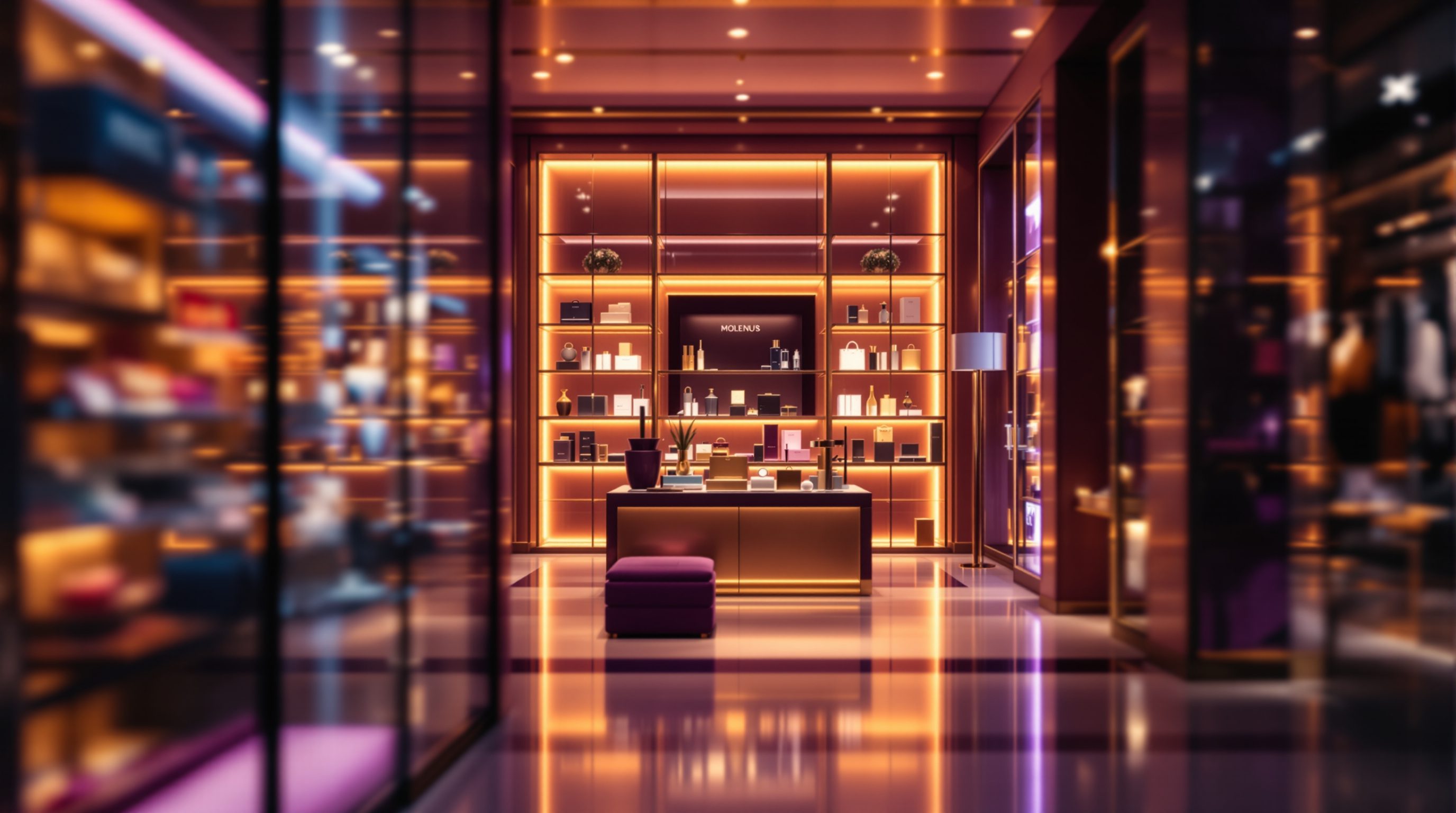
 Lesson 0.3
Lesson 0.3 · Why Retail Design Sells
Types of Retail & Their Briefs
The single word retail hides a spectrum of utterly different machines - from the minute-long convenience run to the hour-long luxury browse - and their shoppers, briefs and economics differ so wildly that the format decides the design before you draw a line
A convenience run and a luxury browse are not two versions of the same trip. They are opposite trips - and their stores must be opposite too.
Picture two shoppers on the same afternoon. One ducks into a neighbourhood store for a cold drink and a packet of biscuits, is at the counter in ninety seconds, and is gone. The other spends an unhurried hour in a boutique, is offered a seat and a coffee, tries three things, talks to an assistant, and leaves with a single carefully chosen bag. Both were shopping. But almost nothing about their trips was the same - not the errand, not the pace, not the basket, not the feeling, and certainly not the store that served each one. To design either well, you first have to know which kind of retail you are dealing with.
This lesson maps the spectrum of retail formats - convenience, grocery and the supermarket, the department store, fashion and apparel, F&B retail, the showroom, the pop-up, the luxury boutique and the mall - and shows how wildly their shoppers, briefs and economics differ. The reason this matters so much is simple: the format decides the brief, and the brief decides the design. There is no universal template for a good store, and the fastest way to design a bad one is to borrow the playbook of the wrong format. Learn to read the format first, and every later technique in the course finds its correct setting.
Read the format first. Convenience to luxury: opposite shoppers, opposite briefs, opposite settings of the same toolkit.
One word, a dozen different machines
The last lesson mapped the shopper journey as if there were one. There is not. The single word retail covers an astonishing range of very different machines, each built around a different shopper on a different errand, answering a different brief and running on completely different economics. A person darting into a convenience store for a cold drink and a person spending a leisurely hour in a luxury boutique are not two versions of the same trip - they are opposite trips, and the stores that serve them must be opposite too. Before you can design a good store, you have to know which kind of machine you are being asked to build, because the format decides almost everything that follows.
Why does the format matter so much. Because it fixes the three things every design decision hangs on. It fixes the shopper and their errand - are they in a hurry or at leisure, buying necessities or treating themselves, one item or a full trolley, deciding fast or deliberating long. It fixes the brief - what the store must do, how long it wants to hold people, how much experience versus efficiency it should offer, how the merchandise should be shown. And it fixes the economics - the margins, the footfall, the space productivity, the refit cycle, the whole commercial logic the design must serve. Change the format and all three change at once, and with them almost every choice about layout, density, light, fixtures and finish.
This is why there is no universal template for a good store, and why copying the look of one format into another produces failure. A supermarket laid out like a boutique would waste ruinously expensive space and frustrate shoppers who came to fill a trolley fast; a boutique laid out like a supermarket would strip away the very slowness and specialness its shoppers are paying for. The professional habit this lesson builds is to read the format first - to ask what kind of retail this is, who its shopper is, and what its economics demand - and only then to design. The rest of the course teaches devices that work across formats, but always calibrated to the format in front of you.
There is no universal store. The format fixes the shopper, the brief and the economics - read it first.
The format spectrum, fast to slow
Let us walk the spectrum, from the fastest, most routine formats to the slowest, most experiential, naming each and what defines it.
Convenience stores trade on speed and proximity - the neighbourhood kirana, the petrol-station shop, the metro-station kiosk. The shopper is in and out in minutes, the basket is small and urgent, the space is tiny and packed, and the whole design serves fast finding and faster paying. Grocery and the supermarket scale that up into the weekly shop: a large, systematic layout that walks the shopper past staples and temptations alike, filling a big basket over half an hour, run on thin margins and high volume where every square foot and every aisle is optimised. Department stores are whole worlds under one roof - many categories, many brands, floors of them - held together by circulation and anchored by destinations, a format under real pressure but still powerful at its best. Fashion and apparel is the heartland of designed retail: browse-led, image-rich, changing with the seasons, built around trying-on, where display, light and the fitting room do the selling and the store is refitted often to stay current.
F&B retail - the cafe, the bakery, the branded food counter - fuses retail with hospitality, selling an experience and a moment as much as a product, and increasingly used to draw footfall and dwell into other retail. Showrooms display big-ticket, considered goods - furniture, cars, kitchens, appliances - that shoppers research and rarely carry home, so the store sells through demonstration, configuration and expert help rather than stock on shelves. Pop-ups are deliberately temporary - a few weeks in a vacant unit or a corner - trading on novelty, buzz and brand-building, cheap and fast to build and gone before they tire. Luxury boutiques sit at the far end: sparse, exquisite, slow, where the space, the materials and the service are the product as much as the goods, and a single high-value sale justifies enormous cost per square foot. And the mall is the container for many of these - not a store but a curated collection of them, planned around anchor tenants, circulation and a day out, an ecosystem the individual store must fit into. Each is a different answer to the question, how do we sell to this shopper.
How the brief changes with the format
Set the formats side by side and the differences in their briefs become sharp and measurable - and seeing them is what stops a designer from applying the wrong playbook. Consider just four levers.
Dwell - how long the store wants to hold the shopper - swings enormously. Convenience wants you out in minutes; a supermarket wants a purposeful half-hour; fashion wants a long, exploratory browse; luxury wants a slow, savoured visit where time itself signals specialness. The layout, the seating, the density and the pace all follow directly from the dwell the format wants. Basket - what a shopper buys per visit - runs from the single urgent item at convenience, through the large weekly trolley at the supermarket, to the few considered pieces in fashion and the one high-value purchase in luxury. That shapes everything from trolley versus basket versus nothing, to the number and placement of tills.
Density - how much merchandise per square metre - is high and packed in convenience and grocery (abundance sells, and space is dear), moderate and edited in fashion, and deliberately sparse in luxury, where empty space itself signals value. Get the density wrong and you either waste selling space or make a premium store look like a bargain bin. Refit cycle - how often the store is rebuilt - is slow for a supermarket, faster and seasonal for fashion, near-constant for a pop-up that exists only briefly, and this changes how durably and how flexibly you must design and specify. Beneath all four sits the economics, and they pull in opposite directions across the spectrum. Thin-margin, high-volume formats such as convenience and grocery live or die by throughput, so they optimise every foot for productivity and every second for speed - footfall is high, the margin on each item is slim, and the store cannot afford to spend space on anything that does not sell. High-margin, experience-led formats such as fashion and luxury run the reverse logic: footfall is lower and more deliberate, the margin on each sale is fat, and the store can lavish space, cost and time on atmosphere and service because a single purchase can pay for a great deal of it. Between them sit formats like the department store and F&B that balance both. The point is not to memorise the figures - treat them as illustrative benchmarks, as of 2026, to calibrate to the specific brand, format and market - but to internalise that the brief itself changes with the format, and the design must change with the brief.
Dwell, basket, density, refit - all swing with the format. Same toolkit, opposite settings.
Matching the design to the format
How do you use all this in practice. The first move on any retail project, before a line is drawn, is to read the format and let it set the brief. Ask: what kind of retail is this, who is the shopper and what is their errand, how long should they stay, how big is the basket, how dense should the merchandise be, how much of the value is experience versus efficiency, and what do the economics - margin, footfall, refit cycle - demand. The answers point straight at the design: a speed format wants clarity, easy finding and fast checkout above all; an experience format wants atmosphere, dwell and service; a considered-purchase format wants demonstration, information and expert help. The techniques in the rest of this course are the same toolkit; the format decides how you set each tool.
Two warnings guard against the common mistakes. The first is copying across formats: admiring a flagship boutique and importing its sparse, slow language into a value supermarket, or a supermarket's ruthless density into a premium store. What is right in one format is wrong in another, because the shopper and economics differ. The second is treating benchmarks as rules - the dwell times, densities, sales per square foot and aisle widths that get quoted for each format are starting points to calibrate to your brand, format and market, not numbers to copy. And formats are not fixed: they blur and hybridise constantly - the supermarket that adds a cafe and a bakery for dwell, the fashion store that becomes an experiential flagship, the D2C brand born online opening a pop-up then a showroom, the mall reinventing itself as a leisure destination.
India shows the whole spectrum at once, which is part of what makes it such a rich place to design retail. The corner kirana and the crowded bazaar are convenience and market retail refined over generations; the great Indian mall and the flagship on the high street bring global formats; the wave of D2C brands going physical is inventing new hybrids; and festive retail turns ordinary stores into destinations for a season. Whatever the format, the same discipline applies: read what kind of machine it is, understand its shopper and economics, and design to that brief - deferring the binding fire, accessibility, licensing and signage specifics, which also vary by format and location, to the current codes, the specialists and the brand standards.
Format benchmarks (dwell, basket, density, sales/sq ft)
The figures quoted for each retail format
Illustrative starting points that differ by format - calibrate to the specific brand, format and market, never copy a figure across formats. Modules 2, 4, 8.
Occupancy, fire & licensing by format (NBC 2016, bye-laws)
Occupant load, egress, food/liquor and trade licences
Requirements vary with the format and occupancy (F&B, mall, showroom differ) - defer every binding value to the current code, local bye-laws and the specialists. Modules 8, 9.
Brand & format design standards
The retailer's rulebook for that format
Chains define a design standard per format - design within it. Modules 7, 10.
Workshop — read three formats against their briefs
The fastest way to internalise the spectrum is to compare formats directly. In this workshop you will read three different retail formats you can visit or recall, and pull out how their shoppers, briefs and economics - and therefore their designs - differ.
Three shops you can visit or recall and a sheet of paper. This is about learning to read formats, not to measure them.
Goal: a side-by-side read of how format sets the brief
Inputs: three different retail formats you can visit or recall + this lesson + paper
Time: ~50 minutes
- 1Pick three genuinely different formats - for example a convenience store, a supermarket and a fashion or luxury store - and for each, describe the shopper and their errand in one sentence.
- 2For each format, estimate the four levers from this lesson: dwell (how long the store wants them), basket (what they buy per visit), density (how packed the merchandise is) and refit cycle (how often it is rebuilt). Note what you observe, not a textbook figure.
- 3For each, name the single biggest thing the design does to serve that brief - the move that would be wrong in the other two formats.
- 4Now imagine swapping one design language into the wrong format (a luxury boutique's sparseness into the supermarket, say) and write two sentences on exactly why it would fail.
- 5Write a short conclusion: what did comparing the three teach you about why there is no universal store, and how you would read a format's brief on your next project.
You’ll walk away with
A one-page comparison of three retail formats - shopper, brief (dwell, basket, density, refit), the signature design move of each, and why swapping languages fails - ending with your rule for reading a format's brief. Keep it as a reference.
Three altitudes on the same idea
Read the band that fits you — or all three.
The format drives the base-build long before the fit-out, so the architect must know it from the brief. A high-volume supermarket wants a large, efficient, column-light floor plate with heavy servicing and loading; a luxury flagship wants a sculpted shell and a controlled, generous approach; a mall is a piece of urban infrastructure planned around anchor tenants, circulation and parking; a pop-up may be a light insertion into an existing space. Frontage, floor-to-floor, structural grid, servicing and access all follow from the format, and for chains you may standardise a shell across many sites. Match the architecture to the format's economics, coordinate early with the retail designers, and defer fire, egress, accessibility and licensing specifics - which themselves vary by format and occupancy - to the codes and specialists.
The format is the single most important input to your interior scheme, because it sets the density, dwell, fixtures and atmosphere. The same designer's toolkit - layout, fixtures, display, light, materials, service points - is set completely differently for a packed convenience store, an edited fashion floor and a sparse luxury boutique. Read the format's shopper and economics, then calibrate: how dense the merchandising, how fast or slow the pace, how much space to spend on experience, how durable and flexible the fixtures given the refit cycle. Resist importing a look you admired from a different format, and work to the brand's design standards, which encode the format's intended feel.
Learning the formats is learning to see that retail is many disciplines, not one - and you can study them all just by shopping. Visit a convenience store, a supermarket, a fashion store and, if you can, a luxury boutique in the same week, and note how differently each treats you: the pace it sets, the density of goods, how long it wants you to stay, how it shows and sells. Ask what shopper and what economics each is built for. You are not expected to know the benchmark figures; you are expected to grasp that the format sets the brief, and that a good store is good for its format, not good in the abstract.
“Good retail design is a set of universal best practices - once you learn how to design a great store, you can apply the same principles to any shop.”
Do it yourself
No tools needed - reason it through.
- 1Name six retail formats and describe the shopper and errand each is built around.
- 2Explain why there is no universal template for a good store, using the idea that the format sets the brief.
- 3How do dwell, basket, density and refit cycle differ between a convenience store and a luxury boutique, and why?
- 4Give an example of a design language that is right in one format and wrong in another, and explain the reason.
- 5Why should format benchmarks like dwell times and sales per square foot be treated as figures to calibrate rather than rules?
The one line to carry out
Peer-reviewed journals & authoritative standards
- 01Retail store — Wikipedia — Retail store, 2026.
- 02Department store — Wikipedia — Department store, 2026.
- 03Supermarket — Wikipedia — Supermarket, 2026.
- 04Convenience store — Wikipedia — Convenience store, 2026.
- 05Pop-up retail — Wikipedia — Pop-up retail, 2026.
Across every one of these formats runs one question that now defines them all: why come to a physical store at all, when so much can be bought online? Next we face that question head on.
The author
Amogh N P
Architect, interior designer, and creative polymath. Studio Matrx began in his notebooks — his vision of design made honest, useful, and open to everyone. Its Academy is written and taught in his memory, and free, forever.
More about Amogh →