
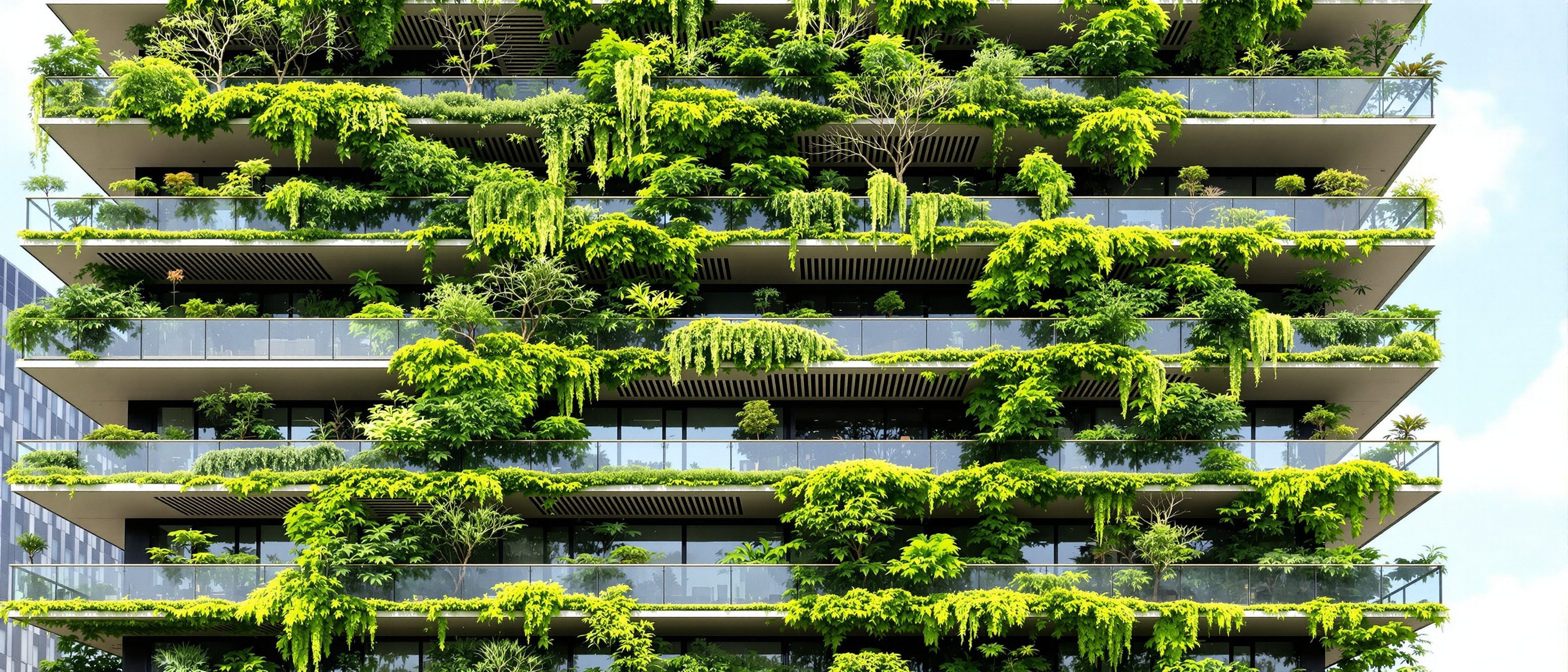
Sustainable & Green Architecture
From form to performance — passive first, and the Indian rating systems untangled.
Sustainable architecture marks a pivot from how a building looks to what it does — measurable energy, water, carbon and materials over its life. The governing rule is passive before active: form, orientation and fabric first, technology second. Learn Ken Yeang's bioclimatic skyscraper, the split between operational and embodied carbon, and — kept precise — India's three confused frameworks: GRIHA (the national system), IGBC (the CII council) and ECBC (an energy code, not a rating). Untangle them with the comparator.
Learning objectives
By the end of this lesson, you will be able to — mapped to the course outcomes for Progressive Architecture:
Explain the pivot from form to performance and the passive-before-active hierarchy.
Describe Ken Yeang's bioclimatic skyscraper and the operational vs embodied-carbon split.
Distinguish GRIHA, IGBC and ECBC precisely — owner, type and origin.
Judge why a green rating does not by itself guarantee real sustainability.
Passive first, then active
Exhaust the cheap, robust passive measures of form and fabric before reaching for active technology — and watch embodied carbon grow as operational energy falls.[1]
Comfort from form & fabric
Passive strategies use building form, fabric and siting to provide comfort with little energy: orientation, massing, shading and overhangs, daylighting, cross-ventilation and stack effect, thermal mass, insulation and appropriate glazing. The roots predate the 1990s (Olgyay's Design with Climate, 1963; Givoni's bioclimatic charts).[1]
The rating systems
Ratings made “green” measurable and marketable — but they are tools, not guarantees. Keep the Indian trio precise.[3, 4, 5]
USGBC, international
Leadership in Energy and Environmental Design, run by the U.S. Green Building Council, launched 2000 — tiers Certified/Silver/Gold/Platinum across energy, water, materials, indoor quality and sites. The best-known international system; used in India often via IGBC's LEED-derived versions.[3]
Untangle the frameworks
Pick a system and read its owner, type and tiers — the fastest way to stop confusing GRIHA, IGBC and ECBC.
Green frameworks · pick one
GRIHA
Owner
GRIHA Council — developed by TERI, anchored by MNRE
Type
Voluntary rating system (India's NATIONAL system)
Tiers / output
Points-based (commonly up to 5-star)
India's own national rating system, tuned to Indian climate, materials and construction realities. Referenced in government projects. NOT the same as IGBC.
The clean distinction: GRIHA = national (TERI/MNRE) · IGBC = CII's LEED-derived family · ECBC = BEE's energy code (a regulation, not a label).
At a glance
| Aspect | One | The other |
|---|---|---|
| Owner | LEED: USGBC (United States) | GRIHA: GRIHA Council (TERI / MNRE) |
| Tuning | LEED: international, US-origin | GRIHA: India-specific climate & materials |
| GRIHA vs IGBC | GRIHA: the NATIONAL system | IGBC: CII's LEED-derived rating family |
| ECBC is | A code (BEE) — a regulation | NOT a rating label you 'earn' |
| Passive vs active | Passive first: form & fabric | Active second: efficient tech, PV |
Key terms
Thermal/visual comfort through form, orientation, fabric and natural energy flows, with minimal mechanical input.
Greenhouse-gas emissions from making, transporting, building and disposing of materials.
A building that produces over a year at least as much energy as it consumes.
Design responding to local climate (sun, wind, humidity); Yeang applied it to skyscrapers.
GRIHA = national (TERI/MNRE); IGBC = CII's LEED-derived family; ECBC = BEE's energy CODE, not a rating.
A framework where materials cycle perpetually as safe biological or technical nutrients ('waste = food').
Studio task
Take a small building in your climate and list its passive strategies first (orientation, shading, ventilation, mass), then the active systems you would add only after. Separately, in one table, state which of GRIHA, IGBC and ECBC you would pursue and why — and explain, in a line, why a Platinum rating still might not mean genuine sustainability.
Self-assessment
1. Which is India's NATIONAL green-building rating system?
2. ECBC is best described as —
3. As buildings become highly operationally efficient, which impact grows in relative importance?
Recap
References & further reading
- [1]Ken Yeang, The Skyscraper Bioclimatically Considered (1996); Ecodesign: A Manual for Ecological Design (2006).
- [2]William McDonough & Michael Braungart, Cradle to Cradle: Remaking the Way We Make Things, 2002.
- [3]U.S. Green Building Council, LEED rating system reference guides.
- [4]GRIHA Manual (GRIHA Council / TERI / MNRE); IGBC Green Rating reference guides (CII).
- [5]Bureau of Energy Efficiency, ECBC 2017; International Living Future Institute, Living Building Challenge.
Further reading
- Ken Yeang — The Skyscraper Bioclimatically Considered (1996).
- McDonough & Braungart — Cradle to Cradle (2002).
- GRIHA Manual / IGBC reference guides (free).
Sources gathered and fact-checked June 2026. Published values vary by source, sample and method — treat as indicative and confirm against the cited standard before structural use.
The author
Amogh N P
Architect, interior designer, and creative polymath. Studio Matrx began in his notebooks — his vision of design made honest, useful, and open to everyone. Its Academy is written and taught in his memory, and free, forever.
More about Amogh →