
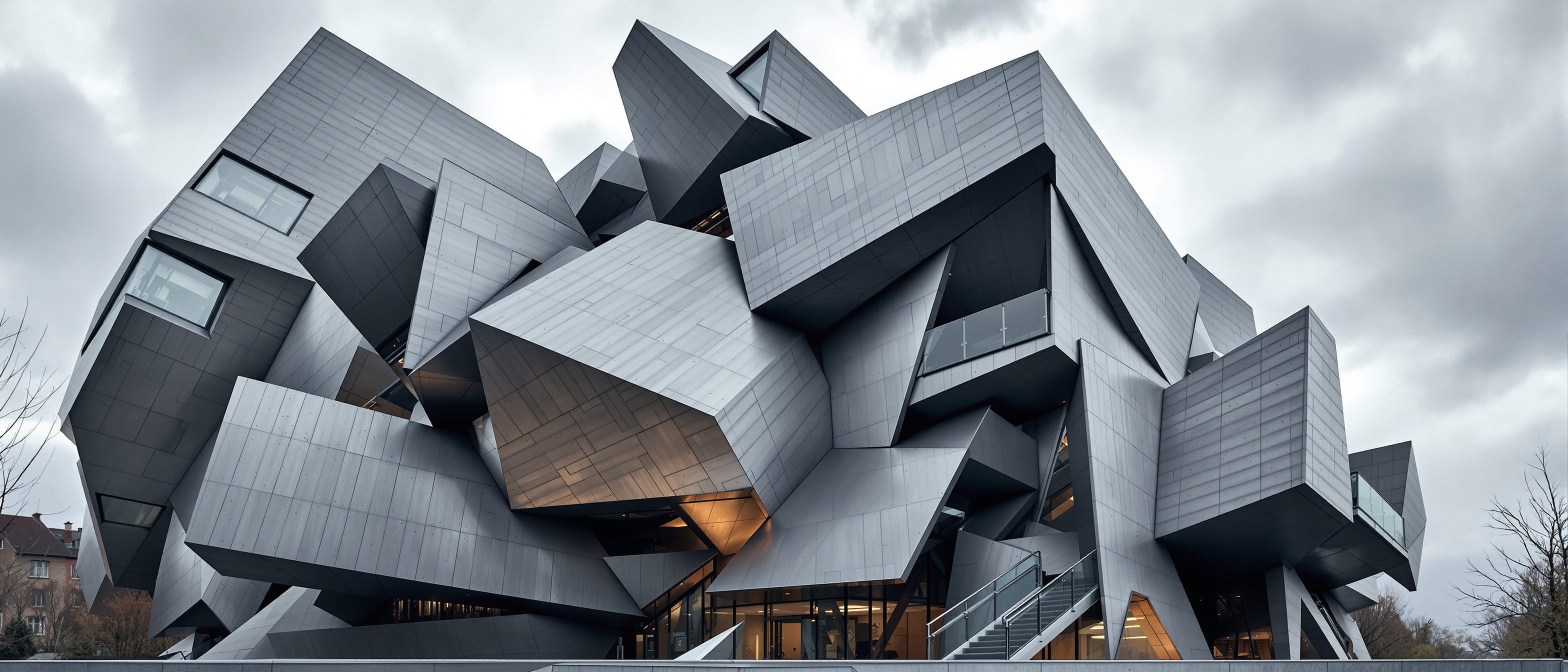
Deconstructivism & the Avant-Garde
The 1988 MoMA show, and the architecture that disrupted the perfect cube.
In 1988 a single MoMA exhibition named a tendency: seven architects — Gehry, Hadid, Libeskind, Eisenman, Koolhaas, Tschumi and Coop Himmelb(l)au — who shared no manifesto but converged on fragmented, skewed, non-rectilinear form. Deconstructivism braids two roots: the diagonal dynamism of 1920s Russian Constructivism and the questioning method of Derridean philosophy. Learn the movement, its signature works, and the myths around it — it is a formal avant-garde, not literal demolition, and Bilbao opened in 1997.
Learning objectives
By the end of this lesson, you will be able to — mapped to the course outcomes for Progressive Architecture:
Explain how the 1988 MoMA show framed deconstructivism as a sensibility, not a school.
Trace the two roots — Russian Constructivism and the Derridean reading.
Name the seven exhibitors and a signature work for each.
Distinguish the formal avant-garde from the myth of literal 'deconstruction'.
The seven exhibitors
The 1988 show framed a convergent sensibility, not a school. Tap through the seven and their landmark works.[1]
Frank Gehry — the sculptural populariser
The populist face of the tendency (though he resisted the label). His Santa Monica house (1978) — chain-link, raw plywood, skewed cubes — is the early gesture; the Guggenheim Museum Bilbao (OPENED 1997) is career-defining: billowing titanium forms resolved with aerospace software (CATIA), and the textbook 'Bilbao effect' of a single icon regenerating a city.[1, 2]
The ideas behind the movement
Russian Constructivist form plus a Derridean reading — held together by fragmentation and instability over harmony.[1, 3]
Curation made the 'movement'
Deconstructivism entered the mainstream through one curated event — the MoMA show by Philip Johnson and Mark Wigley. They were explicit: the seven shared no manifesto or membership; the show NAMED and framed a convergent sensibility more than it created one.[1]
At a glance
| Aspect | One | The other |
|---|---|---|
| Underlying geometry | Modernism: pure, stable, rectilinear | Deconstructivism: skewed, fragmented |
| Attitude to structure | Honest, legible, resolved | Apparently disrupted, in tension |
| Source of order | Function, the grid, rationality | Internal formal logic; controlled chaos |
| Emotional register | Clarity, calm, universality | Instability, rupture, disorientation |
| Late method | Drawing / orthographic | Physical models → digital (CATIA at Bilbao) |
Key terms
A late-1980s formal avant-garde of fragmented, skewed, non-rectilinear architecture, named by the 1988 MoMA show.
1920s Soviet movement of dynamic, diagonal, abstract form — a formal ancestor of deconstructivism.
One of ~35 small red steel pavilions on a grid — each a deconstructed cube acting as a 'point'.
The idea that architecture has a self-referential disciplinary logic, distinct from function and meaning.
The phenomenon of an iconic building catalysing a city's economic and cultural regeneration.
Aerospace surface-modelling software adapted by Gehry's office to build complex curved geometry.
Studio task
Pick one of the seven exhibitors and analyse a single signature work in a one-page study: what is fragmented or skewed, how it disrupts the “perfect” cube, and which root (Constructivist form or Derridean reading) it leans on. Then state, in one line, one myth about deconstructivism your example helps correct.
Self-assessment
1. Who curated the 1988 MoMA 'Deconstructivist Architecture' exhibition?
2. Which software did Gehry's office adapt to resolve the curved geometry of Guggenheim Bilbao?
3. The red 'folies' in Tschumi's Parc de la Villette primarily express which idea?
Recap
References & further reading
- [1]Philip Johnson & Mark Wigley, Deconstructivist Architecture, exhibition catalogue, MoMA, New York, 1988.
- [2]Coosje van Bruggen, Frank O. Gehry: Guggenheim Museum Bilbao, Guggenheim, 1997.
- [3]Mark Wigley, The Architecture of Deconstruction: Derrida's Haunt, MIT Press, 1993.
- [4]Rem Koolhaas, Delirious New York (1978); and S,M,L,XL (with B. Mau), 1995.
- [5]Bernard Tschumi, Cinegram Folie: Le Parc de la Villette, Princeton Architectural Press, 1987.
Further reading
- Johnson & Wigley — Deconstructivist Architecture (MoMA, 1988).
- Kenneth Frampton — Modern Architecture: A Critical History (closing chapters).
- Charles Jencks — The New Paradigm in Architecture (2002).
Sources gathered and fact-checked June 2026. Published values vary by source, sample and method — treat as indicative and confirm against the cited standard before structural use.
The author
Amogh N P
Architect, interior designer, and creative polymath. Studio Matrx began in his notebooks — his vision of design made honest, useful, and open to everyone. Its Academy is written and taught in his memory, and free, forever.
More about Amogh →