
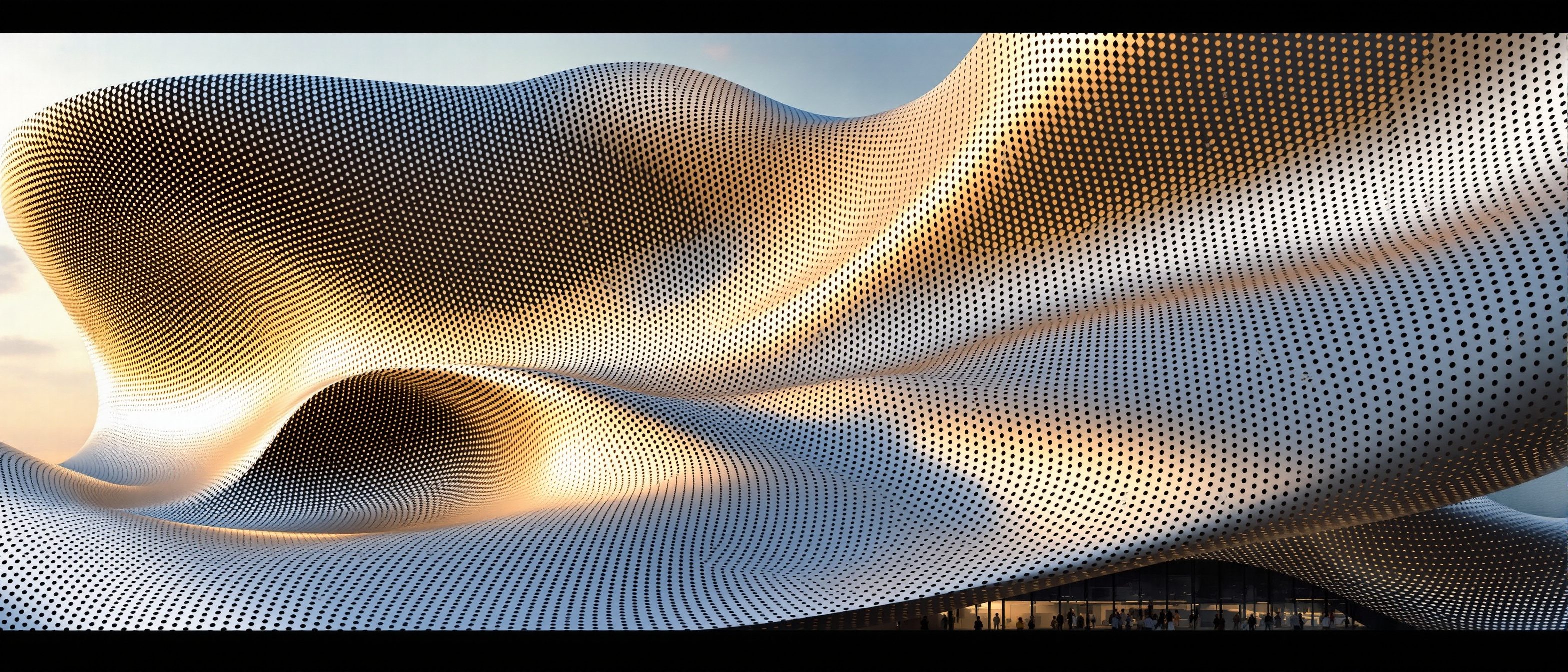
Digital & Parametric Architecture
Relationships, not shapes — and why 'Parametricism' is a contested label.
The digital turn began not with curvy buildings but with a change of medium — the paperless studio, where the computer became the site of design thinking and CAD/CAM linked drawing directly to making. NURBS made the blob buildable; parametric design made form follow rules and relationships, not fixed coordinates. Learn why a parametric building can be perfectly orthogonal, why “Parametricism” is Schumacher's contested style claim (not the invention of the technique), and how BIM and file-to-factory changed practice.
Learning objectives
By the end of this lesson, you will be able to — mapped to the course outcomes for Progressive Architecture:
Explain the paperless studio, the CAD/CAM turn and NURBS / the 'blob'.
Define parametric design as relationships and constraints — not merely curved form.
Explain why 'Parametricism' is a contested style label that did not invent the technique.
Distinguish BIM as a process from '3D modelling', and explain file-to-factory.
The digital method
Parametric design is associative logic — rules and relationships, not curviness. An orthogonal building can be deeply parametric.[1, 5]
A change of medium
The digital turn began in the early-mid 1990s when the 'paperless studio' (Columbia GSAPP; Greg Lynn, Hani Rashid) replaced the drawing board with the computer as the primary site of design thinking — modelling animated, time-based, topological forms orthographic drawing could not describe. CAD/CAM then linked design directly to fabrication.[1]
'Parametricism' — a contested label
Schumacher coined a style label around 2008 — but the technique reaches back to Gaudí, Sutherland's Sketchpad (1963) and Moretti. Hold the two apart.[3, 4]
Parametricism (capital P)
Patrik Schumacher (Zaha Hadid Architects) proposed 'Parametricism' as the name for a new epochal STYLE succeeding modernism — a manifesto around the 2008 Venice Biennale, elaborated in The Autopoiesis of Architecture (2011/12). Be honest: the label is contested as a unifying style.[3]
At a glance
| Aspect | One | The other |
|---|---|---|
| Defining idea | Parametric: rules & relationships | Free-form/blob: smooth curved surface |
| Geometry can be | Parametric: orthogonal OR curved | Blob: necessarily curvilinear |
| Changes propagate? | Parametric: yes — adjust a parameter | Blob: no — it is a shape, not a system |
| Key figure | Schumacher (as style); CAD lineage | Greg Lynn (Animate Form) |
| Common myth | 'Any curvy building is parametric' | 'Blobs are automatically high-performance' |
Key terms
Modelling driven by parameters and associative relationships, so changing an input updates the geometry.
Schumacher's CONTESTED claim that parametric design constitutes a new epochal architectural style.
Non-Uniform Rational B-Spline — mathematics for smooth, free-form curves and surfaces.
Building Information Modelling — a data-rich, object-based PROCESS for designing and managing a building across its lifecycle.
A workflow where the digital model directly drives fabrication machinery without manual re-drawing.
Designing by authoring rules/algorithms that GENERATE form, often coupled to performance optimisation.
Studio task
Write, in plain words (no software needed), a small set of parametric rules for a facade — e.g. “louvre depth grows toward the west; panel spacing follows the floor height; openings shrink where solar gain is highest.” Show how changing one input would ripple through. Then explain why this is parametric even if the building is rectilinear — and why a hand-drawn blob is not.
Self-assessment
1. Parametric design is best defined as —
2. 'Parametricism' as proposed by Patrik Schumacher is —
3. BIM is most accurately described as —
Recap
References & further reading
- [1]Branko Kolarevic (ed.), Architecture in the Digital Age: Design and Manufacturing, 2003.
- [2]Greg Lynn, Animate Form, Princeton Architectural Press, 1999.
- [3]Patrik Schumacher, The Autopoiesis of Architecture, Vols. 1–2, 2011/2012; 'Parametricism' manifesto (c.2008).
- [4]Charles Jencks, The New Paradigm in Architecture, 2002 (the move to 'complexity').
- [5]Chuck Eastman, Paul Teicholz, Rafael Sacks & Kathleen Liston, BIM Handbook, 2008.
Further reading
- Branko Kolarevic — Architecture in the Digital Age (2003).
- Greg Lynn — Animate Form (1999).
- Eastman et al. — BIM Handbook (2008).
Sources gathered and fact-checked June 2026. Published values vary by source, sample and method — treat as indicative and confirm against the cited standard before structural use.
The author
Amogh N P
Architect, interior designer, and creative polymath. Studio Matrx began in his notebooks — his vision of design made honest, useful, and open to everyone. Its Academy is written and taught in his memory, and free, forever.
More about Amogh →