
Emerging Directions & the Future
Mass timber, the 3D-printed wall, AI and the smart city — demonstrated vs hyped.
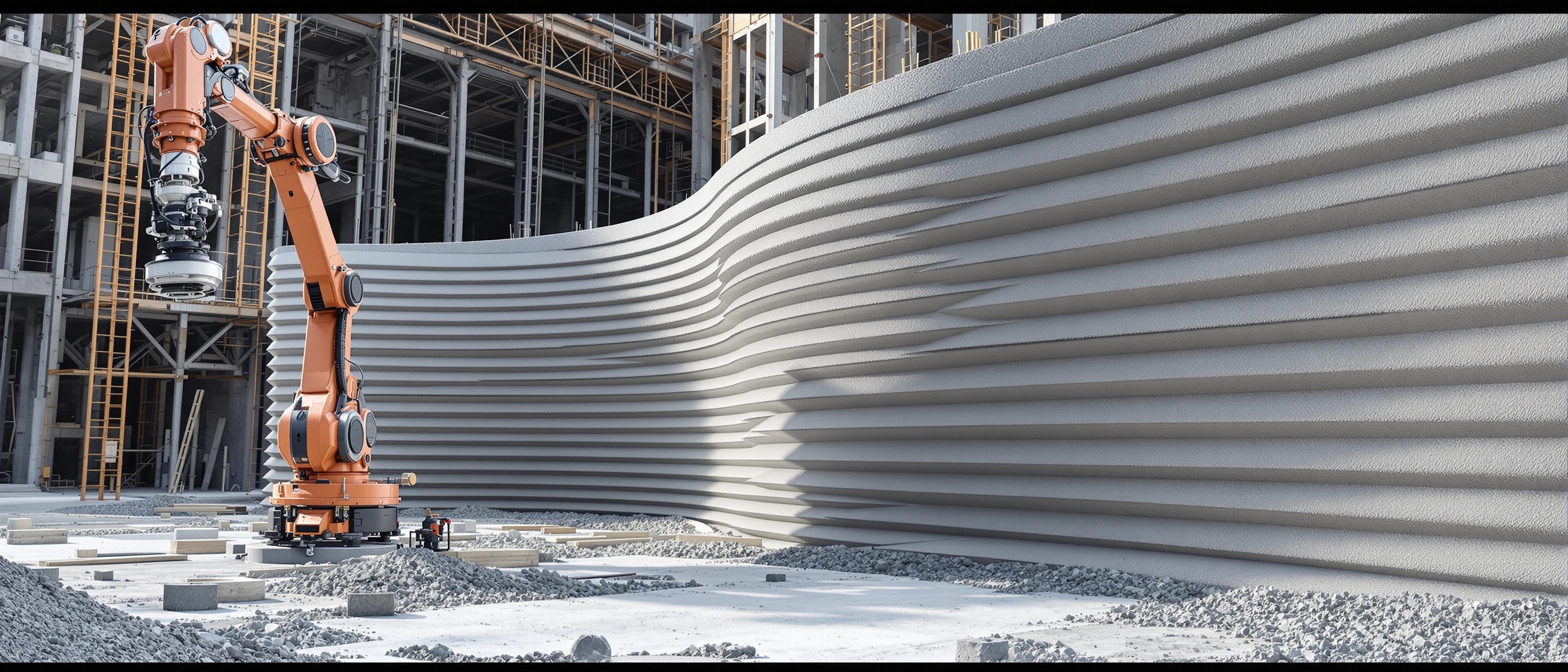
The frontier of the course is also its most over-marketed. Net-zero and climate resilience are becoming the baseline; mass timber is taking buildings that were concrete-and-steel territory; 3D printing, AI and smart cities promise more than they have yet delivered. The single discipline this unit teaches is to separate demonstrated capability (a CLT tower, a printed wall, a working responsive facade) from promising prototype (printed habitats, an autonomous “AI architect”, city-scale digital twins) — celebrating ambition while refusing the hype.
Learning objectives
By the end of this lesson, you will be able to — mapped to the course outcomes for Progressive Architecture:
Explain net-zero and climate-resilient design as the emerging baseline.
Describe mass timber/CLT, 3D printing and the circular economy and their conditions.
Appraise AI and smart cities — their genuine uses and real limits.
Separate demonstrated capability from promising prototype across the frontier.
The emerging technologies
Net-zero as baseline, mass timber for the mid-rise, 3D printing that mostly prints walls, and AI as a co-pilot — not an autonomous architect.[2, 3, 4]
The new baseline
Net-zero (increasingly net-positive) carbon is shifting from aspiration to expectation, and design must address not just mitigation but ADAPTATION — buildings and cities that withstand the heat, flooding and water stress already locked in. Resilient design emphasises passive survivability (habitable during power loss), flood-aware detailing, robust envelopes and redundancy.[4]
Mitigation, adaptation & beyond
From cutting carbon to net-positive impact — and the habit of separating what is demonstrated from what is still hype.[4, 5]
Balanced to zero
A net-zero-carbon building balances its annual emissions to zero (typically via on-site renewables and deep efficiency); net-positive goes further. It is shifting from aspiration to a baseline expectation in progressive practice and standards.[4]
At a glance
| Aspect | Demonstrated | Still nascent |
|---|---|---|
| Mass timber | Demonstrated: CLT mid/high-rise, code-recognised | Speculative: super-tall all-timber towers |
| 3D printing | Demonstrated: printed walls of small buildings | Speculative: whole multi-storey buildings at scale |
| AI in design | Demonstrated: option exploration, prediction | Speculative: autonomous, accountable 'AI architect' |
| Smart city | Demonstrated: sensors, monitoring, twins (pilots) | Speculative: city-scale fully responsive urbanism |
| Circularity | Demonstrated: adaptive reuse, some reclaimed | Speculative: universal material passports & full disassembly |
Key terms
Engineered wood (cross-laminated timber, glulam) used structurally in mid/high-rise; low embodied carbon if sustainably sourced.
Building by depositing material layer-by-layer (3D printing) via gantry or robotic arm.
An economic model designing out waste through reuse, design for disassembly and material recovery.
Design that produces net-positive ecological and social outcomes, going beyond 'less harm'.
A live, data-linked virtual replica of a building or city used to monitor and optimise it.
A building's ability to stay habitable during prolonged loss of power, water or heating/cooling.
Studio task
Pick one emerging direction — mass timber, 3D printing, the circular economy, or AI in design — and write a one-page honest brief: what is genuinely demonstrated today, what is still speculative, and the conditions (sourcing, codes, cost, accountability) on which the promise depends. End with one sentence on how you would use it responsibly in an Indian project.
Self-assessment
1. Which is the GROUNDED statement about 3D-printed buildings today?
2. The main ENVIRONMENTAL argument for mass timber/CLT is that it —
3. Which best describes AI's current role in architectural design?
Recap
References & further reading
- [1]Ellen MacArthur Foundation, reports on the circular economy in the built environment; and commentary on AI in design.
- [2]Michael Green & Jim Taggart, Tall Wood Buildings: Design, Construction and Performance, 2017.
- [3]Behrokh Khoshnevis, 'Automated Construction by Contour Crafting' (USC research papers), early 2000s.
- [4]Ministry of Housing & Urban Affairs, Smart Cities Mission (2015); resilient-design literature.
- [5]Carl Elefante, 'The Greenest Building Is the One That Already Exists' (2007); McDonough & Braungart, The Upcycle (2013).
Further reading
- Michael Green & Jim Taggart — Tall Wood Buildings (2017).
- McDonough & Braungart — The Upcycle (2013).
- Ellen MacArthur Foundation — circular-economy reports (free).
Sources gathered and fact-checked June 2026. Published values vary by source, sample and method — treat as indicative and confirm against the cited standard before structural use.
The author
Amogh N P
Architect, interior designer, and creative polymath. Studio Matrx began in his notebooks — his vision of design made honest, useful, and open to everyone. Its Academy is written and taught in his memory, and free, forever.
More about Amogh →