
Biomimicry, Responsive & Kinetic
Borrowing nature's strategies, and buildings that actually move — told honestly.
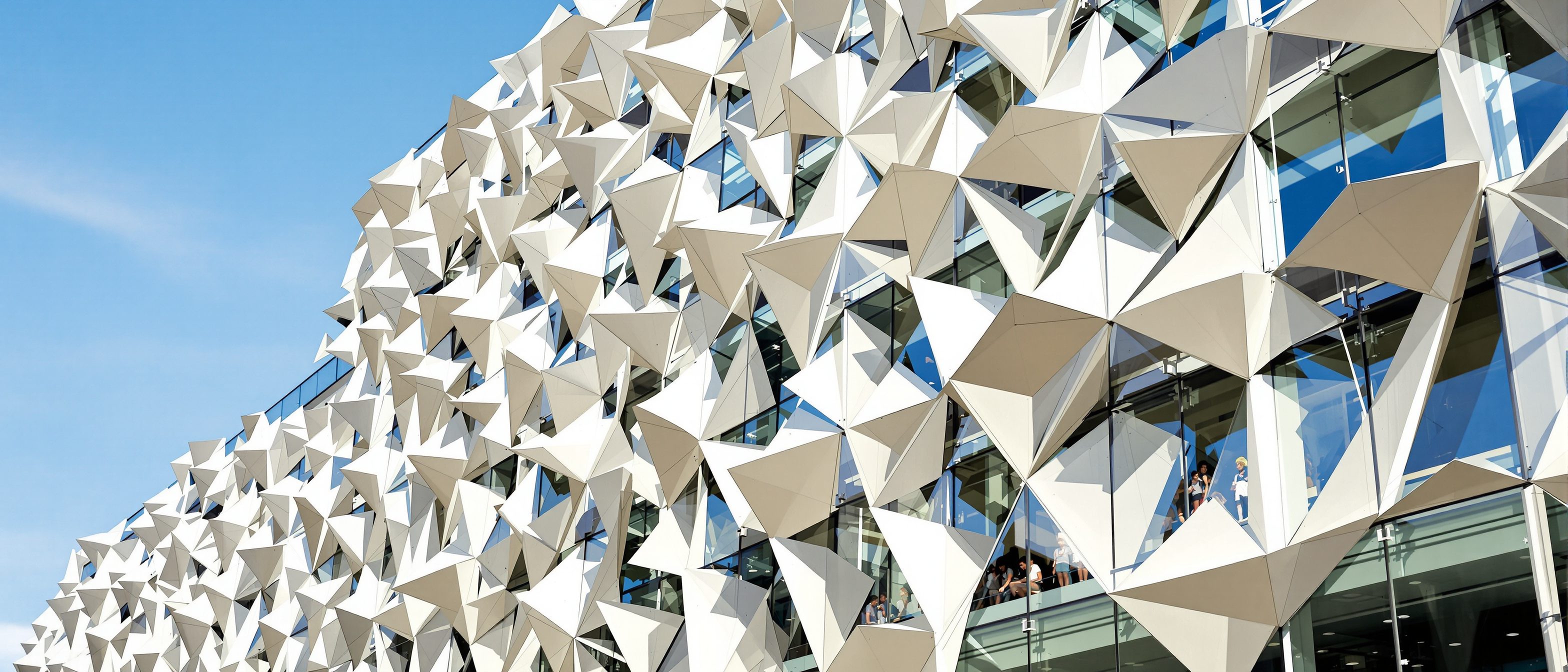
Two related progressive themes meet here: biomimicry — learning from nature's tested strategies at the form, process and ecosystem levels — and responsive/kinetic architecture, buildings that sense and physically change. The unit's discipline is honesty about the gap between narrative and mechanism: the Eastgate Centre's “termite mound” story is loose and based on later-revised biology, the Institut du Monde Arabe's famous apertures barely worked, and a complex-looking facade is not kinetic unless it moves. Sort the cases with the classifier.
Learning objectives
By the end of this lesson, you will be able to — mapped to the course outcomes for Progressive Architecture:
Explain biomimicry at the form, process and ecosystem levels (Benyus).
Tell the Eastgate Centre story carefully — real passive cooling, over-claimed analogy.
Distinguish kinetic, smart-material/passive-responsive and merely static-parametric facades.
Weigh the gap between biomimetic/kinetic narrative and real-world mechanism and maintenance.
Biomimicry & adaptation
Biomimicry is broader than copying shapes — and the Eastgate Centre's passive cooling is real even though its termite analogy is over-claimed.[1, 2]
Form, process, ecosystem
Biomimicry (Janine Benyus, 1997) emulates nature's strategies — tested over ~3.8 billion years. It is broader than copying SHAPES: the form level mimics a shape/surface (sharkskin texture); the process level mimics how an organism makes or does something (self-cooling); the ecosystem level mimics whole-system loops (no waste). The deepest, most progressive level is the ecosystem level — overlapping circular-economy thinking.[1]
The kinetic-facade pair
Same mashrabiya reference, four decades apart — the second far more reliable. And not all responsiveness needs motors.[3, 4, 5]
The elegant precursor (1987)
Jean Nouvel's Institut du Monde Arabe (Paris, 1987) is the landmark early kinetic facade — a south wall of ~240 metallic mashrabiya-like panels with photosensitive diaphragms (like camera apertures) designed to open and close to regulate light. Honest caveat: they proved maintenance-intensive and were famously unreliable — kinetic systems carry real upkeep burdens.[3]
Kinetic, responsive, or just static?
Read each facade scenario and classify it — the fastest way to bust the “any complex facade is kinetic” myth.
Kinetic, responsive, or just static?
Score 0/0
Case 1 of 6
A second skin of triangular umbrella-like mashrabiya units that physically fold and open to track the sun and shade the glass behind (Al Bahar Towers).
Kinetic needs physical movement or a material change — a complex-looking facade alone does not qualify.
At a glance
| Aspect | One | The other |
|---|---|---|
| Movement | Kinetic/responsive: parts move or material changes | Parametric-looking: none — fixed form |
| Trigger | Sensors, climate, occupants | None — set at design stage |
| Example | Al Bahar folding mashrabiya | A faceted but immovable Grasshopper facade |
| Risk | Maintenance, mechanical failure (cf. IMA) | Low maintenance; no adaptability |
| Common confusion | Mistaken for 'just complex form' | Mistaken for 'kinetic because it looks high-tech' |
Key terms
Designing by emulating nature's tested strategies at the form, process or ecosystem level (Benyus, 1997).
Architecture with parts that physically move (rotate, fold, slide) in operation.
Architecture that senses and reacts to environment or occupants, often (not always) by moving.
A traditional Islamic carved/latticed screen for shade and privacy, revived in modern kinetic facades.
A metal (e.g. Nitinol) that returns to a programmed shape when heated — motion without motors.
Buoyancy-driven vertical air movement (warm air rising) used for passive ventilation, as at Eastgate.
Studio task
Choose a hot Indian climate and propose a shading response for a west facade in three versions — a passive (biomimetic process) one, a smart-material (no-moving-parts) one, and a kinetic (moving) one — and weigh each on performance, cost and maintenance. State honestly which you would build, citing the Institut du Monde Arabe's maintenance lesson.
Self-assessment
1. The Al Bahar Towers' facade is an example of —
2. Which statement about the Eastgate Centre is the CAREFUL one?
3. A faceted facade designed in parametric software but with no moving parts is —
Recap
References & further reading
- [1]Janine Benyus, Biomimicry: Innovation Inspired by Nature, William Morrow, 1997.
- [2]J. Scott Turner, The Extended Organism: The Physiology of Animal-Built Structures, 2000 (revised termite function).
- [3]Jean Nouvel / Institut du Monde Arabe technical accounts; Aedas/Arup Al Bahar Towers documentation.
- [4]Michelle Addington & Daniel Schodek, Smart Materials and Technologies, 2005.
- [5]Michael Fox & Miles Kemp, Interactive Architecture, 2009.
Further reading
- Janine Benyus — Biomimicry (1997).
- Addington & Schodek — Smart Materials and Technologies (2005).
- Fox & Kemp — Interactive Architecture (2009).
Sources gathered and fact-checked June 2026. Published values vary by source, sample and method — treat as indicative and confirm against the cited standard before structural use.
The author
Amogh N P
Architect, interior designer, and creative polymath. Studio Matrx began in his notebooks — his vision of design made honest, useful, and open to everyone. Its Academy is written and taught in his memory, and free, forever.
More about Amogh →