
Detail is what you do if there is time. There is never time.
Every candidate knows they should establish the big shapes first and add detail last. Almost every candidate, twelve minutes into an A2, is drawing bricks. Detail is absorbing, it feels productive, and it is the single most reliable way to arrive at minute twenty-four with a beautifully rendered window and an unfinished page.
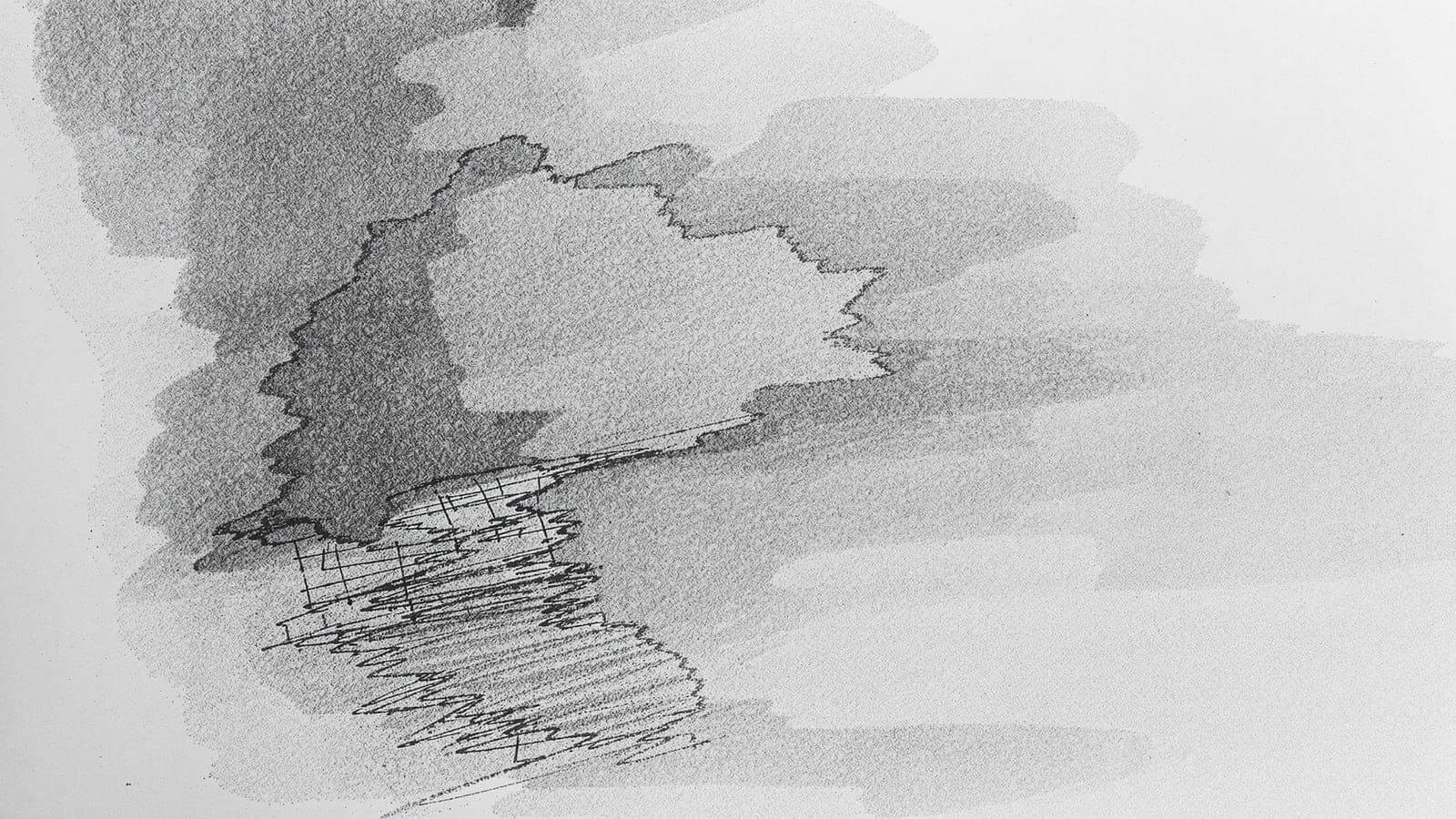
Why detail is a trap and not a temptation
It is worth understanding the mechanism, because knowing that detail is a trap is clearly not enough — everybody knows, and everybody does it anyway.
Detail is immediately rewarding. Each brick you draw looks better than the blank space it replaced. There is instant, continuous feedback that you are improving the drawing, and that feedback is real — the bricks do look good.
The big masses are the opposite. Blocking in a large mid-tone makes the page look worse for several minutes. It is crude, it is flat, it does not look like anything yet, and every instinct says this is not working. So candidates abandon it and return to the bricks, where the feedback is pleasant.
The defence is not willpower, it is sequence. Decide the order in advance and follow it mechanically, precisely because your judgement at minute twelve will be wrong. You are not going to out-argue the temptation in the moment. You are going to have already decided.
A workable twenty-five minutes
Same shape as A1, because it is the same constraint. No per-question split is published — 90 minutes for three questions — so allocate by marks and call A2 twenty-five.
0–2: read and decide. Brief twice. Three-value thumbnail. Light direction. Where the eye lands.
2–4: horizon and big shapes. Freehand, light, structural. Eye level first. No detail whatsoever.
4–14: the big dark shape. Block your grouped darks. This is where the page looks worst and where the drawing is actually being made. Trust it.
14–20: line weight and structure. Now the committed lines. Heavy at the front, heaviest at the focal point, edges dropped where values match.
20–23: detail, one place only. Your focal point gets detail. Nothing else does. This is a feature — selective detail reads as a decision, and detail everywhere reads as anxiety.
23–25: squint and stop.
Three minutes of detail out of twenty-five. That will feel insufficient and it is the correct allocation.
Selective detail is not a compromise
Here is the part that turns a constraint into an advantage, and it is worth internalising because it changes how the shortage of time feels.
When only one part of a drawing carries detail, that part becomes the focal point automatically. Detail is contrast — a dense, worked area against simpler surroundings pulls the eye exactly as a dark against a light does, or a saturated accent against muted neighbours in A1.
So detail everywhere is not just slow, it is compositionally destructive: it flattens the hierarchy you spent twenty minutes building, because when everything is detailed nothing is emphasised. That is the uniformity failure again, arriving through its fourth and final door — six equal blocks, twelve equal colours, constant line weight, and now uniform detail. It is the same mistake in four costumes, and it is the thing this entire Part A course has been about.
Which means the honest version of the time constraint is not that you lack time for detail. It is that you should not want detail everywhere, and the clock is simply enforcing good practice. Master drawings are mostly empty. So are good exam sketches.
The rules behind this
Sourced to the official brochure rather than restated here, so there is one place to correct when the Council revises it.
NATA 2026 is two parts on the same day: Part A offline on paper (80 marks, 90 min), Part B adaptive on computer (120 marks, 90 min). Total 200 marks over three hours.
Part A is taken first, then Part B. A ten-minute break is permitted between them, but the candidate may not leave the centre.
Source · verified 2026-07-16
Part A is three questions: A1 Composition and Colour (25), A2 Sketching and Composition in Black and White (25), A3 3D Composition (30).
Eighty marks across three questions means each is worth roughly 13% of the whole exam. There is no salvaging a bad question by volume, the way a 50-question paper allows.
Source · verified 2026-07-16
What almost everyone believes
“The more detail I get in, the better the drawing will score.”
Detail everywhere destroys hierarchy. Detail in one place creates it — and the clock is enforcing that whether you like it or not.
Detail is contrast: a worked area against simpler surroundings pulls the eye exactly as dark pulls against light. Spread it evenly and it emphasises nothing, flattening the hierarchy you built and costing minutes you do not have. This is the same uniformity failure as six equal blocks, twelve equal colours and constant line weight — the same mistake in a fourth costume. The time limit is not preventing you from doing something good; it is preventing you from doing something bad.
Depending on how long you have
Foundation
Understand the skill. Months out, or starting from zero.
Practise without a timer, but practise stopping. Make drawings that are deliberately unfinished everywhere except one place, and notice that they look better than your fully-rendered ones. Learning that emptiness is a choice rather than a shortfall is worth more than any amount of speed work.
Drill
The practice protocol. What to repeat, how often, how to score it.
Twenty-five minutes, hard timer, prompt you did not choose. Enforce the sequence mechanically — you will not out-argue the temptation at minute twelve, so do not try. Track one number: did you finish? Once finishing is automatic the quality comes on its own, because you stop panicking in the last five minutes.
Exam-Day
What to actually do under the constraint — 108 seconds, no instruments, one pass.
Two minutes deciding, two on the horizon and big shapes, ten on the grouped dark, six on line weight, three on detail in exactly one place, two to squint and stop. When the page looks worst at minute eight, keep going — that is what it is supposed to look like. Detail belongs to your focal point and nowhere else.
Try it
Twenty-five minutes. Full rehearsal, and the sequence is the exercise.
- 01Random prompt, hard 25-minute timer, pencil only.
- 020-2 decide and thumbnail. 2-4 horizon and big shapes, no detail. 4-14 block the grouped dark.
- 03At minute eight the page will look bad. Keep going. This is the test.
- 0414-20 line weight. 20-23 detail in ONE place only. 23-25 squint and stop.
- 05Afterwards, note where you cheated — almost everyone adds detail early. Where you cheated is your actual training target.
The short version
Detail is immediately rewarding and the big masses look worse before they look better, which is why everyone knows the right order and almost nobody follows it. Decide the sequence in advance and follow it mechanically, because your judgement at minute twelve will be wrong. Three minutes of detail out of twenty-five, in one place only — and that is not a compromise forced by the clock. Detail everywhere flattens the hierarchy you just built. Good drawings are mostly empty.
That completes Part A — all 80 marks. Part B is a different animal entirely: adaptive, on screen, 108 seconds, no going back.
Questions people actually ask
- How long should I spend on NATA A2?
- Part A is 90 minutes for three questions and no per-question split is published, so it is yours to allocate. The marks — 25, 25, 30 — suggest roughly even thirds, so about 25 minutes for A2 is a sensible working budget.
- How much detail should I put in a NATA sketch?
- Very little, and in one place. Detail is contrast: a worked area against simpler surroundings creates a focal point, while detail everywhere emphasises nothing and flattens the hierarchy. Roughly three minutes of the twenty-five, all of it at the focal point, is a reasonable target.
- My drawing looks terrible halfway through. Am I doing it wrong?
- Probably not — that is what the correct sequence feels like. Blocking in the big masses makes a page look crude and flat for several minutes before it resolves, which is exactly why candidates abandon it and go back to drawing bricks. Keep going. The feedback is misleading at minute eight.