
You do not get a ruler
Appendix-II is explicit: do not bring any instruments. No set squares, no compass, and a scale no longer than 15 centimetres — which is shorter than the page. So every perspective you draw in NATA is freehand, at speed, by eye. That single constraint invalidates most of how perspective is taught in school, and it should reshape how you practise it.
Construction is not available to you
School perspective is a construction exercise. You establish a horizon, mark vanishing points, rule lines back to them, and the drawing emerges from the geometry. It is rigorous, it is correct, and it is unavailable in this exam.
Without a straightedge, ruled convergence lines are not happening. With a 15 cm scale on a page wider than 15 cm, you cannot even reach across the sheet. And with roughly 25 minutes for the whole question, you do not have time to construct anything even if you could.
So the useful question is not how to construct perspective accurately. It is: what does perspective actually need to look right, freehand, in about ninety seconds? The answer turns out to be shorter than most people expect, and it is mostly one thing.
Eye level does almost all the work
If you get one thing right, get the horizon, which is your eye level. Almost every freehand perspective that looks wrong is wrong here, and almost everything else can be sloppy without anyone noticing.
Eye level tells you what you see. Above it, you see the undersides of things. Below it, you see the tops. Objects at eye level show neither. That is the whole rule, and it governs every surface in the scene simultaneously — a table top, a windowsill, a kerb, the ground plane.
It also does something people find surprising: eye level sets the viewer's height, which sets the mood of the drawing. A low horizon makes buildings loom and the viewer feel small. A high horizon turns the scene into a map and the viewer into an observer. That is a compositional decision, and it is free.
And one rule that costs nothing and immediately reads as competent: standing figures put their heads on the horizon, however far away they are, as long as the ground is flat and they are roughly your height. Get that right and figures anchor the space. Get it wrong and they float or sink, and the whole drawing feels off in a way viewers cannot articulate but immediately sense.
Convergence by feel, and the honesty of the wobble
The second thing is convergence, and freehand convergence is a feel rather than a construction.
Parallel edges going away from you converge toward a point on the horizon. You do not need to know where that point is. You need the edges to agree — to head in a consistent direction and get closer together as they recede. The eye is remarkably tolerant of an imprecise vanishing point and remarkably intolerant of edges that disagree with each other.
So the practical method: draw the nearest vertical, sketch the top and bottom edges heading back, check that they converge rather than diverge, and keep everything on that face agreeing with them. That is it. If your vanishing point lands ten centimetres off the true one, nobody will ever know. If one edge of a building goes up while another goes down, everyone knows instantly.
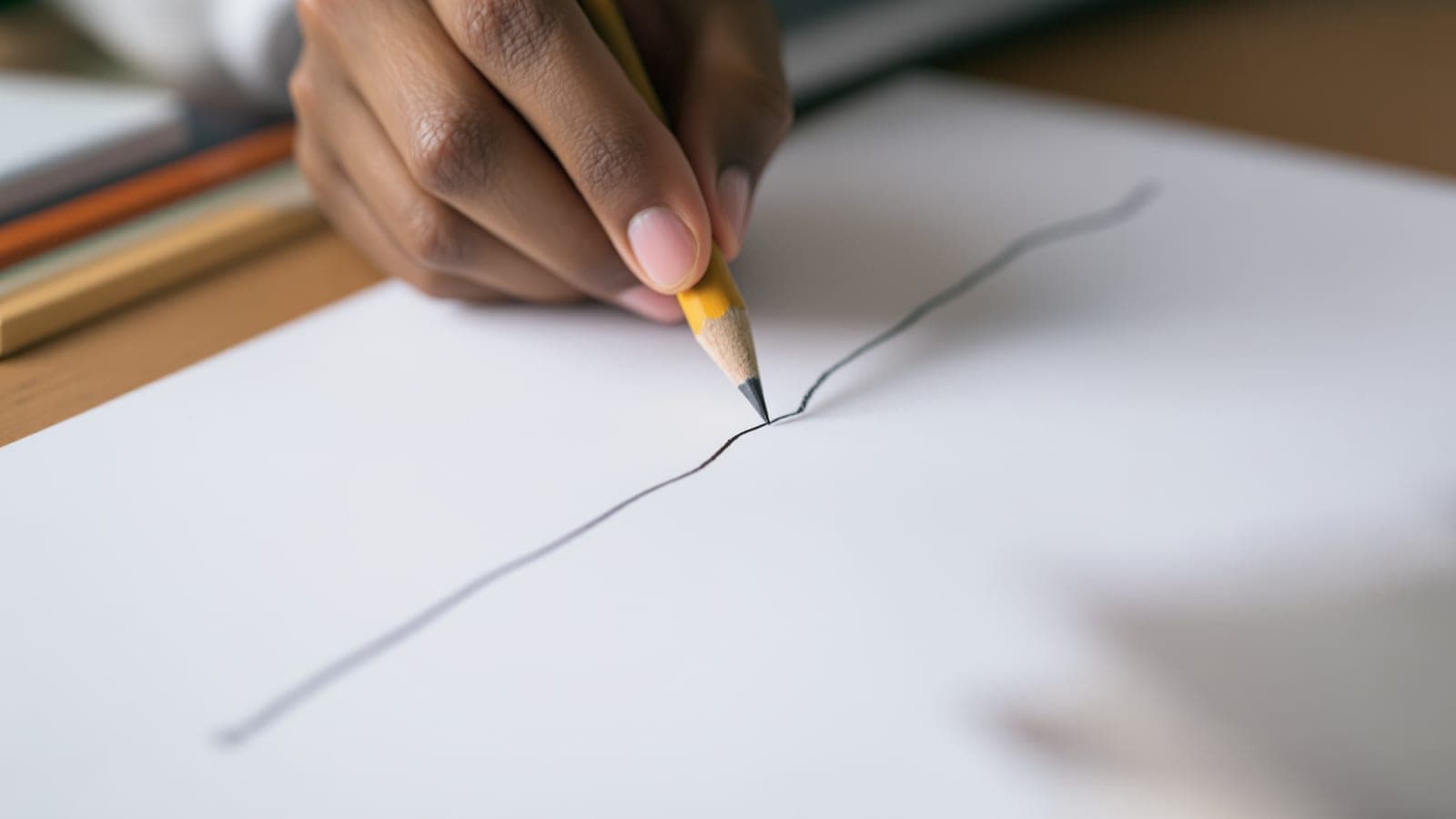
And accept the wobble. A freehand line is not straight, and it should not pretend to be. A slightly wavering line drawn confidently reads as a sketch — which is literally what the question asks for, since the word in the title is Sketching. A tortured line trying to look ruled reads as a failure to have a ruler. Do not try to hide the freehand. It is the register the question is asking for.
The rules behind this
Sourced to the official brochure rather than restated here, so there is one place to correct when the Council revises it.
No instruments are permitted — no compass, no set squares — and no calculators, phones, or wet media.
Appendix-II states "Don't bring any instruments". Also barred: Bluetooth devices, slide rules, log tables, electronic watches with calculators, and any textual material. Numerical Ability is examined without a calculator.
Source · verified 2026-07-16
Bring: the downloaded original Appointment Card, an original photo ID, pencils, erasers, dry colours, and a scale up to 15 cm.
Source · verified 2026-07-16
What almost everyone believes
“I need accurate perspective construction with properly located vanishing points.”
You have no straightedge, a scale shorter than the page, and 25 minutes. Construction is not available, and the eye does not need it.
School perspective is taught as geometry and NATA bars the instruments that make geometry possible — Appendix-II says do not bring any instruments, and the permitted scale is 15 cm on a wider page. More usefully, the eye is highly tolerant of a vanishing point in the wrong place and highly intolerant of edges that disagree with each other, or of an eye level that shifts between objects. So the marks are in consistency, not accuracy, and practising construction trains a skill the exam cannot test.
Depending on how long you have
Foundation
Understand the skill. Months out, or starting from zero.
Throw the ruler away now — permanently, not for the exam. Every perspective you practise from today should be freehand, because the skill is a different skill and the exam only tests the freehand one. Draw boxes, hundreds of them, at every eye level, until convergence is something your hand does without consulting you.
Drill
The practice protocol. What to repeat, how often, how to score it.
Ninety seconds per scene, freehand, horizon first. Then check exactly two things: is the eye level consistent across every object, and does every receding edge on a given face agree with its neighbours? Those two account for nearly all freehand perspective failures. Ignore everything else.
Exam-Day
What to actually do under the constraint — 108 seconds, no instruments, one pass.
Horizon first, before anything else — one light line across the page, and every object obeys it. Heads on the horizon for standing figures. Edges must agree; the vanishing point can be anywhere. Let the lines wobble. The question asks for sketching, and a confident wobble reads as a sketch while a tortured line reads as someone who wanted a ruler.
Try it
Twenty minutes, no ruler. If you reach for one, you have missed the point.
- 01Draw a light horizon line across the page. That is your eye level and everything obeys it.
- 02Draw six boxes freehand — some above the horizon, some below, some straddling it. Ninety seconds each.
- 03Check each: do you see the underside of the ones above and the top of the ones below? If not, the eye level moved.
- 04Add standing figures at three different distances. Every head goes on the horizon.
- 05Now check convergence: on each box face, do the receding edges get closer together? Diverging edges are the one error the eye cannot forgive.
The short version
No instruments means every NATA perspective is freehand, so construction is off the table and consistency is the whole game. Get the horizon right and almost everything else follows: it governs every surface at once, sets the viewer's height, and puts standing heads on the line. Convergence is a feel — edges must agree with each other, and the vanishing point can be anywhere. Let the line wobble; the question asks for a sketch, not a ruled drawing.
Next: putting all of it together in twenty-five minutes.
Questions people actually ask
- Can I use a ruler for perspective in NATA?
- No. Appendix-II of the Test Center Manual says not to bring any instruments — no compass, no set squares — and the only measuring tool permitted is a scale up to 15 cm, which is shorter than the page. Every perspective you draw will be freehand, so practise it that way.
- What is the most important thing in freehand perspective?
- The horizon, which is your eye level. It governs every surface in the scene at once: above it you see undersides, below it you see tops. Almost every freehand perspective that looks wrong is wrong at the eye level, and almost everything else can be imprecise without anyone noticing.
- Does my vanishing point need to be accurate?
- Not really. The eye tolerates a vanishing point well out of position but cannot forgive edges that disagree with each other — one going up while another goes down. Aim for consistent convergence by feel rather than a located point, and keep every edge on a face agreeing with its neighbours.
- Should my freehand lines look straight and ruled?
- No. The question is titled Sketching, and a confident wobbling line reads as a sketch. A tortured line trying to imitate a ruled one reads as someone who wanted a ruler and did not have one. Do not hide the freehand — it is the register being asked for.