
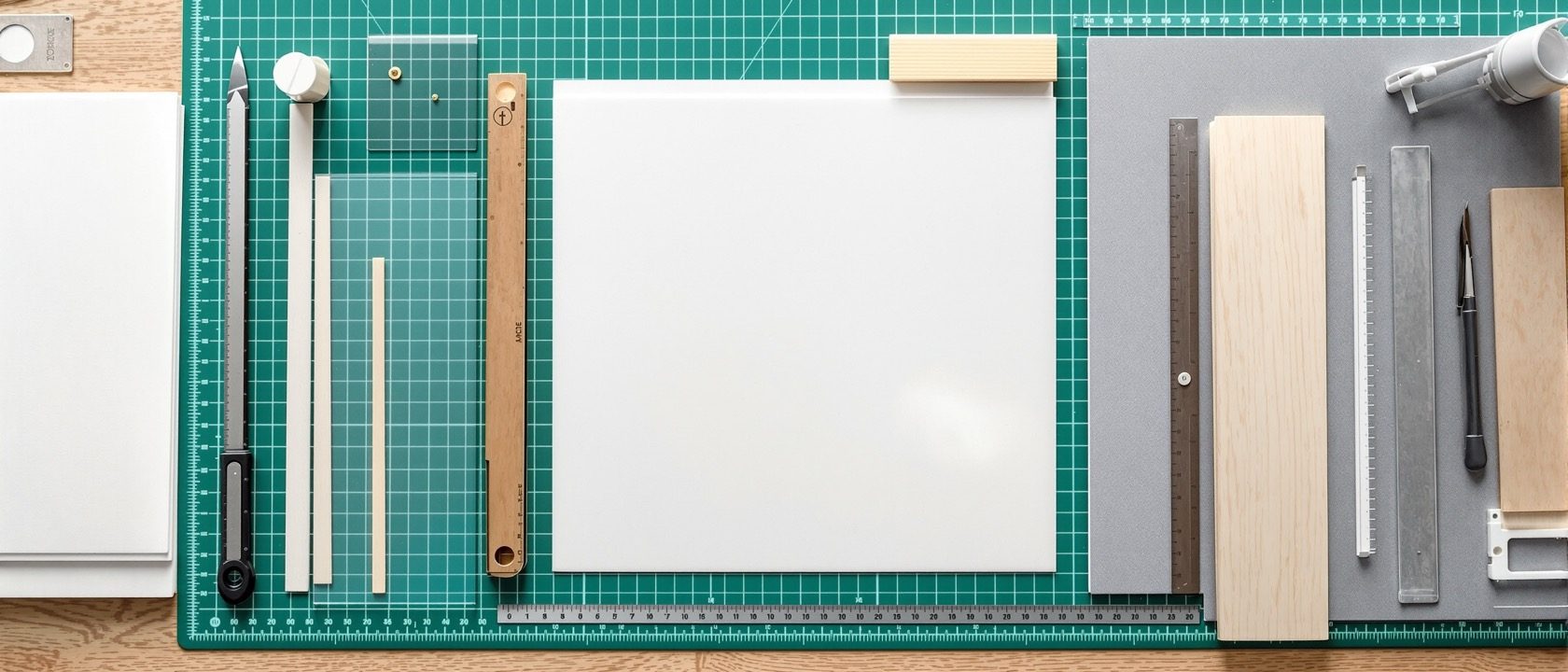
Materials & Tools
The maker's palette and kit — and knife safety as workshop law.
Material choice is a design decision — colour, texture, workability, cost, and the scale it suits. Learn the model-maker’s palette (foamboard, sunboard, mount board, balsa, the premium basswood, acrylic, blue foam) matched to scale and model type, and the tools of the trade. And SAFETY, taught as workshop law — because a sharp blade is safer than a blunt one, you cut away from the body, you cut against steel, and first aid stays within reach.
Learning objectives
By the end of this lesson, you will be able to — mapped to the course outcomes for Model Making:
Identify model materials and match them to scale and model type.
Identify the model-maker's tools and their uses.
Work with correct knife and workshop safety at all times.
Choose materials and tools appropriate to a model's purpose.
Materials & the tool kit
Boards, wood, plastics and massing media matched to scale and model type, and the steel rule, mat, scalpel and the rest of the kit.[1, 2]
The sheet palette
FOAMBOARD (foam-core) — a paper-faced polystyrene-foam sandwich, light and rigid, ideal for walls and floors at 1:50–1:20 (common 3 mm and 5 mm). SUNBOARD (foamed PVC) — the ubiquitous, cheap Indian substitute, solvent-glue-friendly and laser-cuttable. MOUNT BOARD / museum board — dense card, the workhorse of presentation models (museum board is acid-free/archival). GREYBOARD / chipboard — cheap and neutral, superb for study models. CORRUGATED CARD — coarse, for quick massing only. Choose colour, texture and thickness as a design decision.[1, 2]
Tools & safety
The tool kit, and knife and workshop safety taught as non-negotiable law — a sharp blade is safer than a blunt one.[1, 3]
Workshop law, not a suggestion
A SHARP blade is SAFER than a blunt one — a blunt blade needs force, slips and cuts you, while a sharp blade cuts predictably with light pressure. Change blades often; a fresh blade is a safety measure. Let the blade do the work with multiple light passes, never one forced deep cut. Match the blade to the job — a fine scalpel for fine cuts, a snap-off for thick foamboard; forcing a small blade through thick stock snaps the tip.[3]
At a glance
| Aspect | One side | The other |
|---|---|---|
| Blade sharpness | Myth: a blunt blade is safer | Reality: blunt needs force and slips — sharp is safe |
| Thermocol vs foamboard | Thermocol: coarse white beads, crude massing | Foamboard: smooth paper faces, precise sheet |
| Perspex vs acrylic | Myth: different materials | Reality: Perspex is a brand name for acrylic (PMMA) |
| Cutting guide | Myth: a plastic ruler is fine | Reality: the blade shaves it — use steel |
| Balsa vs basswood | Balsa: soft, cheap, bruises | Basswood: fine-grained, crisp, holds detail |
Key terms
Rigid paper-faced foam / foamed-PVC sheet — the workhorse for model walls and floors.
Dense card for presentation models; museum board is acid-free and archival.
Basswood is fine-grained and crisp (for finished detail); balsa is soft, cheap and bruises.
Rigid clear/coloured PMMA sheet for glazing and bases; Perspex is a trade name for it.
A cutting mat whose surface closes behind the blade — protects blade, table and squares work.
A sharp blade cuts predictably with light pressure; a blunt one needs force and slips.
Making task
Write a materials-and-tools shopping list for building a 1:20 sectional model of a room, choosing a specific material for each part — walls, floor, glazing, furniture, base — and justifying each choice by scale and finish. Then write your own one-page workshop safety code in your own words, covering blade sharpness, cutting direction, the cutting guide and surface, fumes and dust, and first aid — the rules you will actually follow at the desk.
Self-assessment
1. For workshop safety, a sharp blade is —
2. 'Perspex' is —
3. The premium fine-grained modelling wood that holds crisp detail is —
Recap
References & further reading
- [1]Megan Werner, Model Making, Princeton Architectural Press, 2011 (the best concise materials and tools catalogue).
- [2]Nick Dunn, Architectural Modelmaking, 2nd ed., Laurence King, 2014 (extended materials — foams, timbers, plastics).
- [3]Criss B. Mills, Designing with Models, 3rd ed., Wiley, 2011 (tools and safe working method); align with your institution's workshop safety induction.
- [4]Rolf Janke, Architectural Models, Praeger, 1978 (classic reference on customary model materials and tools).
Further reading
- Megan Werner — Model Making.
- Nick Dunn — Architectural Modelmaking.
- Criss B. Mills — Designing with Models.
Sources gathered and fact-checked June 2026. Published values vary by source, sample and method — treat as indicative and confirm against the cited standard before structural use.
The author
Amogh N P
Architect, interior designer, and creative polymath. Studio Matrx began in his notebooks — his vision of design made honest, useful, and open to everyone. Its Academy is written and taught in his memory, and free, forever.
More about Amogh →