
 Lesson 2.4
Lesson 2.4 · The Mass Timber Products
DLT, NLT & Other Panels
Not every mass-timber panel needs glue: stand boards on edge and join them with nails or wooden dowels, and you get honest, repairable, glue-free decks -- which rounds out the family and lets us finally map when to choose which product
Every product so far has been held together by glue. But you can build a mass-timber panel with nothing but nails -- or wooden pegs.
Glulam, CLT, LVL, PSL, LSL -- every product in this module so far relies on structural adhesive to turn small pieces of wood into large ones. Glue is what makes them strong, stable and reliable, but it also brings things some designers would rather avoid: chemistry, factories with big presses, a bond that is hard to take apart again, and questions about end-of-life. So it is worth knowing that mass timber has a whole glue-free branch, older and lower-tech, that is quietly useful: panels made by standing ordinary boards on edge, side by side, and joining them with mechanical fasteners instead of adhesive.
The two you should know are NLT -- nail-laminated timber, held together with nails, and DLT -- dowel-laminated timber, held together with hardwood dowels and no metal at all. Both make solid timber decks -- floors and roofs -- from stacks of dimension lumber turned on edge, and both trade some of the strength and two-way action of glued panels for honesty, simplicity, repairability and, in DLT's case, a completely glue-and-metal-free panel that is easy to recycle and kind to CNC machining. This final lesson of the module rounds out the product family with these and a few other panel and deck products -- and then, with the whole family in view, does the most useful thing of all: draws a map of when to choose which product.
Boards on edge + nails (NLT) or dowels (DLT) = glue-free decks. Then the map: linear or plate? glued or not? exposed or hidden? and what can you actually get?
NLT and DLT: mass timber without glue
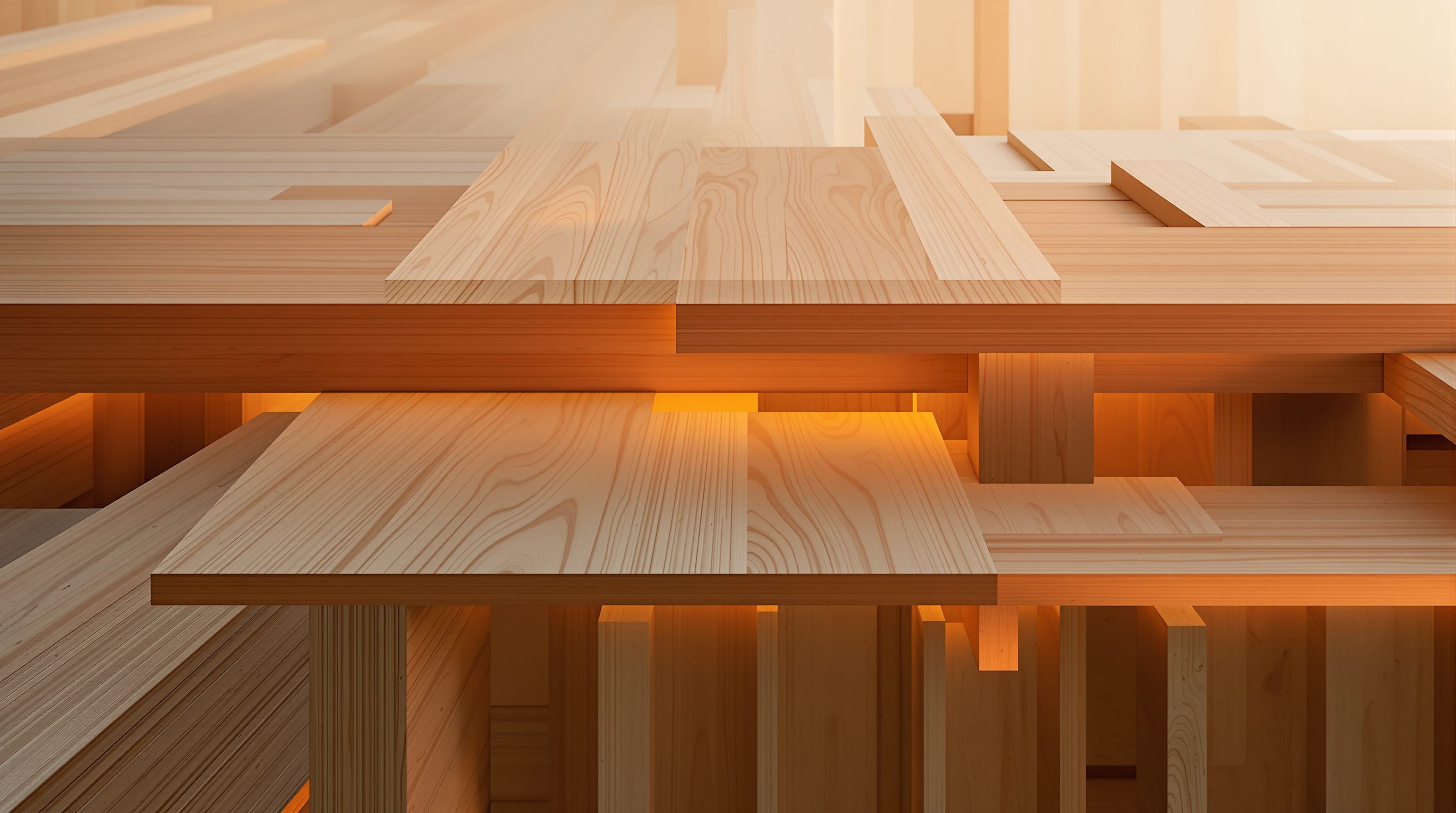
Nail-laminated timber (NLT) is the oldest mass-timber idea of all, predating the glued products by more than a century. It is made by placing dimension lumber boards on edge, face to face, side by side, and nailing (or screwing) them together into a solid panel or deck. The grain of every board runs the same way, so like glulam it is a one-directional product -- strong along the boards' length -- which makes NLT a natural for floor and roof decks spanning one way onto beams or walls. Its charm is its simplicity: it uses ordinary graded lumber and ordinary fasteners, can be made by a competent carpenter without a specialist factory or press, and gives a handsome, linear, board-faced soffit that is lovely left exposed. Its limits are the flip side: it is one-way only, the metal fasteners complicate cutting and CNC machining (and any later demolition), and quality depends on workmanship.
Dowel-laminated timber (DLT) is the clever modern refinement: the same boards on edge, but joined with hardwood dowels driven through holes instead of nails or glue -- no adhesive and no metal at all. The dowels are usually a denser, drier hardwood that, once driven, swells slightly to lock the panel tight. This gives DLT two real advantages. First, with no metal in it, a DLT panel can be machined freely with CNC routers -- for services, connections and profiling -- without a blade ever hitting a nail, which suits precise digital fabrication (Module 8). Second, it is an all-timber, glue-free, single-material panel, which is honest, healthy (no adhesive off-gassing), and genuinely easy to take apart and recycle or reuse at end-of-life -- a real circular-economy virtue (Module 7). Like NLT it is generally a one-way deck product for floors and roofs, and it too makes a beautiful exposed timber soffit.
Both products sit alongside the glued family rather than replacing it: they are chosen when their particular virtues -- simplicity and local buildability (NLT), or glue-free, metal-free, machinable, recyclable honesty (DLT) -- matter more than the two-way strength and larger spans of CLT. As always, spans, board grades, fastener or dowel patterns and fire behaviour are engineered values from the maker and the structural and fire engineers.
The other panels and deck products
Beyond NLT and DLT, a few more panel and deck products round out the family, and it helps to place them. Glulam can itself be laid up as a panel -- glue-laminated timber panels, sometimes called GLT decks -- essentially wide glulam used flat as a one-way floor or roof deck; it is a glued, one-directional relative of CLT for deck applications. There are also mass plywood panels (MPP), made like a very thick structural plywood from many veneers, offering a two-way panel similar in use to CLT but built from veneers rather than boards -- useful where it is available and competitive.
It is also worth remembering the sheet materials that are not mass timber but constantly work alongside it. Plywood and oriented strand board (OSB) -- engineered from veneers and strands respectively -- are the everyday structural sheets used for sheathing, as webs in engineered I-joists (with LVL flanges), as diaphragms and as substrates. They are not the massive, load-bearing solid elements this module is about, but they are part of the same engineered-wood ecosystem and often detail directly onto mass-timber structure, so a designer should know where they sit: sheets that sheathe and brace, not solid members that span and carry as primary structure.
The honest way to see the whole landscape is as a spectrum of how wood is reconstituted and bonded. At one end, solid sawn timber -- one piece, natural. Then mechanically joined solids -- NLT and DLT -- boards fastened without glue. Then glued solids -- glulam and CLT -- boards bonded with adhesive, one-way or crossed. Then glued reconstituted -- LVL, PSL, LSL -- veneers or strands rebuilt into members. And alongside, the sheet products -- plywood, OSB, MPP -- for sheathing and thick panels. Each step trades a little more processing and adhesive for a little more size, strength, consistency or two-way action. You do not need to memorise every product; you need the map, so that when a structural drawing or a supplier names one, you know roughly what it is, how it is made, and what it is good for.
Choosing which product -- a designer's map
With the whole family in view, the practical skill is matching product to job, and a simple decision map gets you most of the way -- always as a starting point that the engineer, the supplier and the budget then confirm. Start with what the element *is*. Is it a linear member -- a beam or column? Then think glulam for long spans, curves and exposed frames; LVL or PSL where it is slim and highly stressed (headers, loaded beams, columns); LSL for lighter studs and rims. Is it a plate -- a floor, wall or roof? Then think CLT for two-way strength, load-bearing and shear walls, and larger or more demanding floors; NLT or DLT for simpler one-way decks where their virtues (buildability, glue-free honesty, exposed board soffit, recyclability) matter; GLT or MPP where available and suited.
Then layer the secondary questions that often decide it. *Exposure*: is the element celebrated and exposed (glulam, CLT soffits, NLT/DLT decks all read beautifully) or hidden (SCL, sheets)? *Span and load*: modest and one-way (NLT/DLT/GLT), or larger, two-way or heavily loaded (CLT, PSL)? *Fabrication*: is free CNC machining and glue-free recyclability a priority (DLT), or is local low-tech buildability the point (NLT)? *Sustainability*: how much adhesive and processing is acceptable, and can you take it apart at end-of-life (DLT and solid timber score well; heavily glued composites less so)? And, decisively in an emerging market, *availability and cost*: what can a real supplier actually deliver to your site, at what price and lead time?
That last question often overrides all the others, especially in India, and it is where the honesty of this course lands: the theoretically ideal product is worthless if you cannot source it, so the real design move is to know the family well enough to choose the best available product for each job, not the textbook-perfect one. Hold the map -- linear versus plate, glued versus glue-free, exposed versus hidden, and always availability and cost -- and you can make sound first choices, brief your engineer intelligently, and let the specialists confirm the sizes, connections and fire design that remain, as ever, theirs.
The glue-free products in context, and closing the module
Globally, NLT is a well-established, low-tech product with a very long history, enjoying a quiet revival as designers rediscover its simplicity and warm exposed soffits, while DLT is a newer, increasingly popular product prized in low-carbon and circular-design circles precisely for being glue-free, metal-free, machinable and recyclable. Both are proven, both make beautiful exposed decks, and both are attractive where their particular virtues matter more than raw span or two-way action. In markets with good timber supply they are readily buildable -- NLT especially, since it needs little more than graded lumber and skilled carpentry.
In India, NLT is arguably one of the more accessible mass-timber approaches, because it can be built from ordinary graded dimension lumber with conventional fasteners and carpentry rather than imported panels and specialist presses -- a genuine entry point for exposed timber decks in the right project, subject as always to sourcing good graded timber, keeping it dry, and engineering the spans and fire behaviour properly. DLT and the other glued panels remain more dependent on specialist manufacture and, today, imports. Module 10 returns to what is realistic to build in India now.
This closes the module on the mass-timber products. You now have the whole family: glulam, the glued, grain-aligned beam and column for spans, shapes and exposed frames; CLT, the crossed-layer panel that is the workhorse plate for floors, walls and roofs; the veneer-and-strand family (LVL, PSL, LSL), the slim, super-strong specialists for concentrated jobs; and the glue-free decks (NLT, DLT) and other panels, honest and repairable for one-way floors and roofs. Above all you have the map -- linear versus plate, glued versus glue-free, exposed versus hidden, and always the decisive question of what is available and affordable in your market. It is worth pausing on how far that spectrum reaches: from a single sawn board a carpenter could cut by hand, through nailed and doweled decks, to precision-pressed panels the size of a room and composite members stronger than the timber they came from -- all of it, at heart, the same renewable, carbon-storing material engineered to different ends. Understanding that family is the foundation everything else in this course builds on. Carry the map into the next module, where these products stop being a catalogue and start becoming buildings: timber structural systems -- post-and-beam, panel and platform, hybrid, and the tall-timber high-rise.
NLT / DLT product and detailing
Board grades, fastener or dowel pattern, deck spans
NLT and DLT are engineered decks; fastener/dowel patterns, board grades and spans are set by the maker and the structural engineer, and workmanship matters. Confirm the actual specification.
Structural + fire design (engineer + code)
One-way spans, diaphragm action, charring, connections
Spans, any diaphragm action and fire behaviour are engineered to the current code (NBC/IS; Eurocode 5 where used). Course figures are illustrative only.
Sourcing & end-of-life
Certified timber; glue-free recyclability
The carbon and circularity case (especially DLT's) depends on certified sustainable timber and honest end-of-life planning (Modules 7). Verify sourcing; do not assume.
Workshop -- build your own product decision map
This is the capstone of the module. You will turn the whole product family into a one-page decision map you can actually use, then test it on a real element.
The module, a building element to test, and a notebook or drawing tool. No calculation -- this is design judgement; the engineer and supplier confirm the final product, sizes and connections.
Goal: a reusable product-selection map, tested on a real building element
Inputs: this whole module (2.1-2.4) + a building element you know + a notebook
Time: ~50 minutes
- 1Draw the family as a spectrum: solid timber, NLT/DLT (mechanically joined), glulam/CLT (glued solids), LVL/PSL/LSL (glued reconstituted), and the sheets (plywood/OSB/MPP). For each, note in a line what it is and its best job.
- 2Build a decision tree starting with one question -- is the element a linear member (beam/column) or a plate (floor/wall/roof)? -- then branch to the candidate products for each.
- 3Add the secondary filters as branches: exposed or hidden? modest one-way span or larger/two-way/heavily loaded? glue-free/recyclable/CNC-machinable a priority? and -- the decider -- available and affordable in your market?
- 4Test it: take one real element (say a residential floor, or a beam over a wide opening) and walk it through your map to a shortlist of one or two products, writing why each survived or was ruled out.
- 5Sanity-check with the honesty rule: for your shortlisted product, could a real supplier deliver it to your site at acceptable cost and lead time, and is the timber certified sustainable? If not, revise the choice to the best available option.
You’ll walk away with
A one-page product-selection map (spectrum + decision tree + filters) plus a worked example choosing a product for one real element -- a reusable tool you will use throughout the rest of the course and in practice.
Three altitudes on the same idea
Read the band that fits you — or all three.
Reach for NLT and DLT when a one-way deck's virtues -- simplicity, glue-free honesty, an exposed board soffit, recyclability, free CNC machining -- matter more than CLT's two-way strength and larger spans. NLT is often the most buildable mass-timber option in a weak supply market because it uses ordinary graded lumber and carpentry; DLT suits low-carbon, circular and digitally-fabricated work. Above all, carry the product map: linear (glulam/SCL) versus plate (CLT/NLT/DLT/GLT/MPP), glued versus glue-free, exposed versus hidden, and always availability and cost. Choose the best *available* product for each job, brief the engineer, and defer spans, fasteners, dowel patterns and fire design to the structural and fire engineers and the maker.
NLT and DLT decks give one of the most beautiful exposed soffits in timber -- a fine, linear, board-by-board ceiling with real craft character -- and DLT's glue-free, metal-free make-up is a genuine healthy-material and circular story to tell a client. Understand that these are one-way decks meant to be seen, so coordinate lighting, services and partitions with the board direction and expressed joints, and remember the fire strategy and any acoustic build-up above still govern how the soffit performs. DLT can be CNC-machined freely for recesses and services; NLT contains nails, so never cut or fix into either without the structural and fire engineers. Use the exposed timber deck as the feature it deserves to be.
The lesson to lock in is the whole-family map, and the idea that not all mass timber is glued. NLT (nailed) and DLT (doweled) stand boards on edge and join them mechanically into honest, one-way, exposed-soffit decks -- lower-tech, repairable, and in DLT's case glue-free, metal-free, machinable and recyclable. Then hold the spectrum: solid timber, mechanically-joined (NLT/DLT), glued solids (glulam/CLT), glued reconstituted (LVL/PSL/LSL), and sheets (plywood/OSB). Learn to choose by asking: linear or plate? glued or glue-free? exposed or hidden? and -- decisively -- what can you actually get? Draw the decision map once; it is the single most useful thing to carry out of this module.
“Nail-laminated and dowel-laminated timber are primitive, weak throwbacks -- if they don't even use glue they must be inferior to CLT, so there's no real reason to choose them.”
Do it yourself
Reason it through -- no calculation needed.
- 1Explain how NLT and DLT are made, and how DLT differs from NLT in what holds it together.
- 2Give two real advantages DLT has over a glued panel like CLT, and one thing CLT does that DLT cannot.
- 3Why might NLT be one of the more realistic mass-timber options in a market without CLT factories?
- 4Walk a residential floor and a beam over a wide opening through the product map -- what would you shortlist for each, and why?
- 5Why does 'what can you actually source' often override the textbook-ideal product choice, especially in India?
The one line to carry out
Peer-reviewed journals & authoritative standards
- 01Nail-laminated timber — Wikipedia -- Nail-laminated timber, 2026.
- 02Mass timber — Wikipedia -- Mass timber, 2026.
- 03Engineered wood — Wikipedia -- Engineered wood, 2026.
- 04Circular economy — Wikipedia -- Circular economy, 2026.
You now know the whole product family and how to choose among it. Next these products stop being a catalogue and become buildings: how timber actually stands up. Module 3 opens with post-and-beam timber frames.
The author
Amogh N P
Architect, interior designer, and creative polymath. Studio Matrx began in his notebooks — his vision of design made honest, useful, and open to everyone. Its Academy is written and taught in his memory, and free, forever.
More about Amogh →