
Vision, Interior & Exterior
The eye that judges the light, how we measure it, and lighting the night.
In the end, the eye is the judge. This unit covers the physiology of vision — rods and cones, the three regimes, adaptation, and why the eye reads contrast, not absolute light — then how we measure light, the cultural dimension, and lighting the exterior without polluting the night sky.
Learning objectives
By the end of this lesson, you will be able to — mapped to the course outcomes for Lighting Design:
Explain the physiology of vision — rods, cones, the three regimes and adaptation.
Explain why the eye reads luminance contrast, not absolute light level.
Use the lux meter and the units of light measurement.
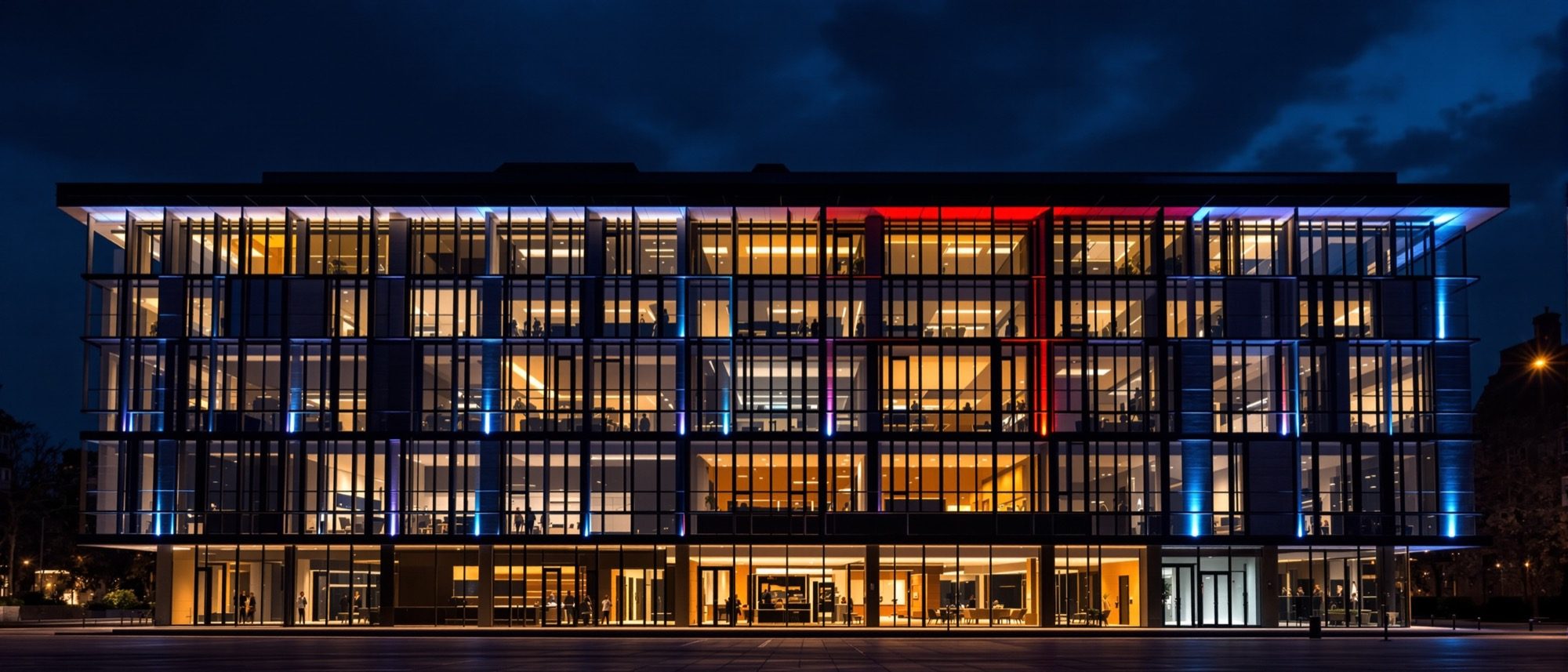
Discuss exterior/façade lighting, the cultural dimension and light pollution.
The physiology of vision
Rods (night, colourless) and cones (day, colour) give three regimes; and the eye reads luminance contrast, not absolute lux — so contrast and uniformity matter as much as quantity.[4, 6]
The two photoreceptors
The retina has two photoreceptors: RODS (~120 million; very sensitive, for night and peripheral vision, but no colour) and CONES (~6 million; colour and fine detail, but needing more light). This gives three regimes: PHOTOPIC (day, above ~3 cd/m²) — cones dominate, full colour and acuity, peak sensitivity 555 nm; SCOTOPIC (night, very dim) — rods only, colourless, peak 507 nm; and MESOPIC (twilight, street lighting) — both active. As light falls, peak sensitivity shifts toward blue-green (the Purkinje shift) and reds darken first.[4, 6]
Measurement, exterior & the night
Measure with the lux meter; light the exterior for meaning and safety — but control light pollution with full-cut-off fixtures, warmer colour and shielding.[4, 2]
The lux meter
The field instrument is the LUX METER (illuminance meter) — a cosine-corrected, V(λ)-filtered photocell reading ILLUMINANCE in lux on a plane. A LUMINANCE meter reads surface brightness (cd/m²) over a small angle; lab instruments (the goniophotometer, the integrating sphere) measure a source's full intensity distribution and total flux. The units recur: lumen (flux), candela (intensity), lux (illuminance), cd/m² (luminance).[4]
At a glance
| Aspect | One | The other |
|---|---|---|
| Photoreceptor | Rods: sensitive, night, no colour | Cones: colour & detail, need more light |
| Regime | Photopic (day) / scotopic (night) | Mesopic (twilight, street lighting) |
| What the eye reads | Not absolute lux — | Luminance CONTRAST (task vs background) |
| Measurement | Lux meter: illuminance on a plane | Luminance meter: surface brightness (cd/m²) |
| Exterior care | Light the building after dark | …without sky glow, trespass or glare |
Key terms
~120 million retinal cells — very sensitive, for night/peripheral vision, but colourless.
~6 million retinal cells — colour and fine detail, needing more light.
Day (cones), night (rods, colourless) and twilight (both) vision regimes.
The eye adjusting to the light level — fast to brighten, slow (~30 min) to dark-adapt.
The difference between task and background brightness — what the eye actually reads.
A cosine-corrected, eye-weighted photocell measuring illuminance in lux on a plane.
Wasted exterior light — sky glow, light trespass, glare and clutter.
An exterior luminaire emitting no light above horizontal — controls sky glow and trespass.
Studio task
Take a lux meter to three spaces and record the level; then judge each not by the number but by the contrast and comfort. Finally, sketch a façade-lighting idea that lights the building, not the sky.
Self-assessment
1. In dim (scotopic) conditions, vision is —
2. The eye judges legibility chiefly by —
3. A 'full-cut-off' exterior fixture helps by —
Recap
References & further reading
- [1]Gary Gordon, Interior Lighting for Designers (5th ed.). Wiley, 2015.
- [2]Derek Phillips, Lighting Modern Buildings. Architectural Press, 2000.
- [4]CIE — V(λ), vision and photometry; the IES Lighting Handbook (10th ed.). https://cie.co.at/
- [6]M. David Egan & Victor Olgyay, Architectural Lighting (2nd ed.). McGraw-Hill, 2002; and the International Dark-Sky Association (light pollution).
Further reading
- Gary Gordon, Interior Lighting for Designers. Wiley.
- M. David Egan, Architectural Lighting. McGraw-Hill.
- Derek Phillips, Lighting Historic Buildings; and IDA dark-sky resources.
Sources gathered and fact-checked June 2026. Published values vary by source, sample and method — treat as indicative and confirm against the cited standard before structural use.
The author
Amogh N P
Architect, interior designer, and creative polymath. Studio Matrx began in his notebooks — his vision of design made honest, useful, and open to everyone. Its Academy is written and taught in his memory, and free, forever.
More about Amogh →