
Types of Lighting
General, accent and the architectural techniques that shape a space.
With sources and fittings in hand, the designer composes — in layers and techniques. General fills the room, task serves the work point, accent draws the eye; and the architectural techniques — cove, wall-wash, grazing, luminous ceilings — shape the space itself. Try the explorer below to see each effect.
Learning objectives
By the end of this lesson, you will be able to — mapped to the course outcomes for Lighting Design:
Distinguish general, local and accent lighting and the layered approach.
Apply the architectural techniques — cove, wall-wash, grazing, up/down-lighting.
Explain recessed lighting and luminous walls and ceilings.
Compose a layered lighting scheme for a space.
Layers of light
A calm ambient base, a focused task layer, and accent (~3–5× ambient) for emphasis — more comfortable and efficient than one flat bright level.[1, 6]
Fill and focus
GENERAL (ambient) lighting gives the room its uniform background level for safe movement and orientation. LOCAL (task) lighting adds a higher, concentrated level at a work point — a desk, a kitchen counter — supplementing the ambient rather than over-lighting the whole room. The two together — a calm base plus focused task light — are more comfortable and more efficient than one flat bright level everywhere.[1, 6]
Architectural techniques
Cove lifts the ceiling, wall-washing flattens a wall, grazing reveals its texture, and luminous planes turn the architecture itself into the luminaire.[6, 1]
Architectural lighting · pick a technique
Cove lighting
How: A source concealed on a ledge throwing light UP onto the ceiling.
Effect: Soft, indirect, glare-free wash that lifts the ceiling and calms the room.
Light that shapes the surface
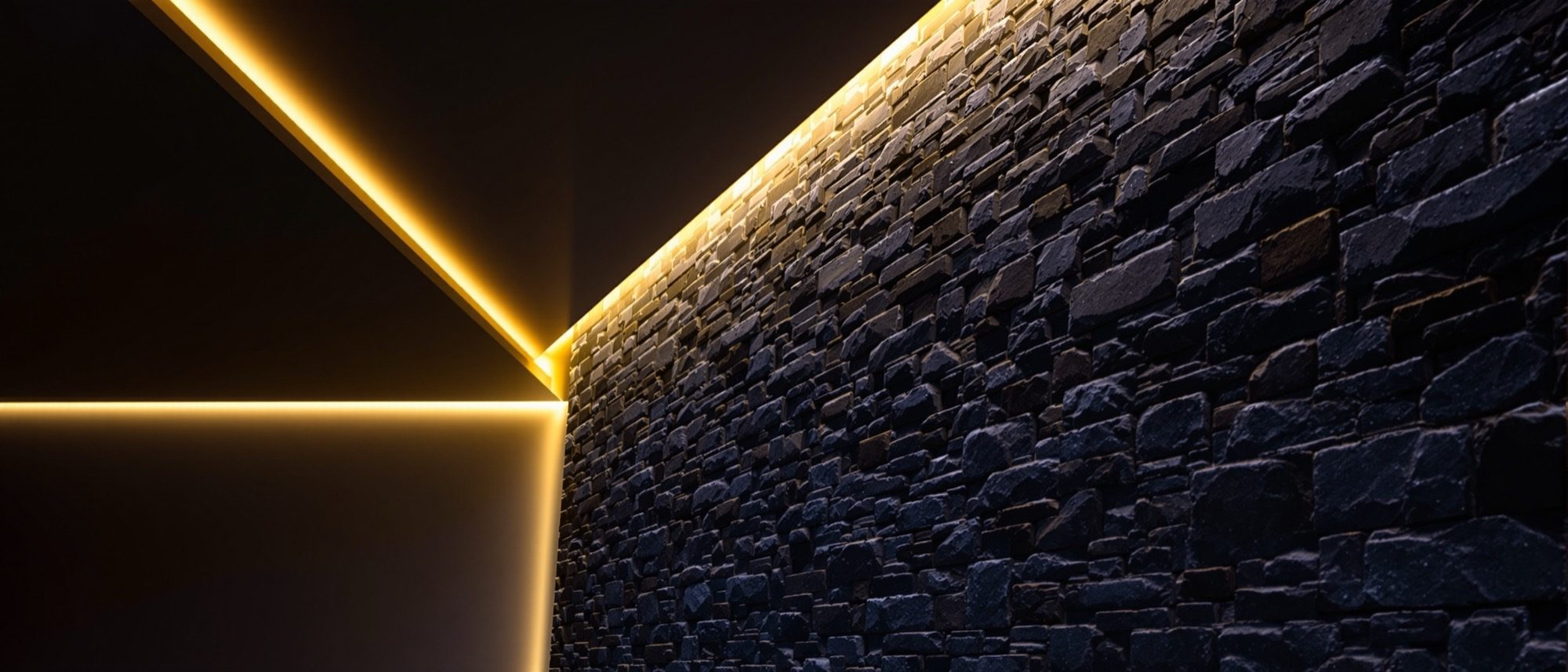
ARCHITECTURAL lighting is built into the fabric. COVE lighting hides a source on a ledge and throws light UP onto the ceiling — soft, indirect, lifting the room. WALL-WASHING sets fittings BACK from a wall for even, flat light that hides texture and displays art. WALL-GRAZING sets them CLOSE to the wall, raking light steeply across it to EMPHASISE texture — stone, brick, fluting. The same wall, washed or grazed, reads completely differently. VALANCE lighting (behind a shield over a window) throws light both up and down.[6, 1]
At a glance
| Aspect | One | The other |
|---|---|---|
| Fill vs focus | General: uniform background level | Local: concentrated task light at the work point |
| Emphasis | Accent: ~3–5× ambient, draws the eye | Used well = hierarchy; overused = noise |
| Wash vs graze | Wall-wash: set back, even, HIDES texture | Wall-graze: set close, raking, SHOWS texture |
| Direction | Cove / uplight: soft, indirect, lifts the room | Downlight / recessed: 'natural', defines form |
| The plane as light | Spot/downlight: a point source | Luminous ceiling: a whole soft glowing plane |
Key terms
The uniform background level of the whole space.
A higher, concentrated level at a specific work point, over the ambient.
A narrow beam (~3–5× ambient) drawing the eye to art or a feature by contrast.
A concealed source on a ledge throwing soft, indirect light up onto the ceiling.
Even, flat vertical light from fittings set back from the wall — hides texture.
Steep, raking light from fittings close to the wall — emphasises texture.
A fitting sunk into the ceiling for a clean, sourceless effect.
A large backlit translucent panel turning a whole plane into a soft light source.
Studio task
Light one room in three layers and name the technique for each surface — would you wash or graze the feature wall, and why? Use the explorer above to test your choices.
Self-assessment
1. To emphasise the rough texture of a stone wall, you would use —
2. Cove lighting works by —
3. Accent lighting typically sits at about — relative to the ambient level.
Recap
References & further reading
- [1]Gary Gordon, Interior Lighting for Designers (5th ed.). Wiley, 2015.
- [6]M. David Egan & Victor Olgyay, Architectural Lighting (2nd ed.). McGraw-Hill, 2002.
Further reading
- M. David Egan, Architectural Lighting. McGraw-Hill.
- Gary Gordon, Interior Lighting for Designers. Wiley.
- Sally Storey, Lighting by Design. Mitchell Beazley.
Sources gathered and fact-checked June 2026. Published values vary by source, sample and method — treat as indicative and confirm against the cited standard before structural use.
The author
Amogh N P
Architect, interior designer, and creative polymath. Studio Matrx began in his notebooks — his vision of design made honest, useful, and open to everyone. Its Academy is written and taught in his memory, and free, forever.
More about Amogh →