
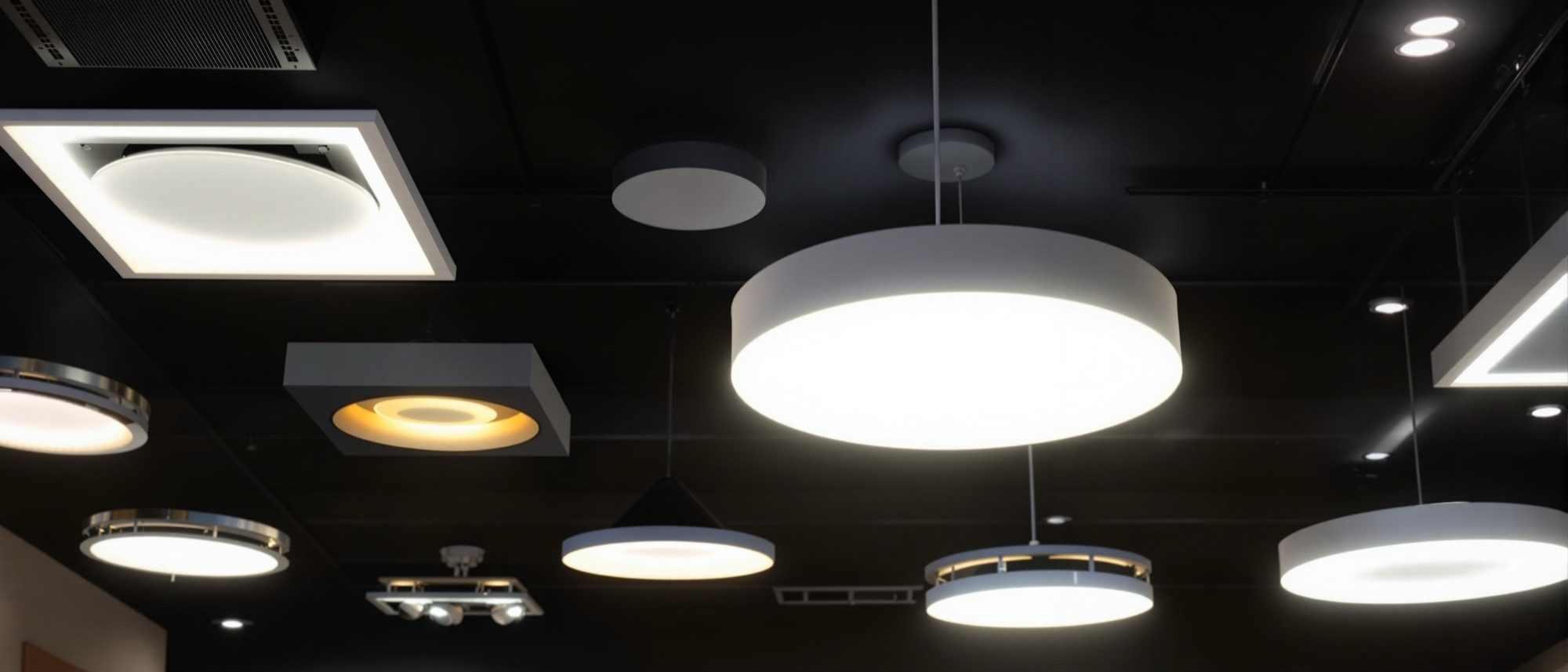
Luminaires & Fixtures
The fittings that deliver the light — their forms, distribution and control.
The lamp makes the light; the luminaire delivers it. This unit covers the fixture forms and the CIE classification by how a fitting throws its light — from direct (efficient, can glare) to indirect (soft, glare-free) — and the control layer, from the switch to the DALI digital bus.
Learning objectives
By the end of this lesson, you will be able to — mapped to the course outcomes for Lighting Design:
Identify the common luminaire forms and their uses.
Classify luminaires by light distribution — direct to indirect — and its effect.
Choose lighting control systems — switching, dimming, sensors, scene control, DALI.
Match a distribution and control strategy to a space's needs.
Fixtures & distribution
The luminaire's CIE distribution — how much light goes up versus down — decides the quality of light more than its looks.[4, 1]
The hardware vocabulary
A LUMINAIRE is the complete fitting — lamp, housing, optics and gear. The common forms: RECESSED DOWNLIGHT (set into the ceiling, clean and sourceless), SURFACE (flush on ceiling or wall), PENDANT/SUSPENDED (hung on rod or cable), TRACK (adjustable heads on an electrified rail, for flexible accent), TROFFER (the rectangular recessed office fitting in a grid ceiling), WALL WASHER (even light down a wall), COVE (concealed for indirect uplight) and SCONCE (wall-mounted, decorative).[1]
Control systems
Controls make lighting responsive — switching, dimming, occupancy and daylight sensors, scene control — and DALI gives each fitting a digital address.[1, 4]
From the switch to the sensor
SWITCHING is basic on/off. DIMMING varies output (phase-cut, 0–10 V, DALI). OCCUPANCY/VACANCY sensors (PIR or ultrasonic) turn light on and off with presence. DAYLIGHT (photocell) sensors dim the electric light as daylight rises — 'daylight harvesting', a major energy saver. SCENE control recalls preset combinations for an activity ('presentation 30%', 'clean 100%'). Together these make lighting responsive and energy-aware rather than a fixed wall of light.[1, 4]
At a glance
| Aspect | One | The other |
|---|---|---|
| Direct vs indirect | Direct: efficient, high contrast, can glare | Indirect: soft, glare-free, less efficient |
| Office fitting | Troffer in a grid ceiling | Suspended direct-indirect for comfort |
| Control | Switching/dimming: manual level | Sensors/DALI: responsive & addressable |
| Energy saver | Occupancy sensor: off when empty | Daylight harvesting: dim as daylight rises |
| Beam accessory | Louvre/baffle: cut glare | Snoot/honeycomb: tighten the beam |
Key terms
The complete light fitting — lamp, housing, optics and control gear.
A fitting set into the ceiling, giving a clean, sourceless downward light.
The rectangular recessed fitting for a modular grid ceiling — the classic office luminaire.
A luminaire set back from a wall to give even, flat vertical illumination.
Direct = ~all light down (efficient, can glare); indirect = ~all up (soft, glare-free).
Dimming electric light automatically as daylight rises (a photocell control) — a major energy saver.
Preset lighting combinations recalled for an activity (e.g. 'presentation', 'clean').
Digital Addressable Lighting Interface (IEC 62386) — individually addressable digital lighting control.
Studio task
For one room, choose a luminaire distribution (direct, direct-indirect or indirect) and justify it for comfort and glare; then sketch a control strategy — what is switched, dimmed, sensed or on a scene.
Self-assessment
1. An indirect luminaire (90–100% up) gives light that is —
2. 'Daylight harvesting' means —
3. DALI is —
Recap
References & further reading
- [1]Gary Gordon, Interior Lighting for Designers (5th ed.). Wiley, 2015.
- [4]CIE — luminaire light-distribution classification; DALI / IEC 62386; the IES Lighting Handbook. https://cie.co.at/
Further reading
- Gary Gordon, Interior Lighting for Designers. Wiley.
- Derek Phillips, Lighting Modern Buildings. Architectural Press.
- Manufacturer luminaire catalogues + IEC 62386 (DALI).
Sources gathered and fact-checked June 2026. Published values vary by source, sample and method — treat as indicative and confirm against the cited standard before structural use.
The author
Amogh N P
Architect, interior designer, and creative polymath. Studio Matrx began in his notebooks — his vision of design made honest, useful, and open to everyone. Its Academy is written and taught in his memory, and free, forever.
More about Amogh →